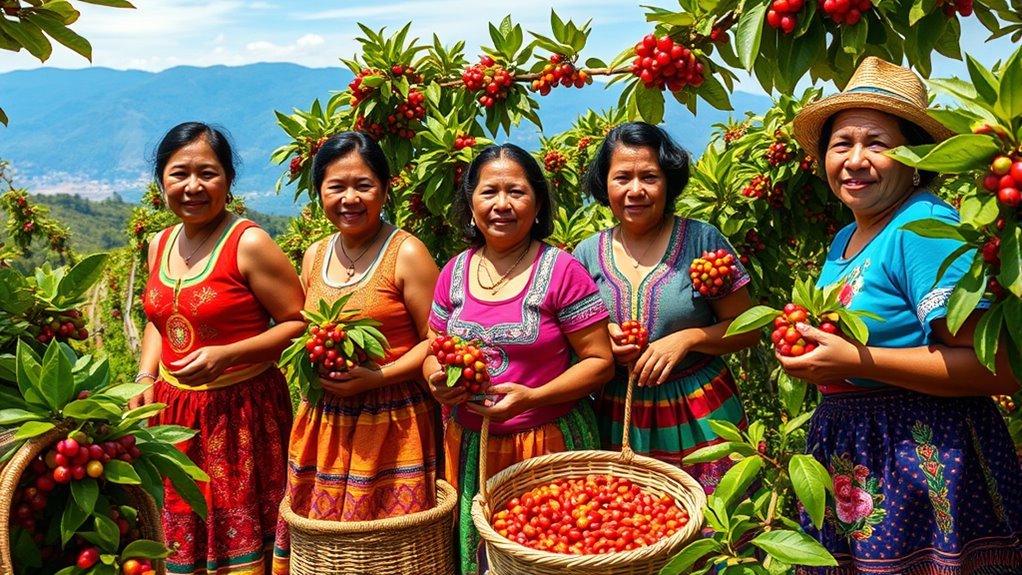

Women play a crucial role in coffee farming worldwide, managing farms, leading cooperatives, and ensuring sustainability. Despite their contributions, many face obstacles like limited land rights, access to credit, and leadership opportunities. Empowerment initiatives are changing this, helping women own land, lead farms, and improve coffee quality. Regional differences exist, but progress is underway. Keep exploring to discover how supporting women transforms the coffee industry and benefits everyone involved.
Key Takeaways
- Women lead or co-manage about 20-30% of global coffee farms, actively contributing to production and decision-making.
- Empowering women through access to land, credit, and leadership roles improves sustainability and coffee quality.
- Cultural norms and legal barriers often limit women’s land ownership and resource access, hindering their full participation.
- Initiatives like Elas no Café and Fairtrade schemes boost women’s leadership, ownership, and economic empowerment in coffee farming.
- Supporting female farmers enhances environmental sustainability, farm productivity, and the overall quality of coffee beans.

Pappyland: A Story of Family, Fine Bourbon, and the Things That Last
As an affiliate, we earn on qualifying purchases.
As an affiliate, we earn on qualifying purchases.
The Growing Presence of Women in Coffee Farm Management
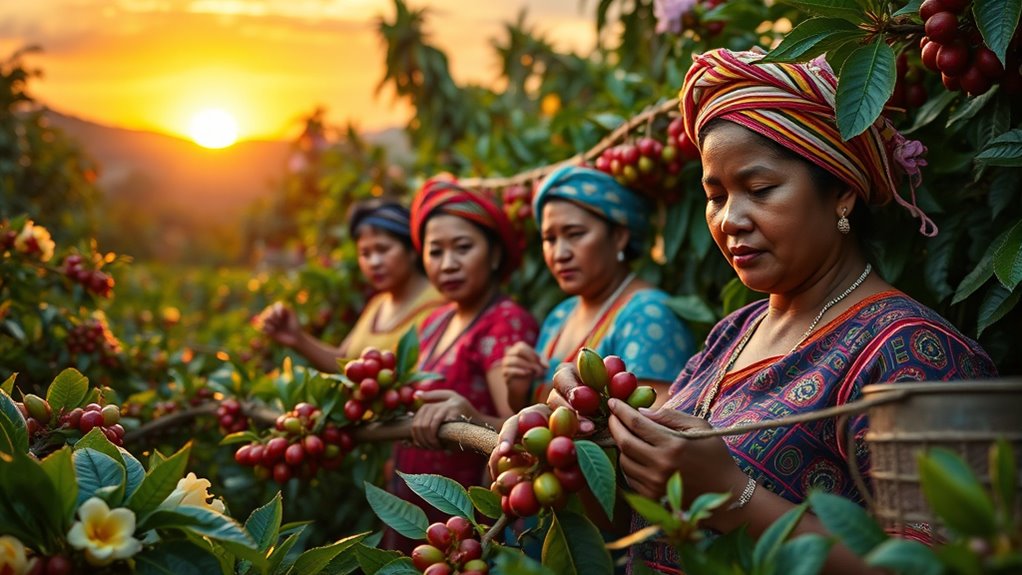
Over recent years, women have been steadily increasing their roles in managing coffee farms worldwide, reflecting a shift toward greater gender inclusion in the industry. You’ll find women leading or co-managing around 20% to 30% of coffee farms globally, a significant rise from past decades. In Brazil, women operate over 13% of coffee establishments, with more than 88,700 women involved in farm management and leadership roles. Many women also hold key positions in cooperatives; for example, 38% of leaders in the Cerrado Coffee Growers’ Cooperative are women. Often, women co-manage family farms, actively participating in decision-making and operations. Initiatives like Elas no Café have dramatically expanded women’s leadership, empowering more women to take on managerial roles and reshape the landscape of coffee farming. Recognizing and supporting cultural intelligence can further enhance women’s leadership opportunities by fostering inclusive environments that respect diverse perspectives. Furthermore, ongoing industry efforts aim to provide training and resources that enable women to develop their skills and expand their influence in the coffee sector.

Garden Silicone Thumb Knife, Harvesting Tools for Garden, Harvesting Knife with Cut Resistant Finger Cots, Garden Tool Set for Trimming Plant, Gardening Gifts and Kitchen Help
Our Harvesting tool set is designed for garden harvesting, also ideal for pruning and kitchen use. You can…
As an affiliate, we earn on qualifying purchases.
As an affiliate, we earn on qualifying purchases.
Women’s Crucial Role in Coffee Production Labor
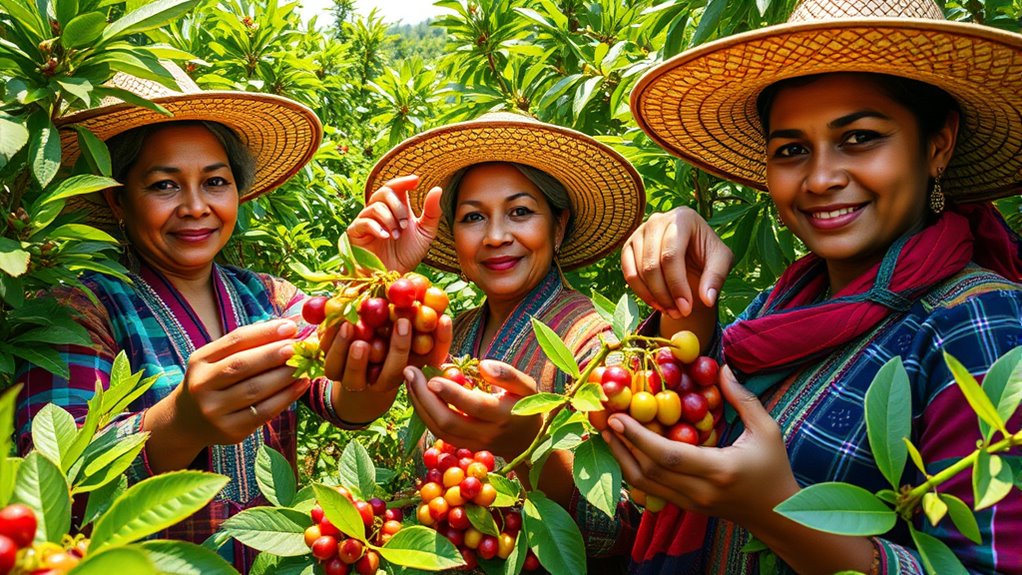
Women play an essential role in coffee production, contributing approximately 70% of the global labor force involved in farming activities. Your efforts span planting, pruning, harvesting, and processing, making women the backbone of coffee farming worldwide. In regions like Africa and Latin America, women’s participation can reach 80%, pivotal for farm productivity and sustainability. Despite this vital input, women often lack recognition and access to resources, impacting their efficiency and income. To visualize their contributions, consider the following ideas:
| Stage of Farm Work | Women’s Roles | Impact on Production |
|---|---|---|
| Planting | Setting seedlings | Ensures healthy growth |
| Harvesting | Picking cherries | Affects quality and yield |
| Processing | Sorting beans | Maintains quality standards |
| Maintenance | Pruning, watering | Sustains farm health |
| Household support | Finances, community | Supports farm success |
Additionally, increasing awareness of women’s empowerment initiatives can improve their access to resources and decision-making roles in the coffee industry. Promoting training and education programs tailored for women can further enhance their skills and confidence in managing farm operations.

Kolice 150L Commercial Pasteurization Machine Pasteurizer for Milk Juice Beer Sauce Sterilization Dairy Equipment
[ Machine Details ] Kolice Commercial Milk Pasteurizer, 220V 60HZ, single phase, 9000W, capacity: 150L, machine dimension:75x75x130cm (29.53''x29.53''x51.18''),…
As an affiliate, we earn on qualifying purchases.
As an affiliate, we earn on qualifying purchases.
Barriers to Land Ownership and Access for Female Farmers
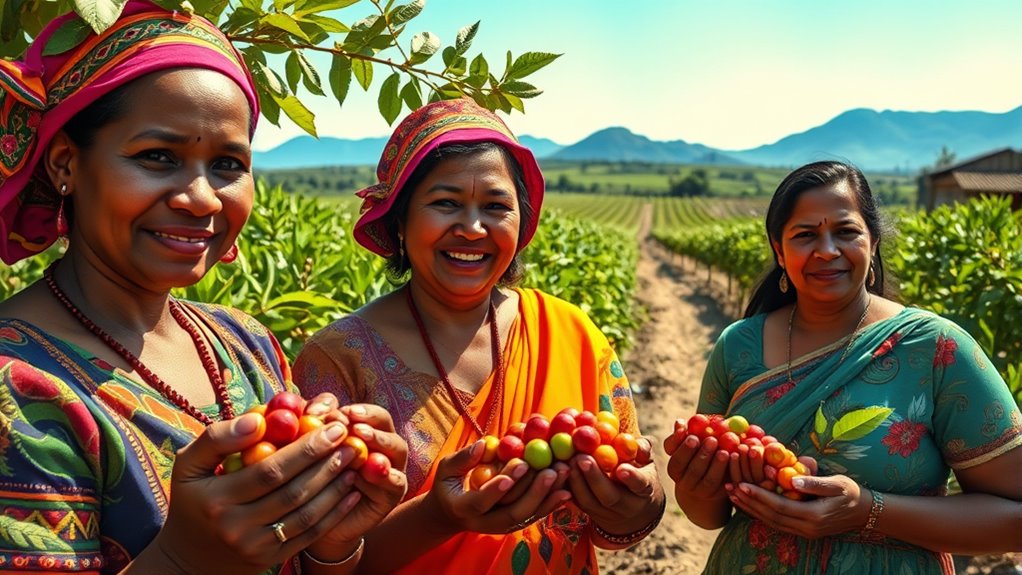
You might notice that women often face significant barriers to owning land and accessing credit, which limit their independence and growth opportunities. Cultural norms and legal restrictions frequently prevent women from securing land titles or financial resources needed to expand their farms. These persistent obstacles keep many female farmers from fully participating in decision-making and benefiting from their work. Additionally, a lack of legal protections often hampers their ability to assert land rights and access credit freely. Promoting land tenure security can help empower women and ensure they can benefit equally from agricultural resources. Moreover, addressing systemic challenges through targeted policy reforms can create a more inclusive environment for female farmers. Implementing inclusive policies can further address these disparities and support women in overcoming systemic challenges.
Land Ownership Gaps
Land ownership remains a significant barrier for female coffee farmers, limiting their access to essential resources like credit, inputs, and technology. Without legal ownership, women struggle to secure loans or investments needed to expand or improve their farms. Cultural norms and legal restrictions often prevent women from owning land outright, reinforcing gender inequality in agriculture. This lack of ownership also affects their decision-making power and recognition within the farming community. Additionally, the presence of mold or signs of spoilage in stored produce can further undermine their economic stability. Understanding the importance of legal land rights and how they relate to home furnishings can help address these systemic issues and promote gender equality in agricultural sectors. Strengthening land rights is crucial for empowering women and ensuring equitable access to resources and opportunities. Moreover, improving access to water management and infrastructure can significantly enhance productivity and stability for female farmers.
Limited Access to Credit
Why do female coffee farmers often struggle to access the credit they need to grow their farms? One key reason is that many women lack formal land ownership, which lenders see as proof of stability and security. Without land titles or collateral, they find it nearly impossible to get loans or credit lines. Cultural norms and legal barriers also play a role, making financial institutions hesitant to lend to women. Additionally, women often don’t have the financial history or credit records that banks require. This limited access to credit prevents them from purchasing quality inputs, technology, or expanding their farms. Furthermore, the lack of custodian services for Gold IRA management highlights the importance of reliable financial support in investments. As a result, their productivity and income remain low, hindering their ability to invest in sustainable growth and economic independence.
Cultural Barriers Persist
Cultural norms and traditional beliefs often reinforce gender roles that limit women’s ability to own or access land for farming. These deep-rooted attitudes persist across many regions, making it difficult for women to establish land rights or participate fully in decision-making. As a result, women face obstacles like:
- Legal restrictions that favor male landholders
- Cultural expectations that prioritize men’s control over resources
- Social stigma discouraging women from claiming land ownership
- Limited access to land-related information and support
- Discriminatory inheritance practices that exclude women
These barriers restrict women’s economic independence and ability to expand their farms. Additionally, legal restrictions often stem from outdated laws that do not recognize women’s property rights, further entrenching inequality. Understanding the operating hours of local stores can also be crucial for women farmers seeking supplies and resources, helping them plan their activities more effectively. To address these issues, community-based programs that promote land rights awareness are essential for empowering women and fostering change. Overcoming these cultural barriers requires targeted education, policy change, and shifting community perceptions about women’s roles in agriculture. Recognizing the importance of land ownership rights is essential for creating lasting change in gender equality and economic empowerment. Furthermore, addressing cultural norms that perpetuate gender inequality is vital for sustainable progress in women’s land access.

Water Hardness Test Kit with 5-Pads(150strips)
RESULTS IN 30 SECONDS – NO CONFUSION:Dip the strip, wait just 30 sec. then match it to the…
As an affiliate, we earn on qualifying purchases.
As an affiliate, we earn on qualifying purchases.
How Empowerment Initiatives Are Transforming Women’s Roles
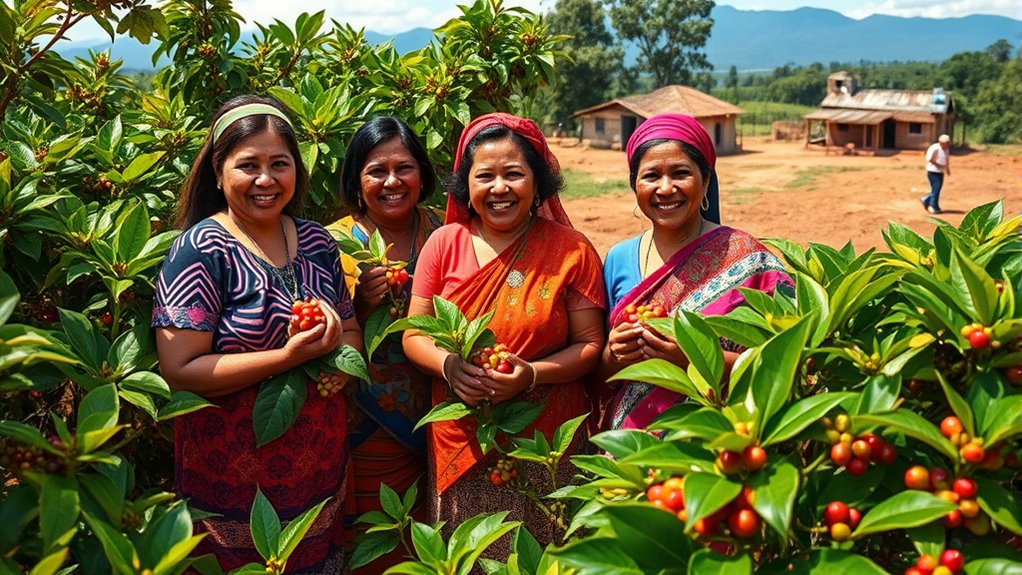
How are empowerment initiatives reshaping women’s roles in coffee farming? These programs are breaking down barriers by providing training, resources, and leadership opportunities. Initiatives like Elas no Café have increased female cooperative members by 792%, boosting confidence and skills. Fairtrade schemes promote women’s ownership of coffee bushes and income. Empowerment initiatives are fostering a sense of ownership and agency among women farmers, leading to more equitable participation. As a result, women are taking on more decision-making roles and managing farms more independently. This shift fosters economic growth and sustainability. The table below highlights key impacts:
| Initiative Type | Impact |
|---|---|
| Training programs | Enhance skills, leadership, and confidence |
| Financial support | Enable resource access and farm scaling |
| Cooperative involvement | Promote women’s management and ownership |
| Certification schemes | Increase market access and income security |
| Community engagement | Strengthen networks and support systems for women through community-led development |
Additionally, access to agricultural resources and targeted support helps women overcome traditional barriers, empowering them to lead more sustainable farming practices.
Regional Differences in Women’s Participation and Leadership
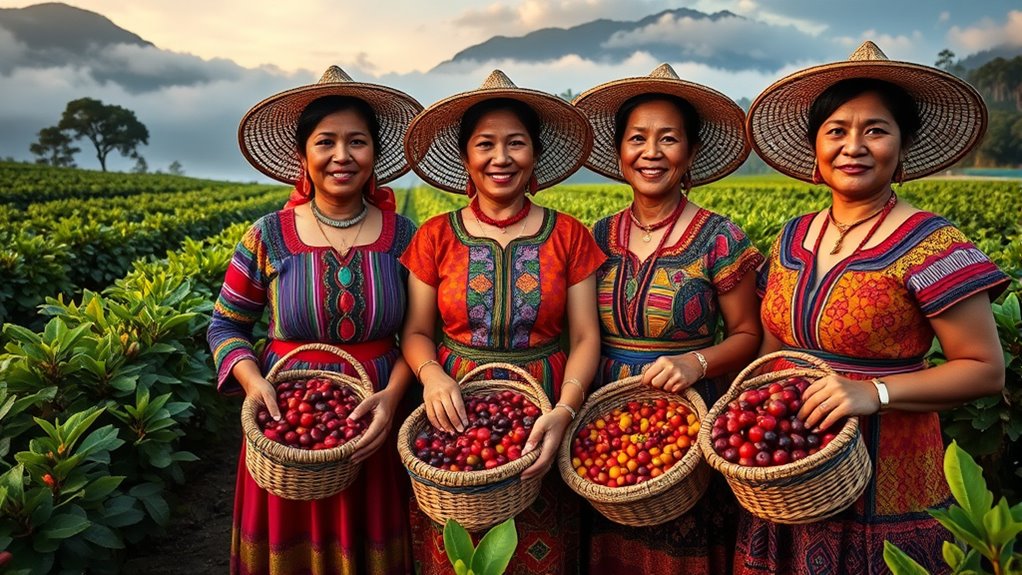
You’ll notice that women’s leadership and land ownership vary widely across regions, influenced by local cultural norms and economic conditions. In Latin America, women often hold more farm ownership and leadership roles, while in Asia, their participation tends to be more labor-focused with fewer ownership rights. Cultural attitudes and legal frameworks continue to shape how women participate and lead in different coffee-producing areas.
Regional Leadership Variations
Regional differences markedly influence women’s participation and leadership in coffee farming, shaped by socio-economic, cultural, and legal factors. These variations determine how women engage in decision-making, farm management, and leadership roles across regions. You’ll find that in Latin America, women lead cooperative initiatives and hold leadership positions, especially with programs supporting organic and Fairtrade certification. In Africa, women often manage farms due to male migration, making them key decision-makers at the farm level. Asian regions show high female labor involvement, but formal leadership roles remain limited. Cultural norms, land rights, and access to education impact women’s ability to ascend to leadership roles in different areas. Additionally, access to reliable resources and training significantly enhances women’s capacity to take on leadership positions and improve farm productivity.
Land Ownership Disparities
Land ownership plays a pivotal role in shaping women’s participation and leadership within coffee farming communities. In many regions, women face significant barriers to owning land, limiting their access to loans, credit, and resources needed to expand or improve their farms. For example, in Latin America, over 25% of women hold land titles, but in Africa and Asia, that figure drops below 20%, sometimes less than 5%. Without formal land rights, women often work on farms owned by family members or partners, restricting their decision-making power. These disparities hinder their ability to invest in their farms, access markets, and assume leadership roles. Addressing land ownership inequalities is vital to empowering women, increasing farm productivity, and fostering gender equality across coffee-producing regions.
Cultural Influences on Roles
How deeply do cultural norms shape women’s roles in coffee farming across different regions? In some areas, traditions empower women, encouraging leadership and ownership. In others, cultural expectations limit their participation, confining them to household tasks or low-skill labor. These differences influence women’s access to resources, training, and decision-making power.
- In Latin America, cultural acceptance supports women’s leadership and farm ownership.
- Asian societies often see women as essential laborers but restrict their land rights.
- African communities frequently have women managing farms due to male migration, despite societal constraints.
- In some regions, gender stereotypes hinder women from participating in higher-level roles.
- Cultural attitudes towards gender roles directly impact women’s ability to lead and own farms.
The Impact of Female Farmers on Sustainability and Quality
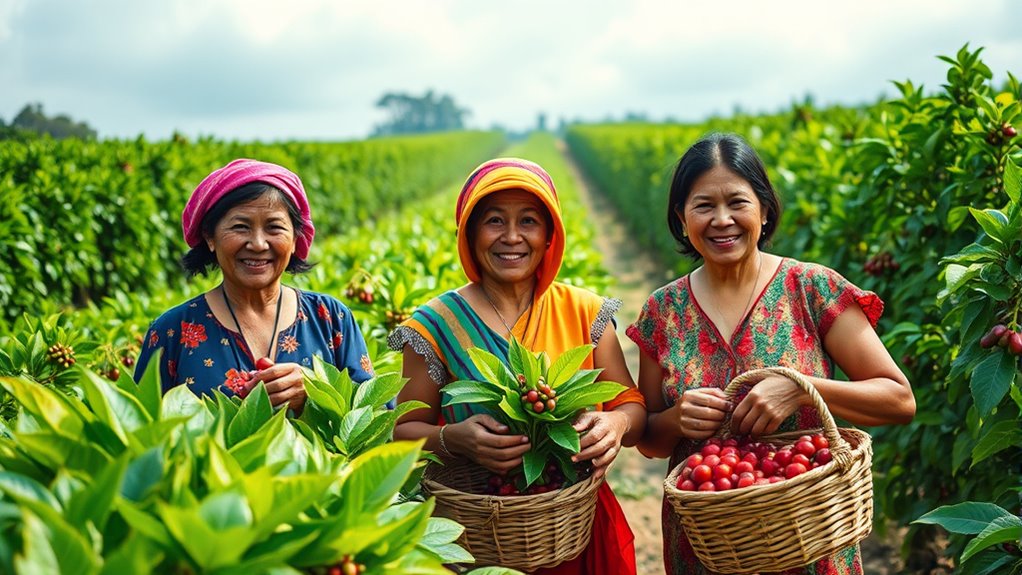
Female farmers play a essential role in advancing sustainability and improving coffee quality through their active engagement in environmentally conscious farming practices. Their attention to soil health, water management, and pest control helps preserve ecosystems and reduces chemical use. Women often prioritize sustainable methods, ensuring long-term farm productivity and resilience against climate change. Their deep knowledge of local environments leads to higher-quality beans, as they tend to focus on careful harvesting and processing. Additionally, empowering women encourages diversity in farming approaches, fostering innovation and adaptation. By supporting female farmers, you promote not only better coffee but also a healthier environment. Their leadership in sustainable practices demonstrates that gender equality directly benefits the planet and elevates the overall quality of your coffee experience.
Strategies for Supporting Women in the Coffee Value Chain
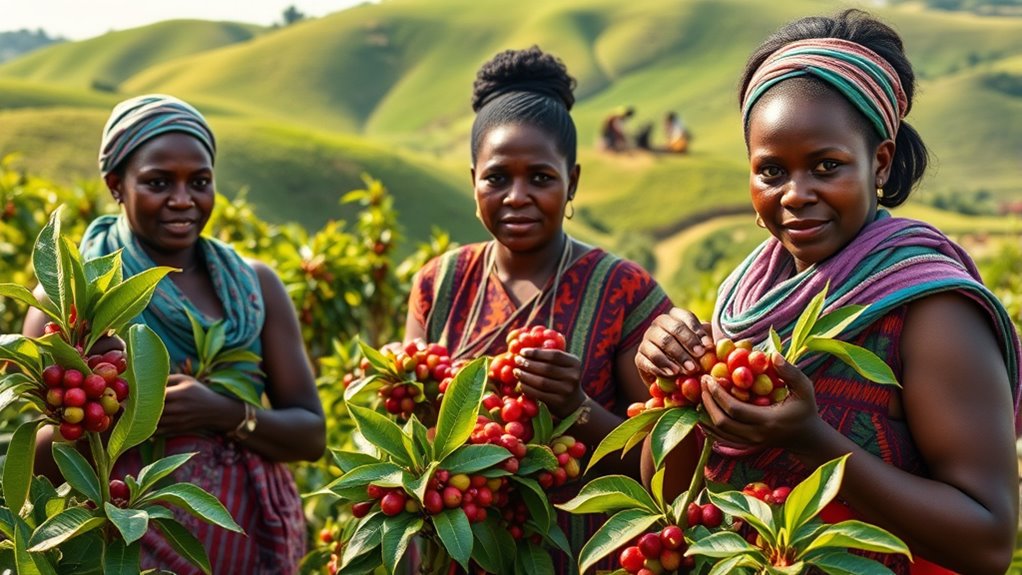
Supporting women in the coffee value chain requires targeted strategies that address their unique barriers and leverage their strengths. You can implement initiatives that focus on increasing access to land, credit, and training, which are essential for women’s economic independence. Promoting gender-sensitive policies ensures women’s voices are heard in decision-making processes. Developing mentorship programs helps women build confidence and leadership skills. Encouraging cooperatives to prioritize women’s participation fosters collective bargaining power. Additionally, providing tailored education on sustainable farming and business practices empowers women to improve productivity and profitability.
- Offer specialized training and workshops on farming and business skills
- Facilitate access to credit and financial services for women
- Support women’s leadership development through mentorship programs
- Implement gender-sensitive policies in cooperatives and organizations
- Promote land rights and resource ownership for women
Success Stories of Women Leading Coffee Farms Worldwide
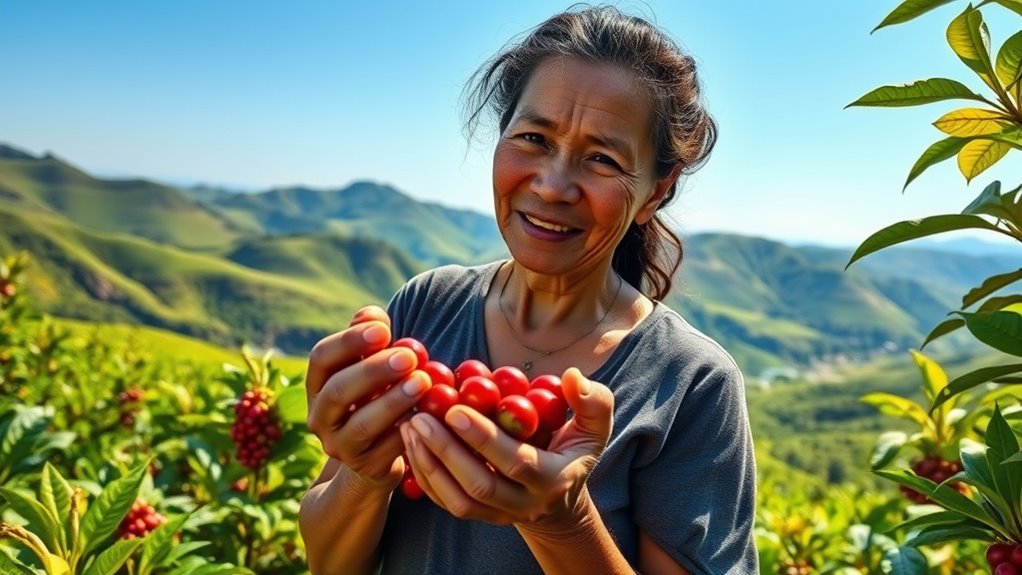
Across the globe, women are transforming coffee farming by stepping into leadership roles and managing successful farms. In Brazil, women run over 40,000 farms, demonstrating strong entrepreneurial spirit. In Ethiopia, women lead cooperatives that support sustainable practices and community growth. In Central America, female farmers have increased their land ownership and expanded their operations, often through innovative practices and cooperative networks. In Vietnam, women’s labor contributes markedly to coffee production, and some have become prominent farm owners. These success stories show that women are breaking barriers, gaining recognition, and shaping the future of coffee cultivation. Their leadership not only boosts productivity but also inspires others to pursue farm ownership and management, proving that gender equality in coffee farming is achievable and impactful worldwide.
Future Opportunities for Gender Equality in Coffee Farming
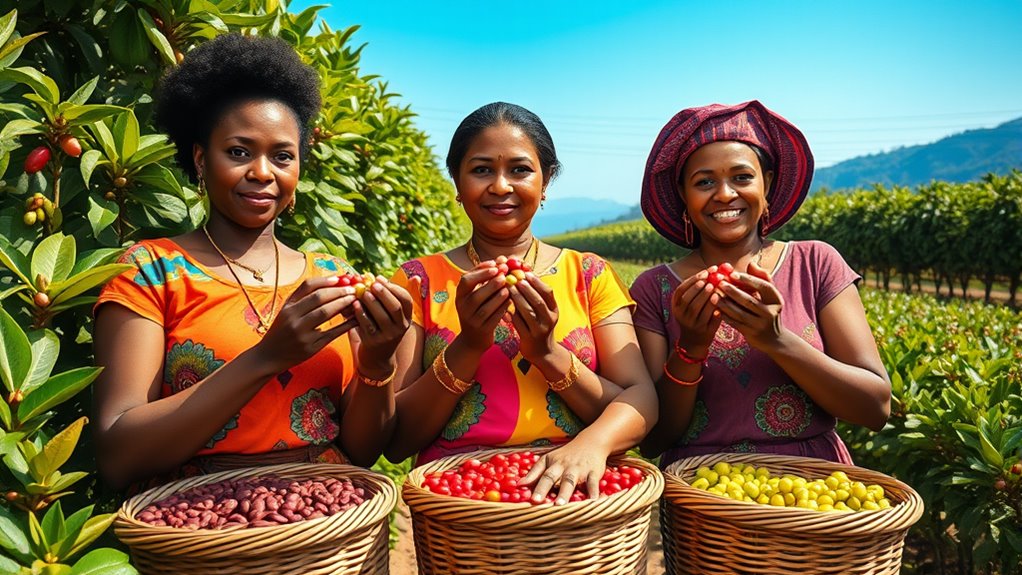
Opportunities to advance gender equality in coffee farming are expanding as innovative policies, technology, and community-driven initiatives gain momentum. You can expect more targeted programs that support women’s ownership, leadership, and access to resources. Advances in digital technology will help women access training, market information, and financial services more easily. Policy reforms are increasingly recognizing women’s rights to land and credit, breaking down longstanding barriers. Community efforts are fostering networks that empower women to share knowledge and collaborate. Additionally, global brands and certifications are prioritizing gender equity, encouraging sustainable practices.
Opportunities for gender equality in coffee farming are growing through policies, technology, and community initiatives.
- Implementing land rights reforms to secure women’s ownership
- Expanding access to affordable digital tools and training
- Supporting women-led cooperatives and leadership development
- Promoting gender-sensitive policies in agricultural finance
- Increasing awareness through media campaigns and education
Frequently Asked Questions
How Do Cultural Norms Influence Women’s Participation in Coffee Farming?
Cultural norms shape women’s participation in coffee farming by defining gender roles and expectations. You might find that in some communities, societal beliefs limit women’s access to land, resources, or leadership roles, restricting their involvement. Traditional views often prioritize men’s authority, making it harder for women to gain recognition or decision-making power. Overcoming these norms requires targeted efforts to challenge stereotypes and promote gender equality in farming communities.
What Specific Skills Are Most Effective for Empowering Women in Coffee Communities?
Imagine planting seeds of confidence and skills—these are the most effective for empowering women in coffee communities. Training in sustainable farming techniques, business management, and leadership acts like nurturing sunlight and water, helping their potential grow. Practical skills, like financial literacy and access to markets, serve as sturdy roots, enabling women to take control, thrive, and lead their farms and communities with resilience and independence.
How Does Land Ownership Impact Women’s Access to Credit and Farm Growth?
When women own land, they gain better access to credit and resources needed for farm growth. Land ownership serves as collateral, enabling them to secure loans for inputs, technology, and expansion. Without ownership, women often face barriers to financial services, limiting their ability to invest in their farms. This restricts productivity, stalls growth, and hampers their economic independence, making land rights vital for empowering women and fostering sustainable farm development.
What Are the Biggest Challenges Women Face in Ascending to Leadership Roles?
You face a mountain of obstacles. Discrimination, cultural barriers, and limited access to education block your path to leadership. Without formal land rights or decision-making power, you’re often sidelined despite your essential contributions. Lack of tailored training and financial resources further hinder your growth. These challenges create a glass ceiling, preventing many talented women from ascending to the top, even when your expertise and dedication shine brighter than any obstacle.
How Can Consumers Support Female-Led Coffee Farms Directly?
You can support female-led coffee farms by choosing brands that prioritize women’s empowerment, such as Fairtrade or certification programs promoting women’s ownership. Look for direct trade options that connect you with women farmers or cooperatives. Share their stories on social media to raise awareness. Additionally, participate in community initiatives or donations supporting training and resources for women in coffee farming. Your choices can help boost their economic independence and visibility.
Conclusion
By supporting women in coffee farming, you’re helping to break down barriers and plant seeds for a more equitable industry. Their leadership boosts sustainability, quality, and community resilience. Remember, when you empower women, you’re not just changing lives—you’re changing the game. So, don’t sit on the sidelines; get involved and help turn the tide toward gender equality in every cup of coffee you enjoy. The future of coffee depends on it.