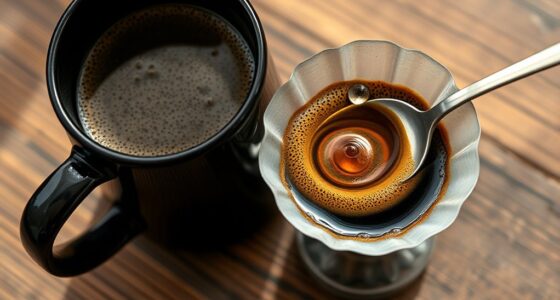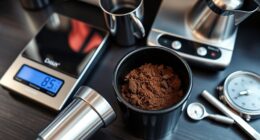
To brew coffee that tastes great black and leaves room for cream if you choose later, start with high-quality, freshly roasted beans—preferably light to medium roasts for brightness. Use a consistent grind size, ideal water temperature of 200–205°F, and precise brew ratios. Choose brewing methods like pour-over or French press that highlight complex flavors. Proper blooming, steeping time, and tasting adjustments can elevate your black coffee experience—plus, you’ll discover tips to make it perfect even before adding cream.
Key Takeaways
- Brew with high-quality, light to medium roasted beans to maximize flavor complexity, reducing the need for added cream.
- Use a clean brewing method like pour-over or French press to produce a pure, well-balanced black coffee.
- Adjust grind size and brew time for optimal extraction, ensuring a smooth, rich flavor without bitterness.
- Maintain proper water temperature (200–205°F) and use filtered water to enhance clarity and brightness.
- Focus on precise ratios and tasting to achieve a balanced, flavorful black coffee that stands strong without added cream.
Selecting the Perfect Beans for Bold Black Coffee

Choosing the right beans is essential for brewing bold black coffee with rich flavor. Start with freshly roasted, high-quality beans to capture maximum freshness and aroma. Opt for light to medium roasts, as they offer more complex flavors and brightness compared to darker roasts, which can taste burnt or flat. Single-origin beans are an excellent choice because they bring distinctive notes like fruity, nutty, or floral qualities that shine in black coffee. Proper storage is vital—keep beans in an airtight container away from light and heat to preserve freshness. Consider subscribing to specialty coffee suppliers for consistent access to fresh, curated beans. Remember, the flavor starts with your beans, so selecting the best possible ones makes a significant difference in your black coffee experience. Additionally, choosing the right coffee brewing equipment can enhance extraction and flavor, ensuring your brew tastes exactly as you desire.
Mastering Grind Size for Optimal Extraction

Getting your grind size right is key to brewing great black coffee. You need consistent grind size to control extraction, and it should match your brewing method for the best flavor. Adjusting your grinder settings accordingly guarantees your coffee is neither under- nor over-extracted. Proper tuning techniques can further enhance your brewing process.
Consistency in Grind Size
Achieving consistent grind size is essential for ideal extraction because it directly influences how water interacts with coffee grounds. When your grind varies, some particles extract too quickly, leading to bitterness, while others under-extract, resulting in weak flavor. Using a burr grinder helps guarantee uniformity, giving you control over particle size. Always measure your coffee by weight to maintain consistency across brews, as volume measurements can be misleading. Adjust your grinder settings based on your brewing method—finer for espresso, coarser for French press—and keep the grind size consistent each time. Regularly cleaning your grinder prevents build-up that can cause uneven grinding. For the best results, consider high-quality brewing capabilities when choosing your equipment, as this can further enhance extraction and flavor. By mastering grind consistency, you optimize extraction, which leads to a well-balanced, flavorful black coffee every time.
Adjusting for Brew Method
Since different brewing methods extract flavors uniquely, adjusting your grind size accordingly is vital for ideal results. For French press, use a coarse grind—it allows oils and solids to steep fully without over-extraction. Pour-over and drip methods require a medium grind; this balance ensures water flows evenly through the grounds, extracting complex flavors without bitterness. Moka pots demand a slightly finer, espresso-like grind for a rich, concentrated brew. Cold brew benefits from a coarse grind, which facilitates slow extraction over hours. If your grind is too fine, you risk over-extraction, leading to bitter, harsh flavors. Too coarse, and your coffee may taste weak and under-extracted. Always modify your grind size based on your brewing method to optimize extraction and flavor clarity.
Perfecting Water Temperature and Quality

Water temperature plays a crucial role in extracting the best flavors from your coffee beans. If it’s too hot, you risk over-extraction, which can cause bitterness and harshness. Too cool, and you’ll under-extract, resulting in weak, sour-tasting coffee. Aim for water around 200–205°F (93–96°C) for most brewing methods like pour-over and French press. Using a thermometer or an electric gooseneck kettle helps you control the temperature precisely. Water quality matters just as much as temperature. Filtered or purified water removes minerals and off-flavors from tap water, letting the coffee’s true character shine. Hard water can cause scaling and alter taste, so choose your water wisely. Proper temperature and quality ensure your coffee’s flavors are clean, balanced, and vibrant. Tuning options from vehicle modifications highlight how precise adjustments can optimize performance, much like controlling water parameters enhances coffee flavor.
Crafting the Ideal Coffee-to-Water Ratio and Brew Time

Getting your coffee-to-water ratio right is key to balancing flavor and strength, whether you’re making pour-over or French press. Brew time also plays a vital role, affecting extraction and overall taste—too long can cause bitterness, too short leaves it weak. By mastering these variables, you’ll consistently craft black coffee with rich, well-rounded flavor. Proper grind size can significantly influence extraction and clarity in your brewed coffee. Additionally, understanding the brewing techniques involved can help you fine-tune your process for the perfect cup every time. Regularly monitoring your quality assurance metrics ensures consistency and helps refine your brewing process for optimal results.
Optimal Ratios for Balance
Finding the right balance between coffee-to-water ratio and brew time is essential to crafting a flavorful black coffee. For pour-over and drip methods, aim for about 1:15 to 1:17 coffee to water by weight. This guarantees proper extraction without bitterness or weakness. French press typically uses a 1:16 to 1:17 ratio, with a steep time of around 4 minutes, balancing richness and clarity. Cold brew is more concentrated, often using a 1:8 to 1:4 ratio, then diluted to taste. Brew time influences extraction: longer steep or pour-over duration increases extraction risk, while too short may under-extract. Adjust ratios and times based on your taste preferences, but always prioritize consistent performance to achieve a well-balanced, flavorful black coffee. Additionally, experimenting with different materials and techniques can help refine your brewing process for optimal flavor. Regularly cleaning your equipment ensures that residues do not affect the flavor profile of your brew, maintaining quality over time.
Timing and Extraction Control
How you time and control extraction is key to brewing a perfect black coffee. Proper timing ensures you extract the right flavors without bitterness or sourness. For pour-over or drip methods, aim for a coffee-to-water ratio of about 1:15 to 1:17, and pour slowly to maintain even extraction. French press steeping around 4 minutes balances body and clarity. Longer brew times increase extraction but risk harshness, while shorter times might under-extract, leaving the coffee weak. Use a timer to track your brew time precisely. Adjust your grind size to influence extraction rate—finer grinds extract faster, coarser slower. Regularly inspecting your equipment, such as the filter or portafilter, ensures consistent results. Understanding extraction control techniques can help you refine your brewing process further. Mastering timing and control allows you to fine-tune flavor, achieving a well-balanced, flavorful black coffee every time.
Exploring Brew Methods for Rich, Black Flavors

To achieve rich, black flavors in your coffee, choosing the right brewing method is essential. Different methods extract flavors uniquely, emphasizing boldness and depth. For example:
- French Press: Steeps coarse grounds, allowing oils and body to shine.
- Pour-Over: Delivers clarity and brightness, highlighting subtle notes.
- Cold Brew: Uses cold water over long steeping, resulting in smooth, concentrated flavor.
- Moka Pot: Produces a strong, espresso-like brew with intense richness.
- Long Black: Combines hot water and espresso for a dense, velvety texture.
Each method influences the flavor profile and mouthfeel. French press offers body, while pour-over emphasizes clarity. Cold brew yields smoothness, and moka pot delivers strength. Select your method based on the flavor intensity you desire. Preservation efforts in coffee brewing methods help maintain traditional techniques and enhance flavor quality.
Enhancing Flavor With Proper Blooming and Steeping Techniques

Proper blooming and steeping techniques can substantially enhance the flavor and aroma of your black coffee. Blooming releases CO₂, helping extract more nuanced flavors. When pouring water, wet the grounds evenly and pause for 30-45 seconds to allow blooming. During steeping, maintain consistent water temperature and timing to prevent over- or under-extraction. Proper technique guarantees a balanced, vibrant cup. Here’s a quick guide:
| Step | Action | Purpose |
|---|---|---|
| Blooming | Pour a small amount of hot water, wait | Release CO₂ and improve extraction |
| Steep Duration | Maintain steep time specific to method | Optimize flavor and strength |
| Water Temp | Keep within 200–205°F | Avoid bitterness or weak brew |
| Agitation | Gently stir or swirl if needed | Enhance saturation and flavor |
Additionally, paying attention to water quality can significantly impact the final taste of your brew. Incorporating freshly filtered water can further improve extraction and clarity.
Tasting and Adjusting for a Superior Black Coffee Experience

Tasting and adjusting your black coffee is essential for achieving a flavor profile that suits your preferences. Start by savoring a small sip, noting the acidity, body, and finish. If it’s too bitter, try a coarser grind or reduce brew time. If it’s weak, consider increasing coffee dose or extending steep time. Adjust temperature if the flavors seem dull or harsh. Here are key steps to refine your brew:
- Taste immediately after brewing to catch fresh flavors.
- Note if the coffee is over- or under-extracted.
- Adjust grind size to control extraction—finer for stronger, coarser for lighter.
- Modify brew time for balance—longer for more extraction, shorter for less.
- Keep detailed records of changes to replicate your perfect cup.
Consistent tasting and tweaking help you craft a black coffee that’s tailored to your taste.
Frequently Asked Questions
How Can I Tell if My Coffee Beans Are Fresh?
You can tell if your coffee beans are fresh by checking their aroma—fresh beans have a strong, vibrant smell. Look at the beans; shiny and oily beans indicate recent roasting, while dull beans are stale. Also, avoid beans that have an unusual or sour smell. When you buy, choose beans with a roast date and try to use them within a month of roasting for ideal freshness.
What’s the Best Way to Store Coffee to Maintain Flavor?
You should store your coffee in an airtight container away from light, heat, and moisture. Keep it in a cool, dark place like a pantry or cupboard, not the fridge, which can cause condensation and staleness. Avoid transparent containers that let in light. Use smaller portions if you buy in bulk to keep beans fresh longer. Proper storage preserves flavor and aroma, ensuring your coffee tastes fresh every time.
How Do Altitude and Origin Affect Black Coffee Flavor?
Altitude and origin markedly influence your black coffee’s flavor. Higher altitudes produce beans with brighter acidity and more complex, nuanced profiles because the cooler temperatures slow development, preserving delicate flavors. Beans from specific regions, like Ethiopia or Colombia, bring distinctive notes—fruity, floral, or nutty—that you’ll notice in taste. Choosing beans from different origins and elevations lets you explore diverse flavor profiles, enhancing your brewing experience and making each cup uniquely satisfying.
Can Water Mineral Content Change the Taste of My Brew?
Like a painter’s palette, water mineral content can dramatically change your brew’s flavor. Higher mineral levels, especially calcium and magnesium, can enhance extraction, making your coffee brighter and more balanced. Too many minerals, though, might add a bitter or metallic taste. Using filtered or soft water often results in cleaner, more nuanced flavors. Adjusting your water’s mineral content guarantees each cup reflects the true character of your beans.
Is It Better to Grind Coffee Immediately Before Brewing?
Yes, it’s better to grind coffee immediately before brewing. When you grind just before brewing, you preserve the beans’ fresh aromas and flavors, which start to degrade quickly once ground. Freshly ground coffee offers a more vibrant, nuanced taste, enhancing your overall brew. Using a burr grinder helps guarantee consistency, so you get the perfect grind size for your brewing method, maximizing flavor extraction and avoiding under- or over-extraction.
Conclusion
Mastering black coffee brewing transforms every sip into a symphony of flavor that can awaken your soul and conquer your day. When you select the perfect beans, tune your grind, and perfect your technique, you reveal a universe of bold, rich taste that’s truly mind-blowing. It’s not just coffee—it’s a gateway to discovering the purest, most exhilarating flavor experience. Brew with passion, and you’ll never settle for anything less than extraordinary.