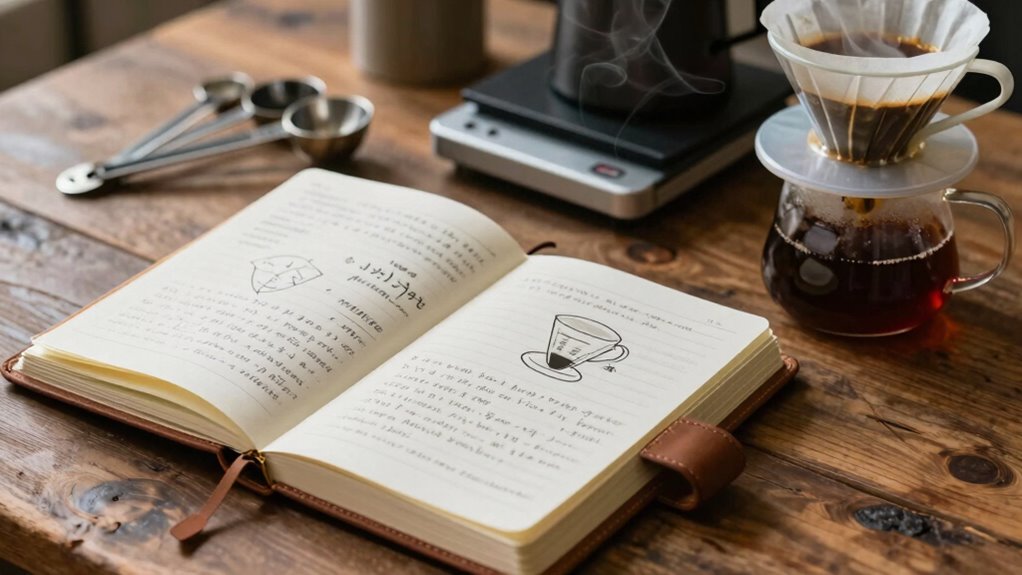

Using a coffee journal helps you improve your brew without needing new gear by tracking flavor notes, grind levels, and brewing variables. It allows you to recognize patterns, refine techniques, and understand how small adjustments impact taste. By documenting each attempt, you can replicate success and avoid repeating mistakes. Over time, this systematic approach boosts your skills and consistency. Keep exploring, and you’ll discover even more ways to elevate your coffee game without extra equipment.

Get coffee and tea gear delivered free with Prime
- Fast, free delivery on millions of items
- Prime Video, Amazon Music and more included
- Member-only deals all year
Key Takeaways
- Tracks brewing variables to identify optimal settings without needing additional equipment.
- Documents flavor notes and patterns to refine techniques and improve taste consistency.
- Enables systematic experimentation with small adjustments for personalized results.
- Promotes consistent methods by recording successful processes, reducing guesswork.
- Facilitates ongoing learning and skill development through detailed review of past brews.
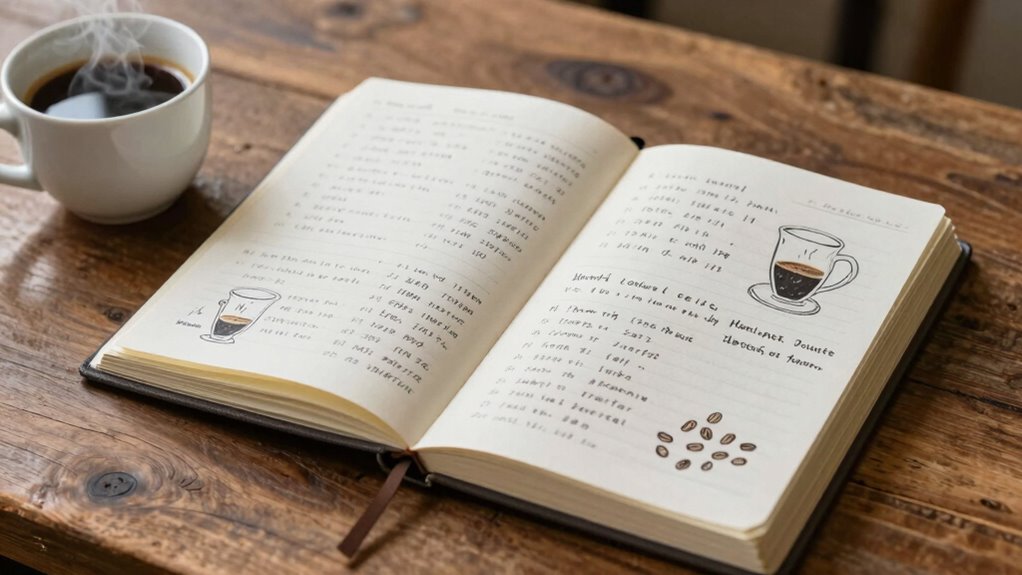
Keeping a coffee journal can substantially enhance your brewing skills by helping you track what works and what doesn’t. When you start recording your brewing experiences, you gain insight into how different variables influence the final cup. One key aspect you’ll notice is flavor profiling—understanding how various beans, roast levels, and brewing techniques affect taste. By noting the flavor notes, acidity, body, and aftertaste of each batch, you begin to identify patterns. Over time, this helps you select beans and methods that consistently produce your preferred flavors. Your journal becomes an invaluable tool for refining your palate, allowing you to recognize subtle nuances that you might overlook otherwise.
Tracking brewing details sharpens your palate and helps identify patterns for consistently better coffee.
Another critical factor you’ll want to pay attention to is grind consistency. Inconsistent grind size can lead to unpredictable extraction, resulting in uneven flavors and a less balanced cup. When you record your grind settings and how they impact flavor and extraction, you develop a better understanding of what works best for your brewing method. For example, a slightly coarser grind might produce a more vibrant cup, while a finer grind could lead to over-extraction and bitterness. By tracking these details, you avoid guesswork and can replicate successful results more easily. Over time, your notes will reveal the ideal grind size for different beans and brewing styles, helping you fine-tune your process without needing new equipment. Recognizing the importance of consistent brewing methods can also improve your overall results and confidence.
Using your journal, you’ll also notice how small adjustments can make significant differences. Maybe a longer brew time enhances sweetness, or a slightly hotter water temperature accentuates certain flavor notes. Recording these variations allows you to build a personalized brewing profile tailored to your taste preferences. This process of trial and error, documented meticulously, helps you learn from each attempt and prevents repeated mistakes. Paying attention to template compatibility can also help you organize your notes effectively and make comparisons easier. Incorporating feedback loops into your process—reviewing your notes regularly—can further accelerate your improvement by highlighting what adjustments yield the best results. Additionally, understanding the role of temperature and timing in extraction can deepen your ability to control flavor outcomes precisely.
As an affiliate, we earn on qualifying purchases.
Frequently Asked Questions
How Often Should I Update My Coffee Journal Entries?
You should update your coffee journal after every brew session. This helps you track flavor profiles and brewing consistency, making it easier to identify what works best. Regular updates show patterns over time, so you can refine your techniques. Even if your brewing method stays the same, jotting down notes keeps your memory fresh and guarantees you’re continually improving your coffee experience. Consistency is key to better results.
What Specific Details Should I Record for Each Brew?
You should record specific details like flavor profiles, noting tastes such as fruity, nutty, or floral notes, and grind consistency, ensuring uniform particle size. Also, document brewing parameters like water temperature, brew time, coffee weight, and grind setting. These details help you identify patterns, refine your technique, and consistently improve your coffee quality over time without needing new equipment.
Can a Coffee Journal Help Identify My Preferred Brewing Method?
Yes, a coffee journal can definitely help you identify your preferred brewing method. By tracking flavor profiles and brewing consistency, you notice patterns and preferences over time. You’ll see which methods bring out your ideal flavor, whether it’s a smooth, sweet cup or a bold, robust brew. Consistently recording details helps you refine your technique, making every cup better and guiding you toward your personal perfect brewing process.
How Do I Track Improvements Over Time With My Journal?
To track improvements over time, you should regularly record your brewing details, noting flavor profiles and brewing parameters. Compare these entries to see how adjustments impact taste and consistency. Look for patterns in flavor development and brewing consistency, and identify which techniques or variables lead to better results. Over time, this helps you refine your process, ensuring consistently improved coffee quality without needing new gear.
Is Digital or Paper Better for Maintaining a Coffee Journal?
Digital organization is unbeatable for keeping your coffee journal ultra-efficient and easily searchable, making improvements feel like a breeze. But if you crave tactile satisfaction and durability, paper wins every time—standing up to spills and wear without blinking. Both have their perks, so choose based on your style: go digital for sleek, quick access, or paper for that satisfying, durable record of your brewing journey.
Conclusion
Keeping a coffee journal is your secret weapon for better brews, no fancy gear required. By recording your experiments, you’ll notice patterns and improvements, turning you into a true artisanal barista. Think of it as your personal almanac—like an old-world chronicle guiding your craft through the ages. So, grab that pen and start writing; your perfect cup awaits, just a few notes away. Remember, even in the age of the internet, a good journal still reigns supreme.
Halloween Picks
halloween
As an affiliate, we earn on qualifying purchases.