
To never make weak coffee again, stick to the brew ratio of 1:16—use 1 gram of coffee for every 16 ml of water. Measure precisely with a scale or use accurate household tools like tablespoons (2 tbsp roughly equals 10g). Adjust slightly for stronger or milder results, depending on your taste. Different brewing methods have specific ratios, so following simple charts helps, and exploring more tips will guarantee perfect strength every time.
Key Takeaways
- Use the standard 1:16 coffee-to-water ratio as your baseline for balanced strength and flavor.
- Measure coffee grounds accurately with a scale or proper measuring tools to ensure consistency.
- Adjust ratios slightly (e.g., 1:14 for stronger, 1:18 for lighter) to customize brew strength.
- Refer to brewing charts for specific methods like French press, pour-over, or espresso for optimal ratios.
- Regularly calibrate your measurements and stick to proven ratios to prevent weak or overly strong coffee.

NKOVE Digital Coffee Scale with Timer 3kg/0.1g High Precision Espresso Scale Tare Function for Pour Over Maker Brew
☕0.1g High Precision Measurement: Experience the ultimate accuracy with a high-precision sensor that delivers results with 0.1g accuracy….
As an affiliate, we earn on qualifying purchases.
As an affiliate, we earn on qualifying purchases.
Understanding the Golden Ratio for Coffee Brewing
The Golden Ratio is the foundational principle for brewing consistent and flavorful coffee. It’s the standard 1:16 ratio recommended by the Specialty Coffee Association, meaning you use 1 gram of coffee for every 16 grams or milliliters of water. This balance prevents weak, watery brews and overly bitter or concentrated coffee. By sticking to this ratio, you guarantee proper extraction, making every cup taste just right. You don’t need fancy equipment—just a simple understanding of the ratio helps you get consistent results. Whether you’re using a French press, pour-over, or drip machine, the Golden Ratio is your reliable starting point. It simplifies brewing, helping you achieve the perfect balance between coffee strength and water. Understanding the Golden Ratio ensures your coffee always hits the mark for flavor and strength.

Flezoo 4Pcs Coffee Scoop Spoon – 1 Tablespoon 15ML Stainless Steel Long Handle Measuring Spoons for Ground Coffee, Loose Tea and Powder
Packing: This set includes 4 stainless steel coffee scoops, each measuring 5.9 inches/15cm in length. With a capacity…
As an affiliate, we earn on qualifying purchases.
As an affiliate, we earn on qualifying purchases.
Measuring Coffee and Water Without a Scale
You can measure coffee and water accurately without a scale by using simple household tools and common measurements. This approach helps you brew consistent, flavorful coffee without extra equipment. Here are some useful tools:
- Tablespoons for scooping coffee grounds
- Standard measuring cups for water
- Coffee scoops for precise amounts
- Liquid measuring jugs for water volume
- Marked water bottles or cups for quick estimates
Using these tools, you can easily follow the 1:16 ratio, ensuring proper strength. For example, two tablespoons of coffee typically equal about 10 grams, and 8 ounces of water is roughly 240 milliliters. These common measurements keep your brewing simple, quick, and reliable—no scale needed. Proper measurement techniques can also contribute to consistent brewing results for better flavor. Additionally, understanding the brew ratio helps you tailor your coffee to your preferred strength and taste. Knowing the electric dirt bike horsepower can inspire you to choose the right model for your off-road adventures. This method is especially helpful for daily routines or when you’re on the go.

The Barista’s Reference: Smart Coffee Charts, Brewing Ratios & Espresso Notes A Pocket Barista Guide to Perfect Coffee Recipes Invent, Mix & Serve 100+ Creative Café-Style Brews at Home
As an affiliate, we earn on qualifying purchases.
As an affiliate, we earn on qualifying purchases.
Adjusting Brew Strength to Match Your Taste

Adjusting the brew strength allows you to tailor your coffee to match your personal taste preferences. To make it bolder, reduce the coffee-to-water ratio to around 1:14 or 1:15. For a lighter brew, increase the ratio to 1:17 or 1:18. Small adjustments can markedly impact flavor, so test different ratios until you find your ideal strength. Use the following guide to help:
| Desired Strength | Coffee-to-Water Ratio | Approximate Coffee (grams) |
|---|---|---|
| Strong | 1:14 | 20 grams |
| Balanced | 1:16 | 25 grams |
| Light | 1:18 | 20 grams |
Experiment and note what works best—your perfect cup is just a small adjustment away. Understanding brew ratios can help you refine your technique even further for the perfect cup. Additionally, nutritional benefits of different brew strengths can influence your choice based on health considerations. Proper brew ratio calibration is essential for achieving consistency in your coffee-making process. To optimize your brewing, consider water temperature as an important factor that can affect extraction and flavor.

Veken French Press Coffee Maker 34oz, No Plastic Touching Cafe,Thickened Glass Stainless Steel Brewer, Cold Brew Cafetera Tea pot for Kitchen Travel Camping, Gifts, Decor, Bar Accessories, Dark Pewter
No Plastic Touching Food: Made with 304 stainless steel and food-grade silicone, our French press keeps all brewing…
As an affiliate, we earn on qualifying purchases.
As an affiliate, we earn on qualifying purchases.
Ratios for Different Brewing Methods
Different brewing methods require specific coffee-to-water ratios to maximize flavor and extraction. Using the right ratio ensures your brew is balanced and satisfying. Here are some common ratios to consider:
- French press typically uses 1:15, with about 30 grams of coffee per 450 ml of water.
- Pour-over favors 1:16 to 1:17, with 25 grams of coffee for 400 ml of water.
- Drip machines often use 1:17, with 60 grams of coffee for 1 liter of water.
- Espresso relies on a 1:2 ratio, with 18 grams of coffee for 36 ml of water.
- Cold brew usually employs a 1:4 or 1:5 ratio, with coffee steeped in cold water for hours.
Adjust these ratios based on your flavor preferences for maximum results.
Perfecting a Four-Cup Brew
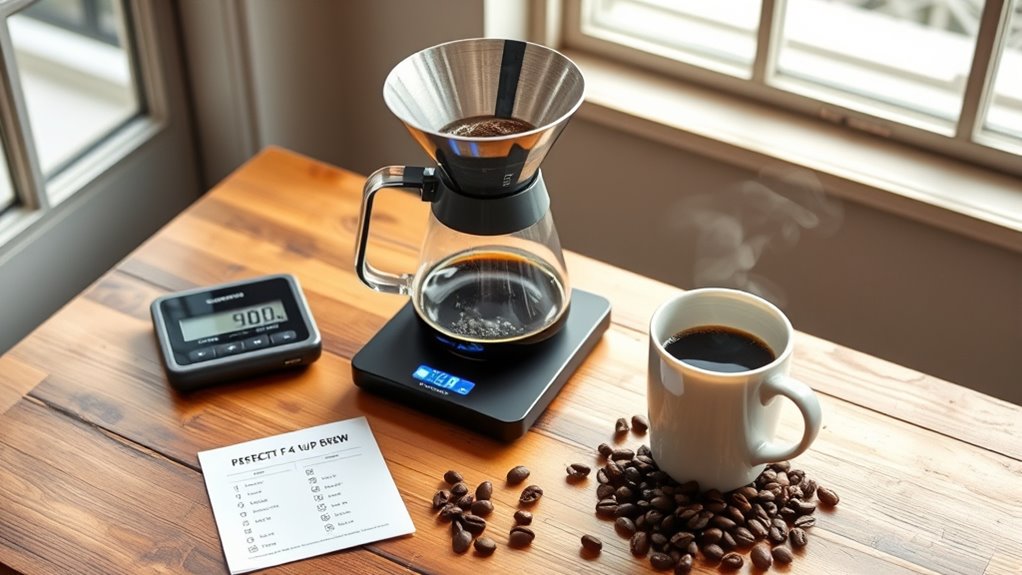
To perfect a four-cup brew, start by selecting the right coffee-to-water ratio to achieve your desired strength. For medium strength, use about 10 tablespoons of ground coffee, which is roughly 5 scoops, combined with 480 milliliters (or 16 ounces) of water. If you prefer a lighter brew, reduce the coffee to around 8 tablespoons; for a stronger flavor, increase to 12 or 14 tablespoons. Remember, a standard cup is approximately 240 milliliters, so adjust accordingly based on your machine’s measurements. Using consistent measurements guarantees your brew tastes the same every time. Proper measurement techniques ensure the best results, and small adjustments can fine-tune your preferred flavor, so don’t hesitate to experiment within these ratios until you find your perfect balance. Paying attention to coffee grind size can also significantly impact the extraction and flavor of your brew.
Using Reference Charts for Precise Ratios
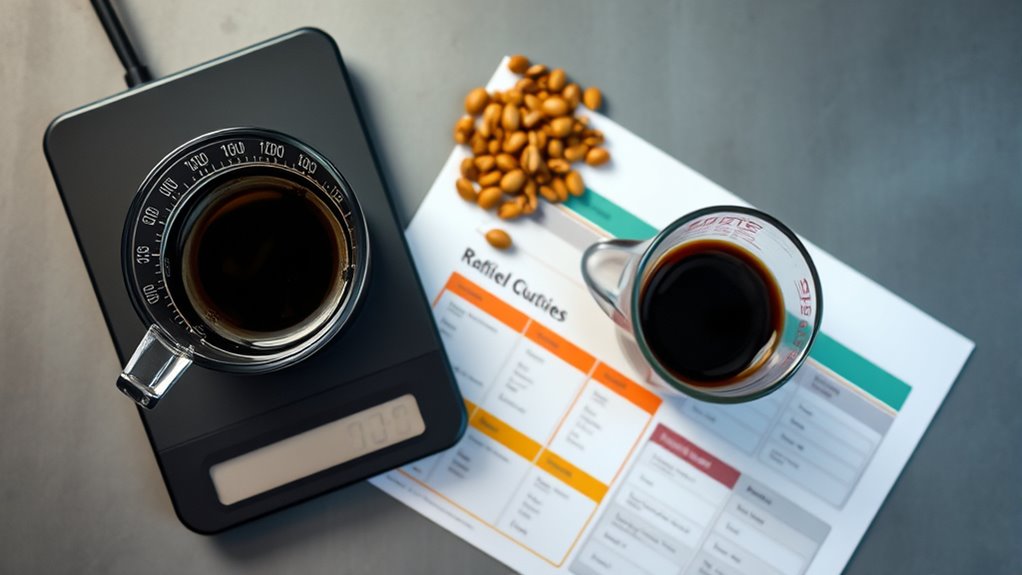
Using reference charts simplifies the process of selecting the exact coffee-to-water ratio for your brew. These charts provide clear, quick guidance tailored to different amounts and preferences, saving you time and guesswork. With a glance, you can determine the right proportions to achieve consistent flavor and strength. Additionally, understanding home security systems can give you peace of mind when away, knowing your property is protected. Exploring eco-friendly accommodations can also enhance your travel experience by aligning your trips with sustainable practices. Familiarity with juice cleanses and their effects can help you incorporate healthier habits into your routine. Incorporating modern tableware trends can elevate your dining presentation and complement your brewing style.
Tips to Avoid Weak or Overly Strong Coffee

Achieving the perfect coffee strength depends on accurate measurements and proper ratios. To prevent weak or overly strong brews, stick to the Golden Ratio of 1:16 as your baseline. Adjust slightly based on taste: for a bolder cup, try 1:15; for a lighter one, go to 1:17 or higher. Use a scale or measuring spoons to ensure consistency. Here’s a quick reference:
| Coffee Ratio | Coffee to Water | Result |
|---|---|---|
| 1:15 | More coffee | Stronger, richer flavor |
| 1:16 | Standard ratio | Balanced, consistent taste |
| 1:17 | Less coffee | Lighter, milder brew |
| 1:18 | Even less coffee | Very mild, delicate flavor |
Testing and noting your preferences is essential to guarantee that perfect strength every time, especially as automation continues to transform how we approach daily routines. Incorporating precise measurements can significantly improve your brewing consistency and flavor profile. Additionally, paying attention to the quality of ingredients can significantly influence the final taste of your brew. Properly measuring coffee grounds with precision ensures that every cup meets your desired strength and flavor profile, regardless of the brewing method used. Being aware of brew ratios helps you fine-tune your coffee to match your personal taste preferences.
Frequently Asked Questions
Can I Use Instant Coffee With the Same Ratios?
You can’t use the same ratios with instant coffee because it dissolves differently from ground coffee. Typically, for instant coffee, you’ll want about 1 to 2 teaspoons per 8-ounce cup, which roughly equates to 1:4 or 1:5 ratios. Using the same ratios as brewed coffee might make your drink too weak or too strong. Adjust based on taste, and remember, instant coffee needs less water for a flavorful cup.
How Do Altitude Changes Affect Brewing Ratios?
Altitude affects your coffee brewing because lower pressure and boiling points change extraction. You might need to adjust your ratios by using slightly more coffee or longer brew times to compensate. For example, at higher altitudes, increase the coffee amount or extend steeping to ensure flavor extraction remains balanced. Experiment with small adjustments, noting how your coffee tastes, until you find the perfect ratio for your environment.
Are There Recommended Ratios for Iced Coffee?
Imagine pouring a strong, chilled brew over ice for a revitalizing summer drink. For iced coffee, stick to the standard 1:16 ratio, using about 2 tablespoons of coffee per 8-ounce cup. You can adjust slightly to 1:15 for a bolder flavor or 1:17 for a lighter taste. Keep the coffee concentrated, then pour over ice to maintain richness without watering down the flavor.
What’s the Best Way to Store Coffee for Freshness?
To keep your coffee fresh, store it in an airtight container away from light, heat, and moisture. Avoid the fridge, as humidity can degrade the beans. Instead, keep it at room temperature in a cool, dark place. Grind just before brewing to preserve flavor. Using a dedicated coffee canister with a one-way valve helps prevent oxidation, ensuring your coffee stays aromatic and flavorful longer.
How Does Grind Size Impact the Ideal Brew Ratio?
Grind size directly affects the ideal brew ratio because it influences extraction speed. A finer grind increases surface area, making coffee more potent and often requiring a slightly weaker ratio to prevent over-extraction and bitterness. Conversely, a coarser grind slows extraction, so you might need to use a stronger ratio or longer brew time. Adjusting grind size and ratio together helps you achieve the perfect balance for your preferred flavor.
Conclusion
Now that you know the secret to perfect coffee, you’ll never settle for weak brews again. Just a simple ratio can transform your mornings—did you know that using the right brew ratio can boost coffee flavor by up to 30%? Keep these tips handy, and you’ll always serve rich, balanced coffee that energizes your day. With a little practice, you’ll be brewing like a pro, impressing everyone with your flawless cup every time.