
Your ability to describe coffee better depends on your sensory sensitivity, vocabulary, and experience. People with more sensitive taste and aroma receptors notice subtle notes others miss. Building a rich vocabulary helps you articulate flavors clearly, while regular practice sharpens your perception. Cultural exposure and learning tasting tools make descriptions more precise. If you want to improve your skills and uncover your full potential, understanding these factors is a great place to start—more tips await you.

Get coffee and tea gear delivered free — and shop member deals
- Fast, free delivery on millions of items
- Access to Prime Big Deal Days deals on October 6–7
- Prime Video, Amazon Music and more included
Key Takeaways
- Individuals with heightened sensory sensitivity detect subtle aromas and flavors more accurately, improving descriptive ability.
- Extensive practice and exposure to diverse coffees enhance vocabulary and perception skills.
- Familiarity with sensory frameworks and tools guides systematic and precise coffee descriptions.
- Personal experiences and mindful tasting techniques deepen sensory awareness and articulation.
- Cultural knowledge and prior experience influence the ability to recognize and describe nuanced coffee characteristics.
As an affiliate, we earn on qualifying purchases.
How Sensory Perception Influences Your Coffee Descriptions
Your ability to describe coffee largely depends on how well your senses perceive its flavors and aromas. Sensory adaptation can dull your perception if you’re exposed to the same scent or taste repeatedly, making it harder to distinguish subtle notes. To improve, you need to reset your senses by taking breaks or switching up your tasting environment. Your taste memory plays an essential role; the more you taste and remember different coffee profiles, the better you become at identifying distinct flavors. Over time, your senses strengthen, allowing you to pick up on nuanced aromas and flavors that others might miss. Developing awareness of sensory adaptation and building a rich taste memory will sharpen your coffee descriptions considerably. Understanding color accuracy in visual perception can also help you better appreciate the visual aspects of coffee presentation, enhancing your overall sensory experience. Incorporating knowledge of sensory perception can further deepen your ability to recognize subtle differences and improve your descriptive skills. Additionally, being aware of sensory fatigue can help you maintain consistent perception during tasting sessions, leading to more precise descriptions. Recognizing the importance of visual cues in coffee tasting can also contribute to a more comprehensive sensory evaluation, enriching your descriptive accuracy. Paying attention to olfactory sensitivities can also improve your ability to detect and describe complex aromas more accurately.
Building a Rich Coffee Vocabulary to Capture Flavors
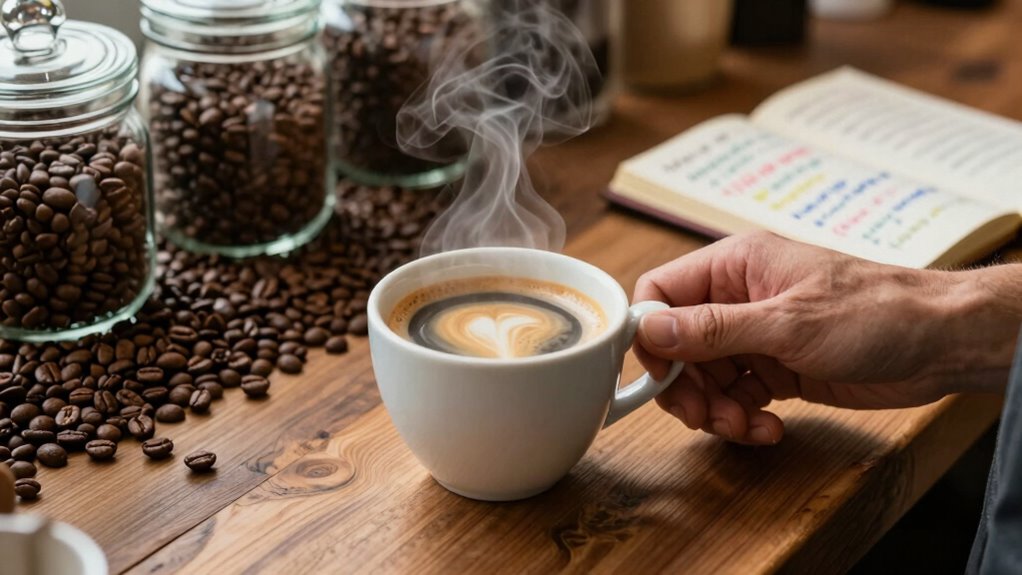
Having a rich vocabulary for describing coffee flavors allows you to communicate your tasting experience more precisely. To do this, focus on expanding your words for various coffee aroma and flavor profiles. Start by learning common descriptors like fruity, nutty, floral, and spicy. Pay attention to subtle differences in aroma, such as hints of citrus or caramel, and how they translate into taste. Keep a tasting journal to record your impressions and develop your own descriptive language. Use specific terms to distinguish between brightness, body, acidity, and sweetness. Recognizing aroma profiles can enhance your ability to identify and articulate nuanced flavors. Understanding the connection between aroma and flavor, as emphasized in the importance of sensory language, can deepen your appreciation of coffee. Developing a coherent descriptive language allows for more meaningful conversations about coffee flavors. Additionally, exploring sensory evaluation techniques can improve your ability to detect subtle differences in coffee. Engaging in guided tastings can further sharpen your palate and expand your descriptive vocabulary. Over time, this detailed vocabulary will help you articulate your experience more clearly, making your coffee conversations richer and more insightful. Building this vocabulary transforms tasting from a simple act into a more nuanced appreciation.
Personal Experiences That Boost Your Coffee Tasting Skills
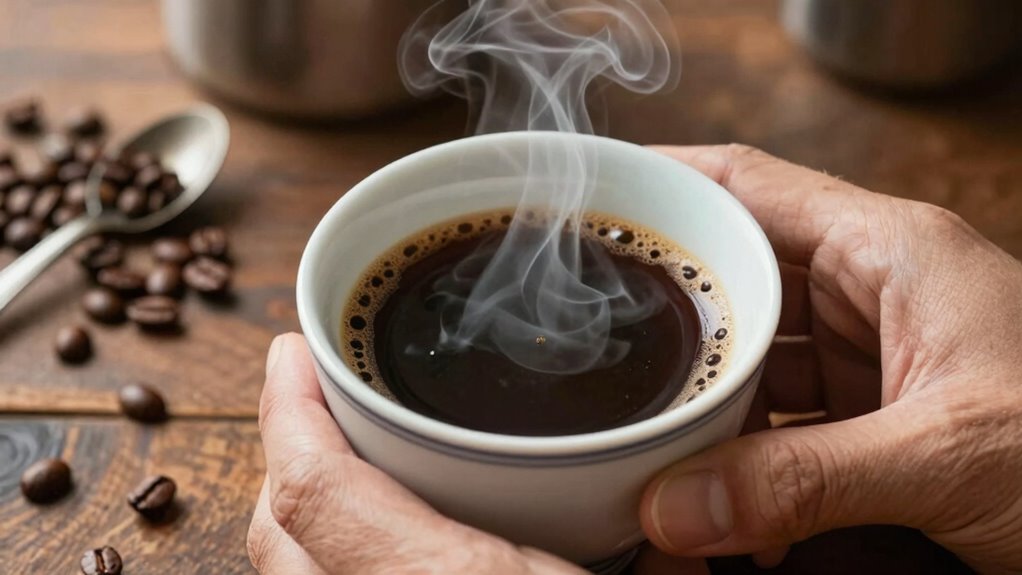
Personal experiences play a crucial role in sharpening your coffee tasting skills because they deepen your sensory awareness and understanding. When you pay close attention to a coffee’s aroma, you start to notice subtle differences that improve your ability to describe flavors. Tasting techniques, such as mindful sipping and palate cleansing, help you pick up on nuanced notes more accurately. Over time, repeated exposure to various coffee types trains your senses, making it easier to identify specific aromas and flavors. Sharing your experiences with others can also enhance your perception, as different perspectives reveal new details. Additionally, practicing with specialized tasting tools can further refine your palate and improve your descriptive abilities. By consciously engaging your senses during tasting, you strengthen your ability to articulate complex coffee qualities, making your descriptions richer and more precise. Developing a sensory awareness through consistent practice helps you notice even the smallest differences, elevating your overall tasting skills. Recognizing the impact of experience-driven learning can motivate you to explore a wider variety of coffees and refine your palate further. Regularly tracking your tasting notes can also help you identify patterns and improve your descriptive accuracy. Remember, sensory development is an ongoing process that benefits greatly from regular, mindful practice.
Practicing Coffee Tasting to Improve Your Descriptions
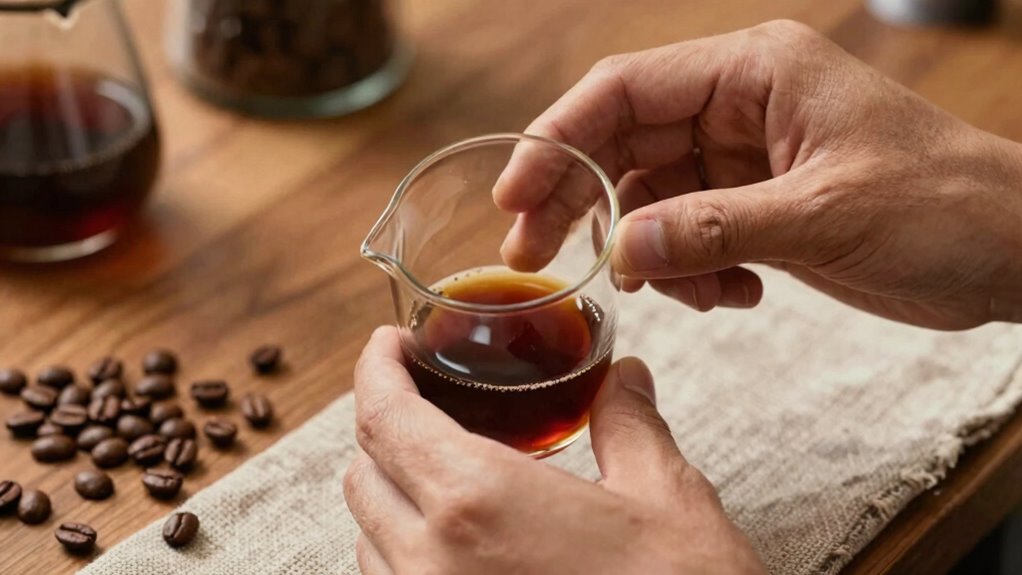
Practicing coffee tasting regularly is essential for sharpening your ability to describe flavors accurately. To improve, focus on experimenting with different coffee brewing methods, such as pour-over or French press, to notice subtle flavor differences. Use tasting techniques like aroma evaluation, slurping, and noting the aftertaste to develop your sensory awareness. Keep a tasting journal to record your impressions, paying attention to acidity, body, and flavor notes. Developing a keen sense of sensory perception can further refine your tasting skills and deepen your appreciation of coffee. Recognizing the importance of brew methods helps you understand how different preparations influence flavor profiles and enhances your descriptive abilities. Understanding drone bees and hive health can also serve as a metaphor for recognizing subtle nuances in flavor profiles and maintaining a balanced palate. Building your sensory awareness by paying close attention to each detail allows you to better discern the individual components of each coffee. Additionally, exploring flavor development through mindful tasting can boost your overall sensitivity and precision when describing coffee.
Why Some People Are More Sensitive to Coffee Aromas and Flavors

Some people are naturally more sensitive to coffee aromas and flavors because of differences in their sensory receptors. This heightened aroma sensitivity allows you to detect subtle scent nuances, enhancing your perception of flavor intensity. Your ability to distinguish complex aromas can make descriptions richer and more accurate. The table below shows how sensory receptor sensitivity influences flavor perception:
| Sensory Receptor Sensitivity | Impact on Coffee Tasting |
|---|---|
| High | Detects subtle aromas, increases flavor intensity |
| Moderate | Recognizes common aromas, moderate flavor perception |
| Low | Misses faint aromas, perceives weaker flavor |
| Very Low | Limited aroma detection, minimal flavor perception |
Understanding your sensory sensitivity helps you improve your coffee descriptions and appreciate the complexity behind each brew. Recognizing sensory receptor sensitivity can guide you in refining your tasting skills and selecting coffees that suit your perceptual strengths. Additionally, aroma detection plays a vital role in differentiating between coffee varieties and brewing methods, further enriching your sensory experience. Being aware of your sensory variation can also help you explore new coffee profiles with greater confidence. Developing an awareness of how sensory thresholds vary among individuals can lead to a more personalized appreciation of coffee flavors. Recognizing individual sensory differences can help you better understand your own preferences and sensitivities.
How Cultural Exposure Shapes Your Coffee Descriptive Skills

Your cultural background considerably influences how you perceive and describe coffee. Cultural traditions shape your expectations, vocabulary, and sensory associations, making your descriptions unique. In some cultures, coffee is linked to specific rituals, flavors, or social settings, which deepen your sensory awareness. Language diversity also plays a role; the words available in your native language influence how precisely you can articulate flavors, aromas, and textures. For example, some languages have multiple words for different coffee flavors, enhancing descriptive detail. Exposure to diverse coffee cultures broadens your palate and vocabulary, giving you a richer palette of terms and impressions. This cultural exposure can significantly improve your ability to notice subtle nuances, sharpening your capacity to describe coffee vividly and accurately. Engaging with different coffee traditions can also introduce you to new sensory descriptors and tasting techniques, further enriching your descriptive skills. Additionally, cultural appreciation for coffee can lead to a more mindful tasting experience, enriching your descriptive skills further. Developing an understanding of sensory language related to coffee can also deepen your engagement with the nuances of each brew, especially when you explore specialized terminology used in various coffee traditions.
Tools and Frameworks to Help You Describe Coffee Better

Using specific tools and frameworks can considerably improve your ability to describe coffee with clarity and precision. They help you structure your tasting process and communicate nuances effectively. For example, sensory wheels guide your tasting techniques, ensuring you explore aroma, flavor, and body systematically. You can also utilize tasting notes templates to record impressions consistently. Incorporating originality in your descriptions can further enhance your ability to convey the unique qualities of each coffee. Here’s a helpful framework:
| Aspect | Focus | Technique |
|---|---|---|
| Aroma | Fragrant notes | Smell deeply, identify layers |
| Flavor | Taste profile | Take small sips, note changes |
| Body | Mouthfeel | Swish coffee, feel texture |
| Acidity | Brightness | Notice sharpness or smoothness |
| Aftertaste | Lingering flavors | Detect lingering sensations |
Common Challenges in Coffee Description and How to Overcome Them
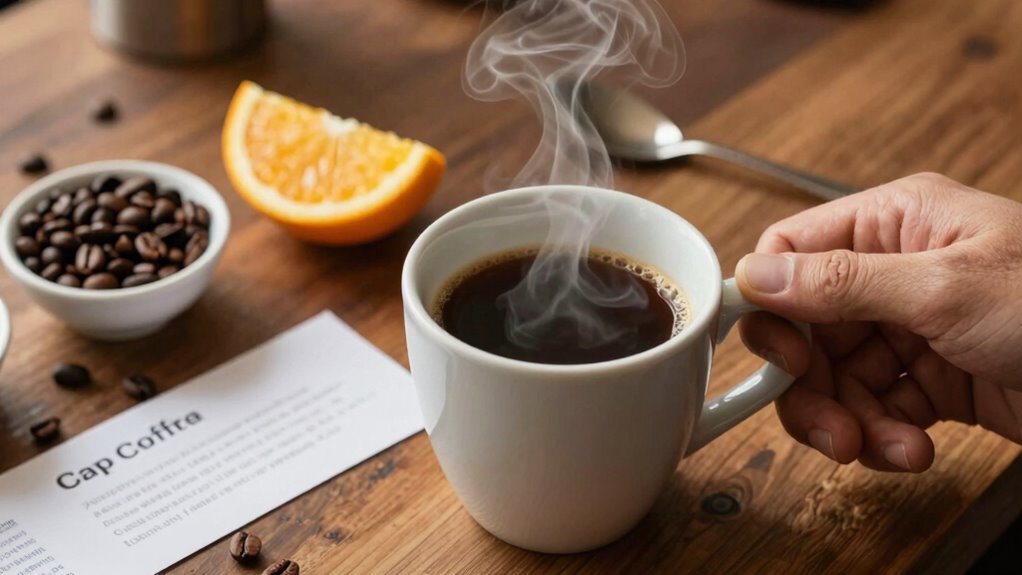
Many people struggle to find the right words when describing coffee, often because they haven’t developed a rich sensory vocabulary or practiced mindful tasting. By intentionally expanding your vocabulary and paying close attention to flavors and aromas, you can improve your descriptions. Consistent practice helps you notice subtle differences and express them more accurately. Incorporating specific descriptive terms from vetted coffee reviews can further enhance your ability to articulate nuanced coffee characteristics.
Developing Sensory Vocabulary
Developing a rich sensory vocabulary for coffee can be challenging because it requires you to identify and articulate subtle flavors and aromas that often go unnoticed. To improve, focus on tasting different brews with varied brewing techniques and exploring coffee pairing options. This experience broadens your palate and sharpens your descriptive skills. Use the table below to categorize common flavors and aromas, making it easier to recognize them:
| Flavor Category | Examples |
|---|---|
| Fruit | Berries, citrus |
| Nut and Grain | Almond, toast |
| Floral | Jasmine, rose |
| Spices | Cinnamon, pepper |
| Earth and Wood | Mud, cedar |
Regular practice with these categories helps you articulate nuanced coffee profiles more confidently.
Practicing Mindful Tasting
Practicing mindful tasting can be challenging because it requires you to stay fully present and attentive to every nuance in the coffee, rather than rushing through the experience. To improve, focus on slow, deliberate sips, paying close attention to flavors and aromas. Experiment with different brewing techniques to bring out unique characteristics in each cup, helping you identify subtle notes. Consider how coffee pairing influences your perception—certain foods can enhance or mask flavors, so choose complementary or contrasting pairings intentionally. Avoid distractions and set aside time for tasting sessions. Over time, this focused approach sharpens your palate, making it easier to describe coffee’s complexities and avoid superficial impressions. Consistent mindful tasting builds confidence and deepens your appreciation of coffee’s rich profiles.
Practical Tips to Develop Your Coffee Vocabulary and Sensory Skills

To enhance your coffee vocabulary and sensory skills, start by actively engaging your senses during each tasting. Focus on the coffee aroma, noting the different scents that emerge before you even sip. As you taste, pay attention to the flavor profiles—bitterness, acidity, sweetness, and body. Keep a tasting journal to record your observations and expand your descriptive language over time. Develop a mental library of common coffee aroma notes like fruity, nutty, or floral, and practice identifying them in different brews. Use tasting wheels or aroma kits to train your nose and palate. Regularly exploring new beans and brewing methods will sharpen your ability to distinguish subtle nuances, making your descriptions more precise and confident.
Frequently Asked Questions
Can Personality Traits Influence How Well Someone Describes Coffee Flavors?
Yes, your personality traits can influence how well you describe coffee flavors. If you’re open-minded and curious, you’re more likely to enhance your sensory perception, noticing subtle flavors others miss. Your linguistic expression skills also play a role, helping you articulate your tasting notes clearly. Confident, expressive individuals tend to describe coffee more vividly, while introverted or less expressive people might struggle to convey their sensory experiences effectively.
Do Age or Education Level Affect Coffee Tasting and Description Skills?
Age and education level can influence your coffee tasting and description skills. As you age, your flavor perception and sensory memory might decline, making it harder to distinguish subtle notes. Higher education, especially in sensory sciences or related fields, often improves your ability to analyze flavors precisely. You develop a richer sensory vocabulary, enhancing your descriptions. So, both age and education shape how effectively you perceive flavors and articulate coffee nuances.
How Does Training or Formal Education Improve Coffee Sensory Vocabulary?
Training and formal education enhance your coffee sensory vocabulary by sharpening your sensory training and improving flavor recognition skills. Through structured exercises, you learn to identify subtle aromas, tastes, and textures, making your descriptions more precise. Consistent practice helps you develop a nuanced palate, enabling you to articulate complex coffee profiles confidently. Overall, education accelerates your ability to recognize and describe coffee’s intricate sensory qualities better than untrained tasters.
Are There Differences in Coffee Description Ability Across Different Cultures?
Like a digital clock in a smoky jazz club, your cultural exposure shapes how you describe coffee. Different cultures develop unique sensory memories, emphasizing specific aromas, flavors, or textures. These differences influence your ability to articulate coffee’s nuances compared to others. Your cultural background provides a framework, enhancing or limiting your sensory vocabulary, making some descriptions more vivid and precise based on shared experiences and traditional tastes.
Can Technology or Apps Enhance Your Coffee Tasting and Descriptive Abilities?
Yes, technology and apps can improve your coffee tasting and descriptive skills. They help strengthen your sensory memory by guiding you through flavor profiling exercises, making it easier to identify subtle notes and aromas. Using these tools, you can expand your palate, sharpen your descriptive vocabulary, and develop a more refined understanding of coffee’s complexities, ultimately enhancing your ability to articulate your tasting experience with confidence.
Conclusion
By sharpening your senses and expanding your vocabulary, you’ll navigate the rich landscape of coffee flavors like a seasoned explorer charting new territories. With practice and cultural exposure, you’ll reveal deeper layers of aroma and taste, transforming each cup into a story waiting to be told. Remember, your sensory skills are the compass — guiding you through the complex, vibrant world of coffee with confidence and clarity. The more you explore, the richer your descriptions become.
Halloween Picks
halloween
As an affiliate, we earn on qualifying purchases.