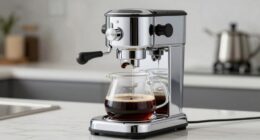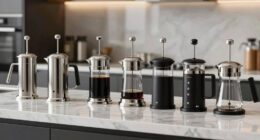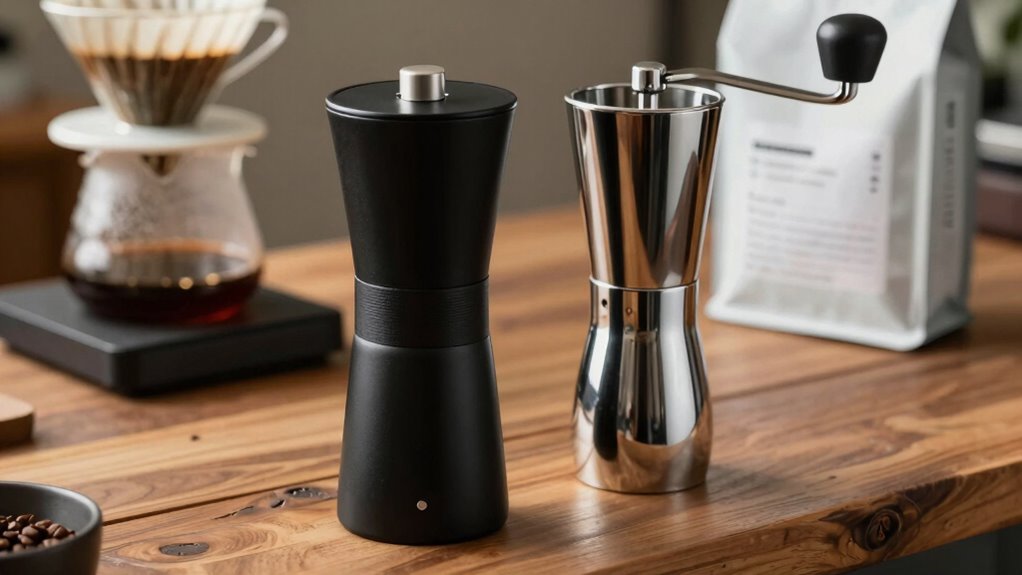
Understanding the differences between flat and conical burrs helps you choose the right grinder for your brewing style. Flat burrs offer consistent grind size, perfect for espresso, but require regular cleaning and can generate more heat. Conical burrs are versatile, easier to maintain, and suitable for various methods like pour-over or French press. Knowing how each impacts flavor and maintenance will help you make better coffee—if you keep going, you’ll discover even more about optimizing your brew.
Key Takeaways
- Understanding burr types helps home brewers select the right grinder for their preferred brewing method and flavor profile.
- Burr design impacts grind consistency, which directly influences extraction quality and coffee flavor.
- Knowledge of maintenance needs ensures optimal grinder performance and longevity for home brewing routines.
- Awareness of heat generation differences preserves delicate coffee flavors during grinding.
- Choosing the appropriate burr type balances precision, ease of maintenance, and versatility for various brewing styles.
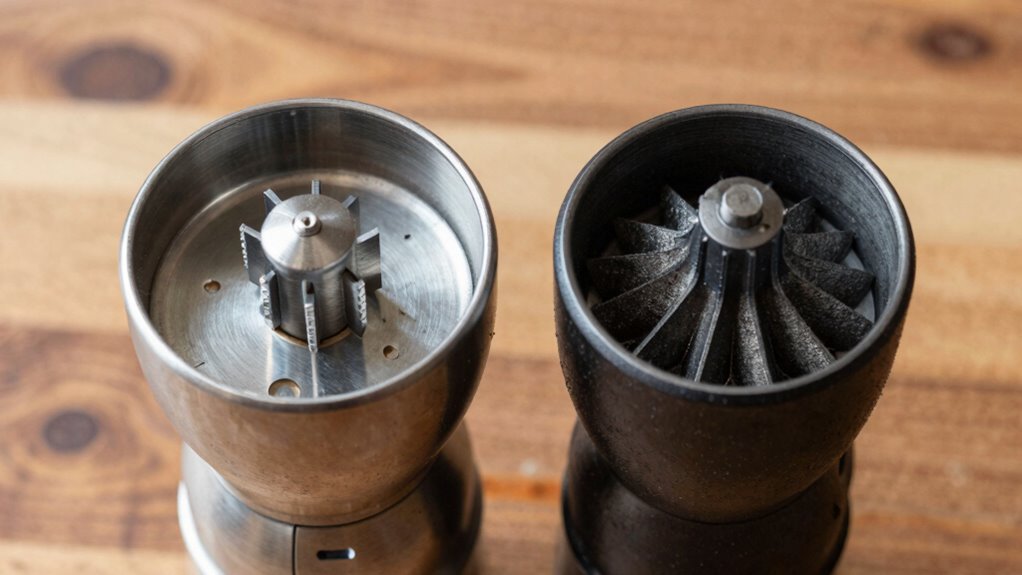
Have you ever wondered how the type of burr in your grinder impacts your home-brewed coffee? The choice between flat and conical burrs isn’t just a matter of preference—it directly influences grind consistency and how you maintain your equipment. These factors, in turn, shape the quality of your brew, making it essential to understand their significance.
Flat burrs tend to produce a more uniform grind because their design crushes beans into consistent particles. This precision results in better extraction, meaning your coffee’s flavors are more balanced and full-bodied. When you’re aiming for a precise brew, especially with methods like espresso, flat burrs are often preferred because they provide that level of grind consistency you need. However, maintaining flat burr grinders requires attention. They can accumulate coffee oils and particles more quickly, which means your maintenance routines should include regular cleaning. Without proper upkeep, the grind consistency can deteriorate, leading to uneven extraction and compromised flavor. If you stay on top of maintenance routines—cleaning burrs, checking for wear, and calibrating your grinder—you’ll enjoy consistently good coffee with flat burrs. Additionally, the technology used in burr design affects how well a grinder maintains its performance over time. A well-designed burr system can help mitigate some of the maintenance challenges and improve long-term consistency. Regularly evaluating your grinder’s performance and wear can help prevent issues before they impact your brewing process. Proper maintenance also involves controlling burr temperature, which is crucial because excessive heat can alter the beans’ flavor profile.
Flat burrs ensure uniform grind size for balanced, full-bodied espresso but require regular cleaning for optimal performance.
Conical burrs, on the other hand, excel at producing a range of grind sizes, from coarse to fine, with a slightly more forgiving grind consistency. They tend to generate less heat during grinding, which preserves the beans’ delicate flavors better. For home brewers who favor methods like French press or pour-over, conical burrs can offer more flexibility. They’re generally easier to clean due to their shape, and their design reduces the buildup of coffee oils, making maintenance routines simpler. This easier upkeep helps maintain grind consistency over time, so your coffee remains flavorful and well-extracted. Plus, their durability often means less frequent calibration, saving you time and effort. By selecting the right burr type and caring for your grinder, you can ensure optimal flavor extraction and a more enjoyable brewing experience.
Ultimately, your choice hinges on your brewing style and how much effort you’re willing to invest in maintenance routines. Flat burrs deliver precision and uniformity, but they demand diligent cleaning. Conical burrs provide versatility and ease of maintenance, making them a popular choice for casual home brewers. Both types impact grind consistency in different ways, so understanding these differences helps you optimize your setup. When you match your burr type with your brewing method and care routines, you’re better equipped to produce consistently excellent coffee at home.
flat burr coffee grinder
As an affiliate, we earn on qualifying purchases.
As an affiliate, we earn on qualifying purchases.
Frequently Asked Questions
Which Grinder Type Is Better for Espresso?
For espresso, conical burr grinders are often better because they provide consistent grind size and reduce heat, preserving bean flavor. They handle different bean types more effectively, ensuring grind consistency across various roasts. Flat burr grinders excel with uniform particle size but can generate more heat, which might affect delicate beans. Overall, choose a conical burr grinder if you want reliable, consistent espresso results with diverse bean compatibility.
How Does Burr Material Affect Coffee Flavor?
Burr material directly impacts coffee flavor through its durability and taste influence. Durable materials like ceramic or stainless steel resist wear, maintaining consistent grind size, which preserves flavor clarity. Some materials might impart subtle taste impacts or introduce metallic notes, affecting your brew’s purity. Choosing high-quality burrs guarantees longevity and ideal flavor extraction, helping you enjoy a richer, more nuanced cup—making your home brewing experience more satisfying.
Can Burr Grinders Be Used for Spices?
Yes, burr grinders can be used for spices, but with some considerations. They’re excellent for spice grinding because they offer consistent grind size, which helps with flavor preservation. However, you should dedicate a burr grinder solely for spices to prevent flavor transfer to coffee. Using a burr grinder for spices guarantees you get evenly ground spices, enhancing your dishes’ flavor and aroma without contaminating your coffee grinder.
Do Burr Grinders Require More Maintenance?
Burr grinders do require more maintenance than some might think, especially with regular grinding. You’ll want to invest time in grinder cleaning to prevent buildup that causes wear and tear. Over time, this maintenance helps keep the burrs sharp and functioning efficiently, reducing the risk of uneven grind sizes. Although it might seem like extra effort, consistent cleaning extends your grinder’s lifespan and guarantees peak performance.
Are Conical Burrs Quieter Than Flat Burrs?
Yes, conical burrs are generally quieter than flat burrs because they produce less grinding noise and have lower sound levels. You’ll notice a smoother, quieter operation when using a conical burr grinder, making it more pleasant for early mornings or shared spaces. Flat burrs tend to generate more noise due to higher grinding speeds and friction. So, if quiet operation matters to you, conical burrs are the better choice.
conical burr coffee grinder
As an affiliate, we earn on qualifying purchases.
As an affiliate, we earn on qualifying purchases.
Conclusion
Choosing between flat and conical burrs might seem like a small detail, but it’s like fine-tuning your craft—each option gently guides your brew toward perfection. When you understand their subtle nuances, you’re not just making coffee; you’re creating an experience. So, embrace these choices as your secret ingredients, quietly elevating your mornings. After all, it’s the delicate touch behind the scenes that turns a simple cup into a moment to savor.
espresso coffee grinder
As an affiliate, we earn on qualifying purchases.
As an affiliate, we earn on qualifying purchases.
manual pour-over coffee grinder
As an affiliate, we earn on qualifying purchases.
As an affiliate, we earn on qualifying purchases.