

Throughout history, governments have enacted bizarre and harsh coffee laws to control its influence. In 1511, Mecca banned coffee to prevent unrest, only for it to be overturned within a year. The Ottoman crackdown in the 1630s involved executions and underground trade, while Sweden and Prussia tried to eliminated coffee with fines, confiscations, and beer promotion. England restricted political speech in coffeehouses, fearing dissent. If you keep exploring, you’ll uncover even stranger laws and the surprising reasons behind them.
Key Takeaways
- Early coffee bans, such as in Mecca (1511) and Cairo (1530s), aimed to prevent political unrest but faced strong public resistance.
- Ottoman Sultan Murad IV (1633-1640) enforced brutal penalties, including execution, to suppress underground coffee trade.
- Sweden (1756–1823) confiscated coffee equipment and publicly burned beans to enforce prohibition, sparking underground drinking.
- Prussia restricted coffee imports and licenses (1777–1786), promoting beer over coffee for economic and political reasons.
- In England, King Charles II limited speech in coffeehouses to curb dissent, blending social gathering with political control.
The 1511 Meccan Coffee Ban and Its Downfall
In 1511, Governor Khair Beg declared coffee consumption illegal in Mecca, fearing it would inspire radical thinking and threaten political stability. He believed the stimulating effects of coffee could fuel dissent and unite opposition groups. To enforce the ban, all coffeehouses were shut down, and severe punishments were handed out to sellers and drinkers. Despite his efforts, the ban lasted less than a year. The Sultan of Cairo, himself a coffee enthusiast, overturned the prohibition, recognizing coffee’s popularity and dismissing Khair Beg’s fears. Tragically, Khair Beg was executed for embezzlement in 1512, marking a swift end to his control over coffee in Mecca. The episode highlights early attempts to suppress coffee due to perceived social and political risks. Historical coffee bans serve as intriguing examples of how societal fears can influence regulations on popular beverages. Additionally, the social impact of coffee during that era played a significant role in shaping public opinion and governmental decisions. The public reaction to the ban demonstrated coffee’s deep cultural significance and its widespread appeal across different social classes. This incident also underscores how governmental control over individual habits has historically faced resistance from the populace.
Cairo’s Coffee Suppression in the 1530s

Following the brief suppression of coffee in Mecca, authorities in Cairo took similar measures in 1532 to curb the beverage’s influence. They raided coffeehouses and warehouses, smashing jars and scattering beans, aiming to eliminate the stimulant entirely. Imagine the chaos as armed guards storm in, sweeping through bustling cafes, forcing patrons to flee. The authorities viewed coffee as an intoxicant like wine, suspecting it fueled dissent. They also targeted Sufi sects, concerned about their use during funeral prayers. Picture the scene:
Cairo’s 1532 crackdown on coffee involved raids, arrests, and sealing cafes to suppress its influence and Sufi practices.
- Coffee beans thrown into fires, smoke billowing out.
- Arrests made amid shouting and panic.
- Coffeehouses shut down, their doors sealed tight.
- Cultural perceptions of coffee’s role in society complicated enforcement efforts. Sometimes, the public’s attachment to coffee made suppression efforts more difficult, as it was deeply woven into social and religious practices. Additionally, the legal status of coffee in various regions influenced the level of enforcement and resistance encountered. Despite these challenges, authorities continued their efforts to suppress the drink, though the effectiveness of the ban remains uncertain.
Despite the crackdown, the ban’s duration and enforcement remain unclear, but Cairo’s attempt to suppress coffee left a lasting impression.
The Ottoman Empire’s Ruthless Crackdown (1633-1640)
During Sultan Murad IV’s reign from 1633 to 1640, coffee consumption became a deadly offense, with violators facing execution, sometimes personally decapitated by the Sultan. Despite these harsh punishments, a thriving underground coffee trade persisted beneath the surface of strict enforcement. This clandestine network kept the beverage alive, even amid the Sultan’s ruthless crackdown. Sustainable practices in the clandestine trade helped ensure its survival despite the risks involved. The resilience of this covert market highlights the importance of reliability and adaptability in maintaining cultural traditions under oppressive regimes. This resilience demonstrates the significance of cultural preservation in resisting oppressive policies and reflects how underground markets can serve as cultural resilience during times of persecution. Additionally, the secret nature of the trade required careful planning and discretion to avoid detection and punishment.
Execution for Coffee Violators
The Ottoman Empire’s crackdown on coffee between 1633 and 1640 was notoriously brutal, with Sultan Murad IV enforcing strict penalties on anyone caught drinking or selling the beverage. Violators faced immediate death, often at the Sultan’s own hand. Picture soldiers patrolling the streets:
- Searching door-to-door for hidden coffee pots and cups.
- Breaking into clandestine coffeehouses where patrons gathered.
- Executing offenders publicly, sometimes by decapitation in the town square.
The fear was so intense that people hid coffee in secret compartments or replaced their cups with tea. Murad IV’s relentless enforcement created a climate of terror—coffee, once a social staple, became a deadly offense under his rule. This harsh suppression was driven by cultural and political motives, aiming to curb the influence of coffeehouse gatherings that were seen as centers of dissent.
Underground Coffee Trade
Sultan Murad IV’s brutal enforcement didn’t completely stop the spread of coffee; instead, it pushed the trade underground. Despite strict patrols and public executions, smugglers and merchants secretly continued to supply coffee to loyalists and enthusiasts. Hidden coffeehouses operated in basements, cellars, and back alleys, often concealed behind false walls or behind other businesses. Traders used coded language and secret routes to evade authorities, maintaining a resilient underground network. These covert operations thrived on the demand of locals who valued coffee’s stimulating effects and social appeal. Even under threat of death, the trade persisted, undermining the Sultan’s efforts. After Murad IV’s death in 1640, authorities relaxed their grip, allowing the clandestine trade to gradually resurface into more open markets.
Sweden’s Health Campaign Against Coffee (1756-1823)
In 1756, Sweden’s government became concerned about coffee’s impact on public health and launched a campaign to ban it. They confiscated brewing equipment, imposed fines, and even burned coffee beans in front of violators to enforce the ban. Despite these strict measures, the restrictions lasted until 1823, fluctuating between full bans and heavy taxes. This campaign was part of a broader effort to control substances considered socially disruptive, reflecting the era’s focus on regulating behavior.
Government’s Health Concerns
Between 1756 and 1823, Sweden’s government actively sought to curb coffee consumption by launching a health-focused campaign. They believed coffee harmed public well-being and took drastic measures to prove their point. Imagine:
- A clinical study on death row inmates, where doctors monitored their health after coffee consumption.
- Authorities confiscating coffee brewing equipment, smashing pots and grinders in front of furious drinkers.
- Fine notices slapped on citizens caught with coffee, with inspectors patrolling streets like health enforcers.
- The government promoted public health campaigns to discourage coffee drinking and educate citizens about its supposed dangers.
Despite these efforts, the government’s claims faltered when studies failed to confirm coffee’s dangers. Still, the campaign persisted, swinging between full bans and heavy taxes, illustrating their persistent concern over coffee’s impact on health.
Enforcement and Bans
From 1756 to 1823, Sweden’s government aggressively enforced its anti-coffee campaign by confiscating brewing equipment, fining drinkers, and deploying inspectors to patrol the streets. You’d see coffee shops shut down, and violators punished by having their coffee beans burned publicly. Authorities monitored citizens closely to prevent brewing and consumption. The table below shows how enforcement evolved:
| Year | Enforcement Action | Public Response |
|---|---|---|
| 1756 | Equipment confiscated, fines imposed | Resistance grew among drinkers |
| 1800 | Street patrols increased | Smuggling and underground trade |
| 1823 | Ban lifted, restrictions eased | Coffee’s popularity resurged |
Despite harsh measures, many continued to drink coffee covertly, challenging the bans and eventually leading to their easing. The ongoing enforcement efforts reflected the strong cultural attachment to coffee despite official opposition.
Prussia’s Beer Advocacy and Coffee Restrictions (1777-1786)
During Frederick the Great’s reign, Prussia launched a vigorous campaign to promote beer over coffee, driven by economic and political motives. He believed coffee drained funds and weakened morale. To enforce this, he implemented strict measures:
- All coffee roasters needed special licenses, most of which were denied, limiting production.
- Soldiers called “sniffers” patrolled streets, searching for illegal coffee roasting and consumption.
- Coffee imports were heavily restricted, favoring domestic beer production.
- These restrictions reflected a broader desire to control public consumption and maintain social order. The restrictions also aimed to control maritime trade and reduce reliance on foreign imports, aligning with broader mercantilist policies of the time. Frederick’s policies aimed to boost local breweries and reduce foreign dependency. These restrictions created a tense atmosphere for coffee drinkers, who faced constant surveillance. When Frederick died in 1786, the ban was lifted, and coffee’s popularity returned, ending the beer advocacy campaign. Additionally, the ban impacted economic trade by limiting the importation of coffee, which was becoming increasingly popular across Europe, and this decline affected the overall consumer culture of the period. Moreover, the restrictions hindered cultural exchange, isolating coffee from the broader European social landscape during that era.
England’s Political Speech Laws in Coffeehouses (1660s)
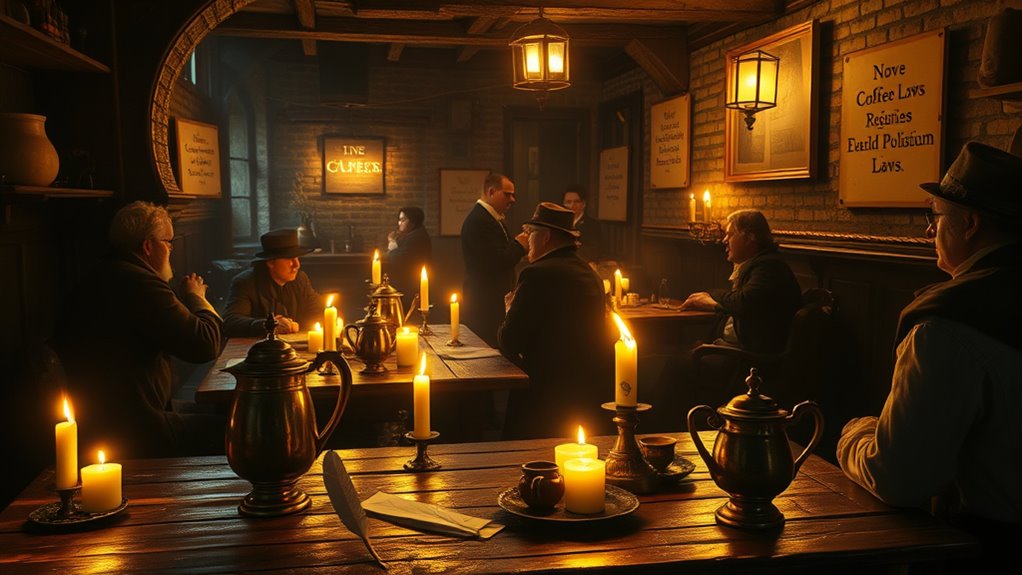
As Frederick the Great’s efforts to restrict coffee marked a significant focus on controlling economic and political influence, England’s approach in the 1660s shifted attention to regulating the very conversations happening within coffeehouses. King Charles II issued a decree restricting “Spreading of False News, and Licentious Talking of Matters of State and Government,” aiming to curb political dissent. Royal spies were planted in coffeehouses to monitor speech and enforce these restrictions. Coffeehouses, known as “Penny Universities,” became hubs for intellectual debate and social mixing across classes. The government feared that unregulated political talk could threaten authority and stability. These laws targeted the content of conversations rather than coffee consumption itself, marking an early effort to control public discourse through legislation and surveillance. Political speech laws were enforced through a combination of legislation and covert observation, illustrating the extent to which authorities sought to influence the flow of ideas in public spaces. This approach reflected a broader concern about public discourse and the potential for dissent to challenge the existing power structures.
The Cultural Impact of Coffee Bans Across Civilizations
Coffee bans have often sparked profound cultural shifts, shaping social behaviors, traditions, and identities in societies that attempted to suppress the beverage. When authorities outlawed coffee, communities responded by forming underground networks, changing social rituals, and redefining their collective identity. For example:
Coffee bans sparked cultural shifts, transforming social bonds, rituals, and identities through underground networks and defiance.
- You might imagine secret gatherings in hidden cellars, where the aroma of illicit coffee brews filled the air despite strict punishments.
- Picture traditional ceremonies evolving around alternative beverages, like beer or tea, as societies adapted to restrictions.
- Envision public defiance, with people risking punishment to preserve their social bonds and cultural practices linked to coffee.
These bans didn’t just suppress a drink; they transformed social dynamics, resiliently shaping cultural expressions, community cohesion, and even political resistance.
Enforcements and Penalties: From Fines to Executions

Enforcement methods for coffee bans ranged from minor fines to harsh executions, reflecting the severity with which authorities sought to suppress the beverage. In Mecca, violators faced physical punishment, while Cairo authorities sacked coffeehouses and seized beans. Ottoman rulers executed offenders, with Sultan Murad IV rumored to decapitate violators personally. Sweden confiscated equipment and burned coffee in front of offenders, imposing fines. Prussia forced licenses and employed “sniffers” to patrol streets, with restrictions lifted after Frederick’s death. England’s spies monitored coffeehouses to control political speech, not consumption itself. To visualize, consider this table:
| Enforcement Method | Target | Consequence |
|---|---|---|
| Fines | Drinkers | Monetary penalty |
| Confiscation | Equipment | Equipment destruction |
| Imprisonment | Sellers | Imprisonment |
| Execution | Violators | Death |
| Public Shaming | Offenders | Humiliation |
The End of Coffee Restrictions and the Rise of Café Culture
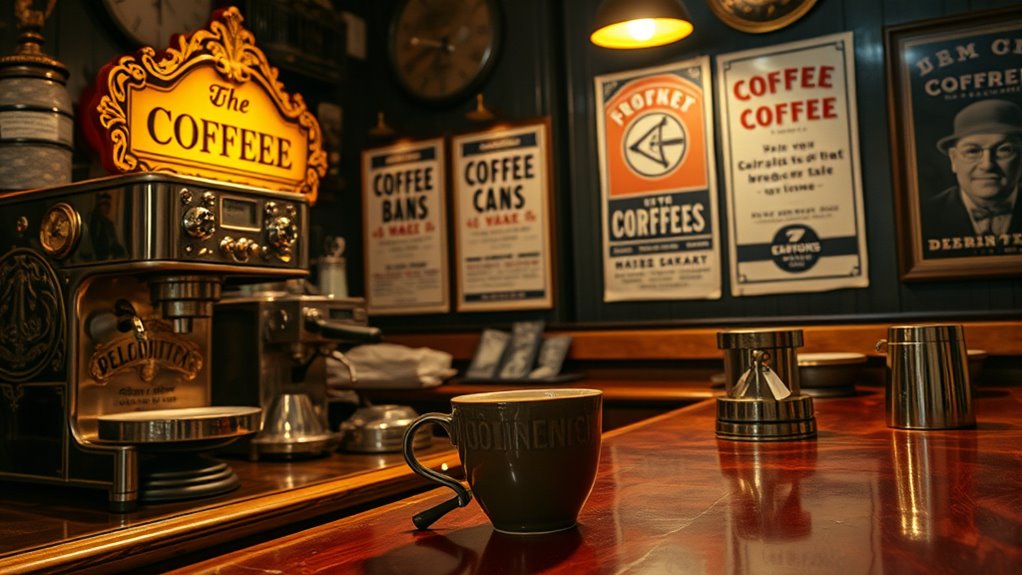
The strict bans and harsh punishments eventually gave way to a gradual relaxation of restrictions, paving the way for the emergence of café culture. As governments loosened their grip, social spaces blossomed where people could gather, converse, and enjoy coffee freely. Imagine:
- Cozy cafés opening in bustling city corners, filled with the aroma of roasted beans.
- Intellectual debates and political discussions spilling out onto lively streets.
- Artists, writers, and thinkers exchanging ideas over steaming cups.
This shift transformed coffee from a banned substance into a symbol of social interaction and creativity. Governments and rulers, once fearful of its influence, now watched as coffeehouses became hubs for cultural and political exchange—laying the foundation for modern café culture.
Frequently Asked Questions
Were There Any Successful Covert Coffee Trade Networks During These Bans?
Yes, covert coffee trade networks thrived during these bans. You’d find underground routes smuggling beans, often operated by skilled merchants who used secret channels to evade authorities. These networks kept the coffee flowing despite strict enforcement. You might even participate in clandestine meetings at hidden cafes, where enthusiasts shared their love for coffee away from prying eyes, ensuring the beverage’s survival against oppressive laws.
How Did Coffee Culture Persist Despite Strict Enforcement and Severe Penalties?
You keep coffee culture alive despite harsh penalties by creating secret networks, using covert trade routes, and holding clandestine gatherings. People hide beans, brew coffee underground, and communicate discreetly to avoid detection. These covert activities foster a sense of community and resistance, making sure the tradition continues. Despite authorities’ efforts, your passion for coffee drives you to find clever ways to preserve its social and cultural significance.
Did Religious or Political Leaders Influence the Bans on Coffee Historically?
Imagine a storm brewing, fueled by leaders fearing coffee’s power to inspire rebellion. Religious and political leaders historically influenced coffee bans to control social and political unrest. For example, in 1511, Mecca’s governor feared coffee would unite opposition, leading to a ban. Similarly, Sultan Murad IV’s execution of violators aimed to suppress revolutionary ideas. These leaders used bans as weapons to maintain authority, but coffee’s cultural allure often proved unstoppable.
Were Other Beverages Targeted Alongside Coffee in These Prohibition Efforts?
Yes, other beverages were targeted along with coffee during prohibition efforts. In Ottoman Empire, alcohol and tobacco faced strict bans, with violators risking execution. Sweden banned coffee entirely but also cracked down on alcohol and other stimulants. Prussia restricted coffee sales to promote beer, and even Sweden burned coffee beans publicly. Governments often aimed to control substances seen as threats to social order or health, targeting multiple drinks simultaneously.
How Did the Public React to and Resist These Various Coffee Bans?
When faced with coffee bans, you resist like a river carving through rock—persistent and unstoppable. People secretly brewed, traded, and gathered in underground cafes, risking punishment for their love of coffee. You might have hidden beans or whispered plans, determined to keep the brew alive. The passion for coffee ignited rebellion, turning suppression into a catalyst for unity and defiance that refused to be silenced.
Conclusion
Even if you think coffee bans sound extreme, remember they often reflected fears of social unrest or moral decay. While it might seem silly now, those restrictions shaped cultures and led to the vibrant café scenes we enjoy today. So next time you sip your brew, thank history’s quirkiest laws for paving the way for your coffee moments—because sometimes, even the strangest bans have a surprising way of fueling our love for coffee.