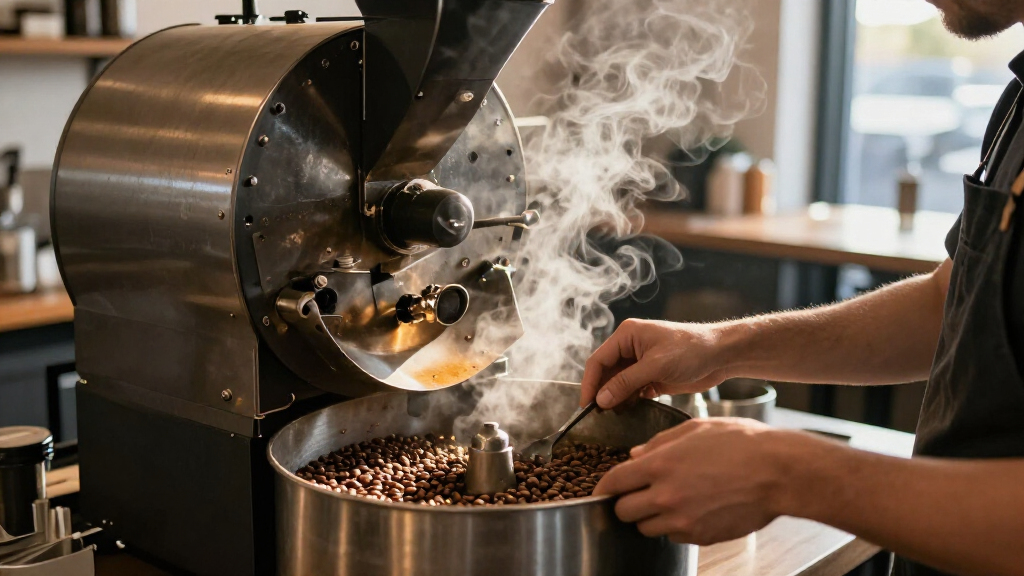
The best commercial coffee roasters depend on how much you roast, what utilities your space supports, and how much control you need. I would put the Precision Coffee Roaster, 1 kg Capacity first for a small operation seeking a defined batch size and PID temperature control; the Kaldi Fortis suits hands-on small batches, while the BEILOCKERY 110 lb Gas Roaster targets much higher-volume production. The main tradeoff is between production capacity and the space, power, ventilation, and operating experience that larger machines demand. Smaller electric models may fit a test-roasting workflow more readily, but their stated capacities and controls need close scrutiny before commercial use. Read on for the full comparison and guidance on matching a roaster to your actual production needs.

Get coffee and tea gear delivered free with Prime
- Fast, free delivery on millions of items
- Prime Video, Amazon Music and more included
- Member-only deals all year
Complete the kit



Key Takeaways
- The 1 kg Precision Coffee Roaster is the clearest small-business starting point in this group because its stated batch size and PID control give buyers more concrete planning information than several broadly named commercial models.
- The two 110 lb gas roasters are aimed at a different scale from the 600 g Kaldi Fortis and 1 kg Precision; buyers should verify installation, utility, ventilation, and batch-size requirements before treating the larger capacity as an advantage.
- Electric models span several distinct workloads: the GYQSSD lists 2,000–4,000 g, the HNZXIB lists 4.4 lb, and the EQCOTWEA electric model lists 16.5 lb, so capacity labels matter more than the shared electric designation.
- The Kaldi Fortis favors hands-on small-batch roasting, while automatic models such as the SBPKMARSCT may appeal to buyers seeking a different operating workflow; neither description alone establishes production consistency or ease of service.
- Multi-use drum roasters introduce a tradeoff: models listed for coffee, peanuts, or nuts may offer broader use, but a coffee business should confirm that the roasting controls and operating process suit its coffee volume and product standards.
| SBPKMARSCT Commercial Automatic Coffee Bean Roaster |  | Best for Large Batches with a Simple Setup | Capacity: 14.5 L / 3.83 gal | Stated batch range: 5.5–6.6 lb | Motor power: 14 W | VIEW LATEST PRICE | See Our Full Breakdown |
| B500 Electric Coffee Bean Roaster with PID Temperature Control |  | Best for Roast Profile Control | Model: B500 | Roasting capacity: Up to 500 g | Roasting method: Direct-fire-style drum roasting | VIEW LATEST PRICE | See Our Full Breakdown |
| EQCOTWEA Commercial Electric Coffee Bean and Nut Roaster, 16.5 lb, 3000 W |  | Best for High-Volume Multi-Ingredient Roasting | Model: 56D | Capacity: 16.5 lb / 7.5 kg | Wattage: 3000 W | VIEW LATEST PRICE | See Our Full Breakdown |
| Commercial Electric Drum Roaster for Coffee Beans, Peanuts, and Nuts, Type 5 |  | Best for Versatile Mid-Size Batches | Model: Type 5 | Coffee capacity: Approximately 2 kg | Temperature range: 0–350°C | VIEW LATEST PRICE | See Our Full Breakdown |
| Precision Coffee Roaster, 1 kg Capacity, 240 V, 2000 W |  | Best for Software-Assisted Small Production | Capacity: 1 kg / 2 lb | Daily roasting capacity: Up to 20 kg / 44 lb | Wattage: 2000 W | VIEW LATEST PRICE | See Our Full Breakdown |
| BEILOCKERY Commercial Automatic Gas Roaster, 110 lb Capacity |  | Best for High-Volume Production | Capacity: 110 lb (50 kg) | Temperature range: 32–572°F (0–300°C) | Fuel: LPG or natural gas | VIEW LATEST PRICE | See Our Full Breakdown |
| HNZXIB Commercial Electric Coffee Bean Roaster, 4.4 lb, Stainless Steel, 110V |  | Best for Small-Batch Electric Roasting | Capacity: 4.4 lb | Temperature range: 86–572°F | Timer: 0–999 minutes | VIEW LATEST PRICE | See Our Full Breakdown |
| Electric Coffee Bean Roaster with Smokeless Drum Roasting |  | Best for Smoke-Conscious Small Batches | Maximum bean capacity: 500 g per batch | Model: BAMI-T500 | Roasting modes: Auto, Assistant, Manual | VIEW LATEST PRICE | See Our Full Breakdown |
| ICZW 14.5L Stainless Steel Coffee Bean Roaster |  | Best for Gas-Stove Batch Flexibility | Model: JT-3A | Capacity: 14.5 liters | Roasting capacity: Approximately 3.5–4.0 kg (7.7–8.8 lb) per batch | VIEW LATEST PRICE | See Our Full Breakdown |
| EQCOTWEA Commercial Gas Roaster, 110 lb Capacity, 304 Stainless Steel, 280 W, 220 V |  | Best for Gas-Fired Processing Lines | Model: CY-100 | Capacity: 110 lb (title); 55 lb / 25 kg pot (description) | Temperature range: 0–300°C | VIEW LATEST PRICE | See Our Full Breakdown |
| Kaldi Fortis Coffee Roaster with Accessories, 600 g Batch Capacity |  | Best for Hands-On Roast Tracking | Batch capacity: 600 g | Roasting type: Semi-convective | Thermometers: Dual data logger | VIEW LATEST PRICE | See Our Full Breakdown |
| GYQSSD Electric Coffee Roaster, 2000–4000 g |  | Best for Multi-Use Electric Batches | Capacity: 2,000 g or 4,000 g | Power: 1.8 kW or 2.5 kW | Temperature range: 0–350°C | VIEW LATEST PRICE | See Our Full Breakdown |
| commercial coffee roaster | Dimensions | Weight | Capacity | Model |
|---|---|---|---|---|
| SBPKMARSCT Commercial Automati | 11.8 × 7.1 × 13.6 in | 13.2 lb | 14.5 L / 3.83 gal | — |
| B500 Electric Coffee Bean Roas | 19.2 × 10.6 × 16.1 in | 22 lb | — | B500 |
| EQCOTWEA Commercial Electric C | 26.8 × 26.8 × 31.5 in | 185 lb | 16.5 lb / 7.5 kg | 56D |
| Commercial Electric Drum Roast | — | 10 kg | — | Type 5 |
| Precision Coffee Roaster | — | — | 1 kg / 2 lb | — |
| BEILOCKERY Commercial Automati | 29.13 × 66.93 × 50.39 in (D × W × H) | — | 110 lb (50 kg) | — |
| HNZXIB Commercial Electric Cof | 10 × 10 × 10 in | 22 lb | 4.4 lb | — |
| Electric Coffee Bean Roaster w | 19.29 × 10.24 × 15.75 in | 22 lb | — | BAMI-T500 |
| ICZW 14.5L Stainless Steel Cof | 8.8 × 8.7 × 9.8 in (D × W × H) | 7 lb | 14.5 liters | JT-3A |
| EQCOTWEA Commercial Gas Roaste | 29.19 × 66.93 × 50.39 in | 490 lb | 110 lb (title); 55 lb / 25 kg pot (description) | CY-100 |
| Kaldi Fortis Coffee Roaster wi | 20.87 × 12.6 × 17.32 inches | 1.32 pounds | — | FORTIS |
| GYQSSD Electric Coffee Roaster | — | — | 2,000 g or 4,000 g | — |
More Details on Our Top Picks
SBPKMARSCT Commercial Automatic Coffee Bean Roaster
The 14.5 L capacity sets this roaster apart from smaller batch machines such as the B500, which handles up to 500 g. Its stated 5.5–6.6 lb batch range can suit a café or restaurant that wants to roast larger amounts at a time. The adjustable 5–45 rpm rotation lets operators change the drum speed, while the rectangular bracket is designed to reduce shaking during operation. The stainless steel body favors a sturdy, heat-resistant setup. The tradeoff is that the supplied details say less about roast profiling and temperature control than the Precision Coffee Roaster, so buyers focused on recording repeatable profiles may prefer that model. At 13.2 lb, it is also less convenient to move, and its 12 V DC power requirement calls for a compatible source.
Pros:- Stated 5.5–6.6 lb batch capacity is substantially larger than the B500’s 500 g capacity.
- Adjustable 5–45 rpm speed supports changes to drum rotation.
- Stainless steel construction is suited to repeated heating.
- Rectangular bracket design is intended to limit shaking.
Cons:- Requires a 12 V DC power source, so a compatible adapter or supply may be needed.
- At 13.2 lb, it is relatively heavy to move and store.
- Product details do not specify PID temperature control or roast curve recording.
Best for: Restaurants and small coffee shops that prioritize larger batches and adjustable drum rotation.
Not ideal for: Roasters who need documented temperature profiles or want a lightweight machine that is easy to move.
- Capacity:14.5 L / 3.83 gal
- Stated batch range:5.5–6.6 lb
- Motor power:14 W
- Voltage:12 V DC
- Speed range:5–45 rpm
- Material:Stainless steel and Bakelite
- Dimensions:11.8 × 7.1 × 13.6 in
- Weight:13.2 lb
- Warranty:2 years
Our verdict“Choose this model for larger batches and adjustable rotation if you can accommodate its DC power setup and do not need detailed profile controls.”
B500 Electric Coffee Bean Roaster with PID Temperature Control
The B500 is the profile-focused choice in this group: it combines PID temperature control with roast curve recording, features not listed for the larger SBPKMARSCT roaster. That pairing gives a buyer more tools for tracking and repeating a roast, while the direct-fire-style drum method provides a distinct approach to heating. Its 500 g batch limit is the main constraint; the Type 5 drum roaster is described as holding about 2 kg, making it a better fit for higher output. The B500 is presented for home or commercial use, but the supplied information gives few details about operating features beyond control and recording. At 22 lb and nearly 20 inches long, it also needs a dedicated spot rather than casual countertop storage.
Pros:- PID temperature control supports regulated roasting.
- Roast curve recording helps track roast progression.
- Direct-fire-style drum roasting distinguishes its heating method.
- Designed for both home and commercial settings.
Cons:- 500 g maximum capacity is far below the Type 5 and EQCOTWEA capacities.
- At 22 lb, it is not especially easy to relocate.
- Supplied product information lacks detail about day-to-day operation.
Best for: Small-batch roasters and coffee businesses that value temperature regulation and recording roast curves over batch size.
Not ideal for: Commercial operators who need multi-kilogram batches or buyers who need detailed information about operating workflow before choosing.
- Model:B500
- Roasting capacity:Up to 500 g
- Roasting method:Direct-fire-style drum roasting
- Temperature control:PID
- Roast curve recording:Supported
- Dimensions:19.2 × 10.6 × 16.1 in
- Weight:22 lb
Our verdict“Pick the B500 when roast tracking and PID control matter more than producing large batches.”
EQCOTWEA Commercial Electric Coffee Bean and Nut Roaster, 16.5 lb, 3000 W
With a stated 16.5 lb capacity, the EQCOTWEA is built for much larger batches than the B500 or Precision Coffee Roaster. Its 3000 W electric heater, cast iron pot, and 3D stirring blades suit operators who want one machine for coffee, nuts, chestnuts, and seeds. Adjustable time and temperature controls offer more direct process adjustment than the product details provide for the SBPKMARSCT. That versatility comes with substantial infrastructure demands: this model needs 220 V power and weighs 185 lb, so it is a fixed commercial installation rather than a portable roaster. The supplied information describes basic controls but does not list PID regulation or roast curve recording, leaving profile-focused buyers better served by the B500 or Precision model.
Pros:- 16.5 lb capacity supports substantially larger batches than the B500.
- Adjustable time and temperature controls allow process changes.
- Cast iron pot and 3D stirring blades are designed for even roasting.
- Can roast coffee, nuts, chestnuts, and seeds.
Cons:- Requires a 220 V power supply.
- At 185 lb, it is difficult to move and requires a dedicated location.
- No PID control or roast curve recording is specified.
Best for: Commercial kitchens or production spaces roasting large batches of coffee alongside nuts, chestnuts, or seeds.
Not ideal for: Home users, mobile vendors, or profile-driven coffee roasters without 220 V power and space for a 185 lb machine.
- Model:56D
- Capacity:16.5 lb / 7.5 kg
- Wattage:3000 W
- Voltage:220 V
- Electrical configuration:60 Hz, single-phase
- Roasting pot:Cast iron
- Frame:Stainless steel
- Dimensions:26.8 × 26.8 × 31.5 in
- Weight:185 lb
Our verdict“Choose the EQCOTWEA for high-volume, multi-ingredient production if your site can support its power and footprint.”
Commercial Electric Drum Roaster for Coffee Beans, Peanuts, and Nuts, Type 5
The Type 5 fills the gap between small profile roasters and heavy production equipment: its approximately 2 kg coffee capacity is more than the B500’s 500 g, while the machine itself weighs 10 kg, far less than the EQCOTWEA. A rotating drum and stirring paddle are intended to distribute heat through coffee, nuts, grains, and other dry goods. Temperature adjustment up to 350°C and a long timer range give operators room to set a roast, and the removable inner drum can simplify cleanup. Its controls are less specified than the Precision Coffee Roaster’s touchscreen profiles and Artisan compatibility, so buyers seeking software-assisted repeatability may prefer that option. The listing also warns against flour and very small particles, and damp products may require roasting with the machine uncovered.
Pros:- Approximately 2 kg capacity exceeds the B500’s 500 g batch limit.
- Rotating drum and stirring paddle support more even heating.
- Temperature and timer settings can be adjusted.
- Removable inner drum makes cleaning easier.
Cons:- Not suitable for flour or very small particles.
- Damp products may require operating with the machine uncovered.
- Product details do not list roast curve recording or software compatibility.
Best for: Small food businesses that roast coffee and other dry goods in mid-size batches and want a removable drum for cleaning.
Not ideal for: Coffee roasters who need software-linked profile control, or operators processing flour, very small particles, or damp products under a covered setup.
- Model:Type 5
- Coffee capacity:Approximately 2 kg
- Temperature range:0–350°C
- Timer range:0–999 minutes
- Machine power:1.8 kW
- Drum size:30 × 20 × 12 cm
- Product size:47.5 × 27 × 29 cm
- Weight:10 kg
- Material:Stainless steel
Our verdict“The Type 5 suits small businesses needing flexible mid-size batches and straightforward controls, provided their ingredients fit its operating limits.”
Precision Coffee Roaster, 1 kg Capacity, 240 V, 2000 W
The Precision Coffee Roaster pairs a 1 kg batch size with a more developed control setup than the Type 5: a 10.1-inch touchscreen, 10 preset profiles, manual profile saving, and Artisan compatibility. Those tools make it the clearest fit here for a small roastery that wants to work with recorded curves and repeatable settings. Its listed daily capacity of up to 20 kg is well above what the B500’s 500 g batch size suggests, though the Precision model still cannot match the EQCOTWEA’s 16.5 lb batch capacity. The 240 V supply and 70 lb weight narrow where it can be installed, and its 1 kg batch size means frequent cycles for operators seeking large single batches.
Pros:- Artisan compatibility and manual profile saving support a profile-based workflow.
- Ten preset roasting profiles provide starting points for operation.
- 10.1-inch touchscreen displays roasting temperatures and curves.
- Stated daily capacity of up to 20 kg suits regular small-production use.
Cons:- 1 kg batch capacity is much smaller than the EQCOTWEA’s 16.5 lb capacity.
- Requires 240 V AC power.
- At 70 lb, it needs a stable, dedicated location.
Best for: Small roasteries that want touchscreen controls, saved profiles, and Artisan software support for regular production.
Not ideal for: Businesses needing large batches per cycle or sites without a suitable 240 V outlet.
- Capacity:1 kg / 2 lb
- Daily roasting capacity:Up to 20 kg / 44 lb
- Wattage:2000 W
- Voltage:240 V AC
- Operation mode:Semi-automatic
- Roasting profiles:10 presets; manual profile saving
- Software compatibility:Artisan
- Display:10.1-inch HD LCD touchscreen
- Dimensions and weight:21.3 × 13.4 × 17.7 in; 70 lb
Our verdict“Choose this model for software-assisted profile control and regular small batches if 240 V power and a permanent setup are available.”
BEILOCKERY Commercial Automatic Gas Roaster, 110 lb Capacity
The BEILOCKERY is the clearest fit here for a roastery that needs to process large batches: its listed 110 lb capacity far exceeds the 4.4 lb HNZXIB and the 500 g Electric Coffee Bean Roaster with Smokeless Drum Roasting. Its horizontal drum and 304 stainless steel liner suit coffee as well as peanuts and almonds, while casters help with repositioning a machine that weighs over 340 lb. The tradeoff is a demanding installation: it needs 220V single-phase power and an LPG or natural gas supply, so it is not a plug-in option for a small workspace. Buyers should also account for its roughly 67-inch width and confirm that the floor plan can accommodate it.
Pros:- Listed 110 lb capacity supports much larger production runs than the small electric models in this group
- 304 stainless steel inner liner is specified for food contact
- Temperature adjusts up to 572°F for a broad roasting range
- Casters help reposition the large machine
Cons:- Requires both a gas supply and a 220V single-phase electrical connection
- Large footprint and heavy shipping weight complicate delivery and placement
- The product data does not specify roast automation or batch cycle times
Best for: Commercial roasteries and food processors with gas service, a 220V connection, and demand for large batches of coffee or nuts
Not ideal for: Small cafés, home roasters, or sites without LPG or natural gas and 220V single-phase power
- Capacity:110 lb (50 kg)
- Temperature range:32–572°F (0–300°C)
- Fuel:LPG or natural gas
- Voltage and phase:220V, single phase
- Power:280W
- Inner liner:Food-grade 304 stainless steel
- Dimensions:29.13 × 66.93 × 50.39 in (D × W × H)
- Net weight:342.82 lb (155.5 kg)
Our verdict“Choose the BEILOCKERY when large batch capacity and gas heating matter more than easy installation or a compact footprint.”
HNZXIB Commercial Electric Coffee Bean Roaster, 4.4 lb, Stainless Steel, 110V
The HNZXIB offers a middle ground for buyers who want a rotating stainless steel drum without committing to a gas-fired production machine. Its listed 4.4 lb capacity is substantially above the 500 g Electric Coffee Bean Roaster with Smokeless Drum Roasting, while its 110V electric supply is simpler than the BEILOCKERY’s gas and 220V setup. PID temperature control and a timer that reaches 999 minutes give operators control over roast settings, and the removable drum can make cleaning more manageable. Capacity claims need care: the supplied data lists 4.4 lb but mentions a larger model elsewhere. It also specifies a four-hour limit on continuous heating, which makes this a poor match for extended production shifts.
Pros:- 4.4 lb listed capacity is larger than the 500 g smokeless electric roaster
- PID temperature control supports managed heat adjustment
- Removable drum is designed to simplify cleaning
- Can roast coffee beans, nuts, and grains
Cons:- Continuous heating should not exceed four hours
- Product information also mentions a larger model, creating uncertainty about which capacity applies
- Does not offer the production capacity of the BEILOCKERY commercial gas roaster
Best for: Small cafés, test kitchens, and micro-roasters seeking an electric drum machine for modest batches and shorter roasting sessions
Not ideal for: High-volume operations needing continuous production, or buyers who need verified capacity across multiple models
- Capacity:4.4 lb
- Temperature range:86–572°F
- Timer:0–999 minutes
- Control:PID temperature control
- Voltage:110V
- Material:Stainless steel
- Dimensions:10 × 10 × 10 in
- Weight:22 lb
Our verdict“Pick the HNZXIB for moderate electric batches and accessible power, provided its listed capacity and operating limit fit your schedule.”
Electric Coffee Bean Roaster with Smokeless Drum Roasting
This compact electric drum roaster stands out for pairing three roasting modes with a built-in purifier designed to reduce smoke and dust before discharge. That makes it more suited to a café, teaching space, or small roasting room where ventilation is a concern than the HNZXIB, whose listing does not describe smoke purification. Operators can adjust bean temperature, rate of rise, firepower, and airflow, giving more control than a basic small drum. The main compromise is scale: 500 g per batch is far below the HNZXIB’s listed 4.4 lb capacity and the ICZW’s stated 3.5–4.0 kg range. Its modes may make experimentation more accessible, but frequent small batches limit throughput for a business supplying regular wholesale orders.
Pros:- Built-in purifier is designed to reduce smoke and dust
- Auto, assisted, and manual modes accommodate different operator experience levels
- Controls include bean temperature, rate of rise, heat, and airflow
- Can cool a batch while the next one roasts
Cons:- Maximum batch capacity is only 500 g
- Small batches mean more cycles for businesses with regular production demand
- The product data does not specify electrical voltage or power
Best for: Small cafés, training spaces, and micro-roasters that need roast controls and smoke reduction for batches under 500 g
Not ideal for: Commercial producers focused on throughput or buyers who need multi-kilogram batches
- Maximum bean capacity:500 g per batch
- Model:BAMI-T500
- Roasting modes:Auto, Assistant, Manual
- Controls:Bean temperature, rate of rise, firepower, damper
- Purifier:Built in; designed to purify smoke and dust before discharge
- Dimensions:19.29 × 10.24 × 15.75 in
- Weight:22 lb
Our verdict“Choose this model for smoke reduction and hands-on roast control when small batches are enough.”
ICZW 14.5L Stainless Steel Coffee Bean Roaster
The ICZW offers a comparatively large stated batch range in a simple drum format: the listing gives approximately 3.5–4.0 kg per batch, putting it between the HNZXIB’s 4.4 lb electric drum and the much larger BEILOCKERY. Its thermometer, cooling holes, and double baffles give buyers practical tools for monitoring and moving beans through a roast, while the same drum can handle peanuts, nuts, and soybeans. Its gas-stove heating requirement changes the buying equation: unlike the plug-in HNZXIB, it depends on a suitable stove and operator-managed heat. Although the listing calls operation fully automatic, it does not describe a dedicated burner or detailed control system. This makes the ICZW a flexible batch vessel, but a less self-contained commercial setup than the powered machines.
Pros:- Stated 3.5–4.0 kg capacity is larger than the HNZXIB’s listed 4.4 lb batch
- Stainless steel drum supports roasting coffee and several types of nuts and soybeans
- Included thermometer helps monitor roasting temperature
- Double baffles and cooling holes are provided for roasting and cooling
Cons:- Requires a gas stove for heat
- Product listing does not explain the automatic operation or detail temperature controls
- Does not provide the integrated electric heating and controls of the HNZXIB
Best for: Small food businesses or experienced operators who already have a compatible gas stove and want a multi-kilogram drum for varied ingredients
Not ideal for: Buyers seeking a self-contained electric roaster, precise automated controls, or a verified high-throughput commercial line
- Model:JT-3A
- Capacity:14.5 liters
- Roasting capacity:Approximately 3.5–4.0 kg (7.7–8.8 lb) per batch
- Material:Stainless steel
- Heating:Gas stove
- Power:22 watts
- Voltage:100 volts
- Dimensions:8.8 × 8.7 × 9.8 in (D × W × H)
- Weight:7 lb
Our verdict“The ICZW suits operators with a gas stove who want a simple multi-kilogram drum and can manage heat themselves.”
EQCOTWEA Commercial Gas Roaster, 110 lb Capacity, 304 Stainless Steel, 280 W, 220 V
The EQCOTWEA is aimed at commercial kitchens and food processors that want gas-fired batch roasting with powered drum controls. Its automatic forward and reverse switches give operators a way to manage feed-in and feed-out, while the 304 stainless steel drum and insulation are intended for frequent use. Like the BEILOCKERY, it accepts LPG or natural gas, reaches 300°C, and needs 220V single-phase power; both models occupy a similar wide footprint. The major concern is the capacity conflict: the title says 110 lb, while the description specifies a 55 lb / 25 kg pot. That uncertainty makes production planning difficult. Four casters aid movement, but at 490 lb this is still a heavy machine to position.
Pros:- 304 stainless steel drum and insulation are specified for frequent commercial use
- Automatic forward and reverse switches support feed-in and feed-out operation
- Compatible with LPG or natural gas
- Four casters provide mobility for repositioning
Cons:- Capacity is inconsistent across the listing: 110 lb in the title versus 55 lb / 25 kg in the description
- At 490 lb, the machine is difficult to move despite its casters
- Requires gas service and 220V single-phase power
Best for: Food processors with gas service and 220V power who need forward and reverse drum controls and can verify the actual usable capacity before purchase
Not ideal for: Buyers who need dependable capacity figures for production planning or a machine that one person can reposition easily
- Model:CY-100
- Capacity:110 lb (title); 55 lb / 25 kg pot (description)
- Temperature range:0–300°C
- Fuel compatibility:LPG or natural gas
- Voltage and phase:220V, single phase
- Power:280W
- Controls:Automatic forward and reverse switches
- Dimensions:29.19 × 66.93 × 50.39 in
- Weight:490 lb
Our verdict“Consider the EQCOTWEA for gas-fired processing with drum controls only after confirming its usable batch capacity.”
Kaldi Fortis Coffee Roaster with Accessories, 600 g Batch Capacity
The Kaldi Fortis pairs a 600 g batch capacity with dual data logger thermometers, giving operators more temperature information to guide repeatable small-batch roasting. That makes it a more hands-on choice than the GYQSSD Electric Coffee Roaster, whose adjustable timer and temperature settings suit broader dry-goods use. The Fortis’s semi-convective design and included accessories give a small café or sample roaster room to build a measured workflow, while the gas burner requirement means it needs a suitable heat source and workspace. Its stated dimensions also call for a dedicated counter or roasting area. I’d choose it for operators who value monitoring and control over push-button convenience; those needing electric operation or substantially larger batches should look elsewhere in this lineup.
Pros:- 600 g batch capacity supports meaningful small production runs
- Dual data logger thermometers provide two temperature readings to inform roast decisions
- Semi-convective roasting offers a distinct approach from the GYQSSD’s heated tube and stirring paddle
- Accessories are included
Cons:- Requires a separate gas burner, adding setup and fuel-source constraints
- Less suitable for high-volume production than the roundup’s large-capacity commercial models
- The listed dimensions require a dedicated roasting area
Best for: Small café operators and serious sample roasters who want dual temperature logging for guided 600 g batches and already have a suitable gas burner.
Not ideal for: Roasters without access to a gas burner, or production teams that need larger batches and an electric setup.
- Batch capacity:600 g
- Roasting type:Semi-convective
- Thermometers:Dual data logger
- Fuel requirement:Gas burner required
- Dimensions:20.87 × 12.6 × 17.32 inches
- Weight:1.32 pounds
- Model:FORTIS
Our verdict“Choose the Kaldi Fortis for tracked, hands-on small-batch roasting if you have a gas burner and do not need production-scale capacity.”
GYQSSD Electric Coffee Roaster, 2000–4000 g
The GYQSSD Electric Coffee Roaster stands apart from the Kaldi Fortis with electric heating, adjustable temperature and timer settings, and a stated capacity of 2,000 g or 4,000 g. Its stirring paddle is designed to distribute heat through the batch, while the stainless steel heating tube supports a setup that also handles grains, peanuts, and chestnuts. That flexibility may suit a small food business more than a dedicated coffee-only machine. The tradeoff is that the listed controls and capacity do not provide the Fortis’s dual data logger thermometers for tracking roast temperatures. Roasting also produces smoke, so it needs a well-ventilated location. I’d favor this model for operators who want electric, multi-use batch roasting; buyers focused on close temperature monitoring should compare it with the Kaldi.
Pros:- Available in stated 2,000 g or 4,000 g capacities
- Adjustable temperature and timer settings allow changes for different roasting needs
- Stirring paddle supports heat distribution through the batch
- Can roast coffee beans and other dry goods
Cons:- Roasting produces smoke and requires good ventilation
- The listed specs do not include dual data logger thermometers like the Kaldi Fortis
- The larger capacity and dimensions may be more than a small sample-roasting operation needs
Best for: Small food businesses and coffee operators seeking an electric roaster that can process coffee beans alongside grains, peanuts, and chestnuts.
Not ideal for: Roasters without strong ventilation, or coffee specialists who prioritize dual data logger temperature readings over multi-use operation.
- Capacity:2,000 g or 4,000 g
- Power:1.8 kW or 2.5 kW
- Temperature range:0–350°C
- Timer range:0–999 minutes
- Gross weight:10 kg or 13 kg
- Product dimensions:475 × 270 × 290 mm or 55.5 × 32 × 37.5 cm
- Heating element:Stainless steel heating tube
- Functions:Roasts coffee beans, grains, peanuts, chestnuts, and other dry goods
Our verdict“Pick the GYQSSD if you need electric batch roasting for coffee and other dry goods and have a well-ventilated workspace.”
How We Picked
I ranked these roasters around the decisions a commercial buyer must make first: usable batch capacity, heat source, stated control features, likely fit for the intended workload, and the practical demands of installation and operation. Models with specific capacity or control information are easier to match to a production plan, while broad product names offer less evidence for predicting output or workflow. I also treated gas and electric machines as different installation choices rather than assuming one is inherently better.
The ordering reflects how clearly each model fits a defined buyer need, not a claim that every listed specification has been independently verified. The Precision 1 kg model leads as a more legible small-operation option; the Kaldi Fortis and 110 lb gas machines serve very different scale and operating preferences. Larger capacity does not automatically earn a higher position: space, ventilation, utilities, service access, and repeatable roast control can outweigh maximum batch size. Buyers should confirm current specifications and commercial suitability with the seller before purchase.
Factors to Consider When Choosing Best Commercial Coffee Roasters
Before choosing a machine, I would work backward from the coffee you plan to sell and the room where roasting will happen. The product list spans small batches through very large stated capacities, so a model that looks capable on paper may be a poor fit for your utilities, staffing, or demand pattern.
Match batch size to sales and roast frequency
Start with how many kilograms of roasted coffee you expect to sell in a typical week, then account for time spent cooling, cleaning, and preparing each batch. A large drum can reduce the number of roast cycles, but it can also leave you with excess inventory if demand is modest or variable. Smaller machines can support frequent fresh batches and product development, though the operator may spend more time repeating the process. Check whether the advertised capacity refers to green or roasted coffee, since the difference affects planning. Ask the supplier for realistic batch guidance and cycle time for the roast profiles you expect to produce. Leave room for growth, but avoid paying for capacity your workflow cannot use.
Plan utilities and ventilation before ordering
Electrical ratings and gas connections are part of the installation plan, not minor spec details. A 220–240 V machine may require electrical work, while a gas roaster needs an approved supply and suitable exhaust arrangements. Smoke, chaff, heat, and noise can affect neighboring tenants, staff comfort, and local compliance. Confirm the machine’s actual connection requirements with the seller and a qualified installer before committing to a location. Check whether exhaust equipment is included or sold separately. A roaster that fits your output target can still be impractical if the building cannot support its installation.
Choose control features around your roast process
PID temperature control, automation, and manual operation shape how an operator repeats a roast, but their labels do not tell the whole story. Ask which temperatures are measured, how the machine controls heat, whether airflow is adjustable, and what data can be recorded or exported. Automation may reduce some hands-on steps, but it does not replace profile development or quality checks. A manual machine can give an experienced roaster direct input while demanding more training and attention. Request a demonstration or operating documentation that matches the specific model. Prioritize controls your staff can use consistently over a long feature list.
Account for service, cleaning, and parts
Commercial roasting puts wear on moving parts, heating components, sensors, and chaff-handling systems. Before buying, ask who provides technical support, where replacement parts ship from, and whether maintenance instructions are available in a language your team can use. Find out how often routine cleaning is needed and how much access the machine provides to the drum and exhaust path. A low-complexity machine may be easier to maintain, but a specialized component can still create delays if parts are hard to source. Ask about warranty coverage and what labor or shipping it excludes. Reliable support can matter more to a small roastery than a modest increase in batch capacity.
Check whether multi-use claims fit your business
Some machines in this roundup are described for coffee alongside peanuts or other nuts. That flexibility may help a business with several product lines, but the use of one roaster for different foods can raise cleaning, flavor carryover, and allergen-control questions. Ask the manufacturer whether the machine is designed for the specific products you intend to roast and what cleaning procedure separates runs. Confirm that its controls support the level of consistency your coffee customers expect. If coffee is the main business, a machine designed around coffee workflow may be a better fit than a broader-purpose appliance. Treat versatility as useful only when it does not complicate quality control or operations.
Frequently Asked Questions
Can a 600 g or 1 kg roaster support a commercial coffee business?
It can support a small business, sample roasting, or a limited production menu if the output matches demand and the machine is suitable for commercial operation. A small batch size means more roast cycles to reach the same weekly volume, which adds labor and scheduling demands. Ask the seller for recommended green-coffee batch size and expected cycle time, then estimate output across your available roasting hours. Also confirm warranty coverage and service support for business use. The Kaldi Fortis and Precision 1 kg models are smaller-scale choices in this lineup, not direct substitutes for the 110 lb gas machines.
Should I choose a gas or electric commercial roaster?
Choose based on the utilities your site can support, your planned output, and the installation requirements of the exact model. Gas machines may suit higher-volume production, but they require an appropriate gas connection and exhaust planning. Electric models avoid a gas supply but can still require high-voltage wiring and substantial electrical capacity. Ask for a complete installation specification, including ventilation and any required accessories, before comparing models. A qualified installer can confirm whether your premises can support the machine safely and within local rules.
Is a roaster listed for 110 lb suitable for a new café?
A stated 110 lb capacity may exceed a new café’s early demand and require more space, utilities, and operating infrastructure than the business needs. It may make sense for a production roastery supplying multiple locations or wholesale customers, provided the facility and staffing match the machine. Verify what the capacity figure means and whether it represents a recommended working batch. Consider how you will keep output and inventory aligned with sales while demand develops. For a single café, a smaller roaster may offer a more manageable path until sales justify larger production equipment.
What should I verify before buying a roaster online?
Confirm the exact model, batch capacity, voltage or gas requirements, included accessories, exhaust needs, warranty terms, and parts availability in writing. Product titles can be broad, and a stated capacity may not describe the recommended working load. Ask for an installation manual, maintenance schedule, and details about technical support. Check whether the machine is intended for sustained commercial operation and what certifications apply in your location. These details can reveal whether the listed machine fits your premises and workload before delivery becomes difficult to unwind.
Does an automatic roaster guarantee consistent coffee?
No. Automation can help repeat a programmed process, but consistency still depends on green coffee, batch loading, calibration, maintenance, and how the roast profile is developed. Ask what variables the machine actually controls and whether it saves or exports roast data. Operators also need a way to evaluate the coffee and adjust profiles when beans or conditions change. Compare those capabilities with the PID control listed for the Precision model and the hands-on approach associated with the Kaldi Fortis. Training and documented procedures remain part of a dependable roasting workflow.
Conclusion
For a small operation seeking a clearly stated batch size and PID control, I would start with the Precision Coffee Roaster, 1 kg as the best overall fit in this lineup. The GYQSSD Electric Coffee Roaster is a value-minded option for buyers whose workload fits its listed 2,000–4,000 g range, after confirming its controls and support. For a premium production setup, the BEILOCKERY 110 lb Gas Roaster is the high-capacity choice for a business prepared to handle gas installation, ventilation, and larger output. Beginners who want small, hands-on batches may prefer the Kaldi Fortis, while buyers needing a large electric machine can compare the EQCOTWEA 16.5 lb model with the HNZXIB 4.4 lb option. My final recommendation is to choose by realistic weekly volume and site readiness, then verify specifications and service arrangements before ordering.