For most home baristas, the Breville Barista Pro is my best overall pick: its built-in grinder and fast-heating design balance hands-on control with a streamlined routine. The Fellow Espresso Series 1 suits buyers who want pressure profiling, while the Breville Barista Touch puts more of the drink-making process behind guided controls. The main tradeoff is between convenience and room to refine technique, with grinder quality, milk steaming, and counter space also shaping the choice. Read on for how the 12 machines differ and which one fits your habits.

Get coffee and tea gear delivered free with Prime
- Fast, free delivery on millions of items
- Prime Video, Amazon Music and more included
- Member-only deals all year
Complete the kit

Key Takeaways
- The Barista Pro leads as an all-around choice because it combines an integrated grinder with a quick, direct workflow; the Barista Touch favors guided drink preparation.
- The Fellow Series 1 stands apart for pressure profiling, giving curious users more control over extraction than the more routine-focused all-in-one machines.
- The Gaggia Classic E24 models prioritize a separate-machine approach, appealing to buyers who value a traditional semi-automatic workflow and are comfortable managing more of the process themselves.
- Built-in grinders simplify setup but tie two decisions together; the Barista Express, Barista Pro, and De’Longhi La Specialista models suit buyers who want fewer separate components.
- Milk automation and manual control point to different buyers: the Barista Touch and Gemilai G3028A emphasize easier milk preparation, while the Gaggia Classic E24 asks for more hands-on technique.
| De’Longhi La Specialista Touch Espresso Machine with Coffee Grinder |  | Best Guided All-in-One | Grinder: Italian-made conical burr | Grind settings: 15 | Touch display: 3.5-inch high-resolution | VIEW LATEST PRICE | See Our Full Breakdown |
| Fellow Espresso Series 1 Espresso Machine with Pressure Profiling |  | Best for Pressure Profiling | Type: Semi-automatic espresso machine | Coffee input: Ground coffee | Water capacity: 2 liters | VIEW LATEST PRICE | See Our Full Breakdown |
| Breville Barista Express Espresso Machine, Black Sesame |  | Best All-in-One for Hands-On Brewing | Type: Semi-automatic espresso machine | Grinder: Integrated precision conical burr | Water tank capacity: 67 oz | VIEW LATEST PRICE | See Our Full Breakdown |
| Breville Barista Pro Espresso Machine with Grinder, Brushed Stainless Steel |  | Best for Fast Heat-Up | Model: BES878BSS | Heating system: ThermoJet | Heat-up time: 3 seconds | VIEW LATEST PRICE | See Our Full Breakdown |
| De’Longhi Classic Matte Black Espresso Machine with Milk Frother |  | Best Compact, Simple Pick | Model: EM350BK | Type: Espresso machine | Pressure: 9 bar | VIEW LATEST PRICE | See Our Full Breakdown |
| AMZCHEF Espresso Machine with Built-In Grinder |  | Best for Grind and Temperature Range | Type: Semi-automatic espresso machine | Grind settings: 44 | Brewing temperature: 190°F–201°F | VIEW LATEST PRICE | See Our Full Breakdown |
| De’Longhi Classic Signature Espresso Machine with Adjustable Milk Frother |  | Best for Simple Milk Drinks | Operation mode: Fully automatic | Pump pressure: 15 bar | Coffee input: Ground coffee | VIEW LATEST PRICE | See Our Full Breakdown |
| Gaggia Classic E24 Semi-Automatic Espresso Machine, Brushed Stainless Steel | 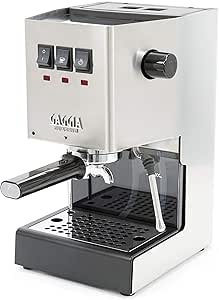 | Best for Traditional Espresso Control | Type: Semi-automatic espresso machine | Portafilter: 58 mm commercial-style | Output pressure: 9 bar | VIEW LATEST PRICE | See Our Full Breakdown |
| Breville Barista Touch Espresso Machine, Brushed Stainless Steel (BES880BSS) |  | Best for Guided Custom Drinks | Operation mode: Fully automatic | Grinder: Integrated precision conical burr grinder | Heating system: ThermoJet; reaches extraction temperature in 3 seconds | VIEW LATEST PRICE | See Our Full Breakdown |
| De’Longhi La Specialista Opera Espresso Machine with Coffee Grinder |  | Best for One-Machine Drink Variety | Operation mode: Semi-automatic | Grinder: Built-in burr grinder with 15 settings | Output pressure: 19 bar | VIEW LATEST PRICE | See Our Full Breakdown |
| Gaggia Classic E24 Semi-Automatic Espresso Machine, Cherry Red |  | Best for Hands-On Traditional Espresso | Operation: Semi-automatic | Portafilter: 58 mm | Extraction pressure: 9 bar | VIEW LATEST PRICE | See Our Full Breakdown |
| Gemilai G3028A Semi-Automatic Espresso Machine with Automatic Milk Frother |  | Best for Temperature-Controlled Milk Drinks | Machine type: Semi-automatic espresso machine | Brew boiler capacity: 550 ml | Water tank capacity: 57 oz | VIEW LATEST PRICE | See Our Full Breakdown |
| prosumer espresso machine | Dimensions |
|---|---|
| De’Longhi La Specialista Touch | — |
| Fellow Espresso Series 1 Espre | 23.07 × 14.57 × 12.6 in (D × W × H) |
| Breville Barista Express Espre | 13.8 × 12.5 × 15.9 in |
| Breville Barista Pro Espresso | 13 × 14 × 16 in (D × W × H) |
| De’Longhi Classic Matte Black | 11.22 × 13.98 × 15.94 in |
| AMZCHEF Espresso Machine with | 12.5 × 10.82 × 13.38 in |
| De’Longhi Classic Signature Es | 11.22 × 13.98 × 15.94 in (D × W × H) |
| Gaggia Classic E24 Semi-Automa | 8 × 9.5 × 14.2 in (D × W × H) |
| Breville Barista Touch Espress | — |
| De’Longhi La Specialista Opera | 17.72 × 17.83 × 21.38 in |
| Gaggia Classic E24 Semi-Automa | 8 × 9.5 × 14.2 inches |
| Gemilai G3028A Semi-Automatic | — |
More Details on Our Top Picks
De’Longhi La Specialista Touch Espresso Machine with Coffee Grinder
The La Specialista Touch suits buyers who want fresh-ground espresso with a guided route through each step. Its 15-setting burr grinder and on-screen recipes bring grinding, brewing, and milk preparation together, while adjustable froth and temperature options give it more drink flexibility than the simpler De’Longhi Classic. Cold Extraction also adds a quick cold-brew option without another appliance. That convenience comes with a larger footprint and a busier feature set, so it is less appealing for a small counter or someone who wants a minimal routine. Compared with the Fellow Espresso Series 1, it includes a grinder but offers less emphasis on pressure profiling. I’d choose it for guided variety and an integrated workflow over hands-on shot experimentation.
Pros:- Integrated conical burr grinder with 15 grind settings
- Guided touchscreen and 10 preset recipes help structure drink preparation
- Automatic frother offers five froth levels and four temperature settings
- Cold Extraction makes cold brew without a separate machine
Cons:- Large footprint can be difficult to fit in a compact kitchen
- Many settings and functions may feel involved for buyers seeking simple operation
Best for: Home espresso drinkers who want an integrated grinder, guided recipes, and several milk and cold coffee options
Not ideal for: People with limited counter space or buyers who prefer a simple machine with few settings
- Grinder:Italian-made conical burr
- Grind settings:15
- Touch display:3.5-inch high-resolution
- Preset recipes:10
- Milk froth levels:5
- Milk temperature settings:4
- Cold brew time:Under 5 minutes
- Included accessories:Portafilter, filter baskets, precision tamper, milk jug, dosing and tamping guide, tamping mat
Our verdict“Choose the La Specialista Touch if guided, varied drinks and a built-in grinder matter more than a compact setup or pressure profiling.”
Fellow Espresso Series 1 Espresso Machine with Pressure Profiling
The Fellow Espresso Series 1 is the pick for buyers who want help refining espresso without giving up control. Its pressure profiling, adjustable temperature, and shot feedback make it more suited to experimenting with extraction than the recipe-led De’Longhi La Specialista Touch. On-screen guidance and a temperature-sensing steam wand can also help newer users build technique, while a heat-up time under two minutes keeps the wait short. The main tradeoff is that it takes ground coffee, so a grinder must be part of the setup; the Barista Express is more self-contained with its integrated grinder. Its two-liter capacity may also call for refills during a run of drinks. I’d favor this machine when brew control matters more than an all-in-one counter setup.
Pros:- Pressure profiling supports control over shot extraction
- Shot feedback and on-screen recipes can guide adjustments
- Adjustable temperature and assisted milk steaming offer room to refine technique
- Heats in under two minutes and includes a 58 mm portafilter
Cons:- Requires ground coffee, so a separate grinder is needed for whole beans
- Two-liter water capacity may need frequent refilling during repeated drink preparation
Best for: Espresso drinkers who already own a capable grinder and want guided shot feedback plus room to experiment with pressure and temperature
Not ideal for: Buyers who want an integrated grinder or regularly make many drinks without stopping to refill the tank
- Type:Semi-automatic espresso machine
- Coffee input:Ground coffee
- Water capacity:2 liters
- Dimensions:23.07 × 14.57 × 12.6 in (D × W × H)
- Portafilter:58 mm bottomless
- Heating time:Under 2 minutes
- Included baskets:18 g single-wall and 18 g pressurized
- Warranty:2 years standard
Our verdict“Pick the Espresso Series 1 if you value feedback and pressure control and are prepared to supply your own grinder.”
Breville Barista Express Espresso Machine, Black Sesame
The Barista Express earns its place for buyers who want to grind and brew on one machine while keeping espresso preparation hands-on. Its integrated conical burr grinder doses into the portafilter, and PID temperature control with low-pressure pre-infusion supports a more controlled extraction. That makes it more self-contained than the Fellow Espresso Series 1, which requires ground coffee, but less guided than the De’Longhi La Specialista Touch. The tradeoff is manual milk texturing: buyers need to learn the steam wand rather than rely on automatic frothing. Its 67-ounce tank and half-pound hopper support home use, though the machine still needs routine refilling. I’d choose it for a traditional barista workflow with the grinder built in, not for maximum automation or the fastest heat-up.
Pros:- Integrated conical burr grinder doses directly into the portafilter
- PID temperature control and low-pressure pre-infusion support controlled extraction
- Steam wand can create microfoam for milk drinks
- 67-ounce water tank and half-pound bean hopper suit regular home use
Cons:- Milk texturing requires manual practice and attention
- Limited to 120 V power
- One-year limited warranty is shorter than the Fellow Espresso Series 1’s stated two-year warranty
Best for: Home espresso learners who want a built-in grinder, adjustable brewing technique, and manual milk steaming
Not ideal for: People who want automatic milk frothing, minimal hands-on preparation, or operation outside 120 V power
- Type:Semi-automatic espresso machine
- Grinder:Integrated precision conical burr
- Water tank capacity:67 oz
- Bean hopper capacity:1/2 lb
- Power:1600 W
- Voltage:120 V
- Dimensions:13.8 × 12.5 × 15.9 in
- Weight:22.1 lb
Our verdict“Choose the Barista Express if you want an integrated grinder and are willing to learn manual espresso and milk preparation.”
Breville Barista Pro Espresso Machine with Grinder, Brushed Stainless Steel
The Barista Pro is aimed at hands-on espresso drinkers who want an integrated grinder and a short wait before brewing. Its ThermoJet system reaches extraction temperature in three seconds, a clear convenience edge over the Barista Express, while PID control and low-pressure pre-infusion support repeatable shots. An LCD shows grinding and extraction progress, but milk steaming remains manual, so the machine rewards practice rather than removing that step. Like the Barista Express, it includes a grinder and makes more sense for whole-bean users than the ground-coffee-only Fellow Espresso Series 1. Its half-pound hopper and 67-ounce tank still need attention with frequent use. I’d pick it over the Express when quick start-up is a priority and keep the Express in mind for buyers who value a simpler, slower routine.
Pros:- ThermoJet reaches extraction temperature in three seconds
- Integrated conical burr grinder with dose control
- Digital PID and low-pressure pre-infusion support controlled brewing
- LCD displays grinding and extraction progress
Cons:- Grinding, extraction, and milk texturing require hands-on operation
- Half-pound hopper and 67-ounce water tank may need refilling with frequent use
- Limited to 120 V power
Best for: Whole-bean espresso drinkers who want manual control and a very fast heat-up for frequent home use
Not ideal for: Buyers who want automatic milk preparation or prefer a machine that requires little hands-on technique
- Model:BES878BSS
- Heating system:ThermoJet
- Heat-up time:3 seconds
- Temperature control:Digital PID, ±2°C
- Bean hopper capacity:1/2 lb
- Water tank capacity:67 oz (2 liters)
- Dimensions:13 × 14 × 16 in (D × W × H)
- Warranty:2-year limited product warranty
Our verdict“Choose the Barista Pro if fast start-up and a built-in grinder matter more than automatic preparation.”
De’Longhi Classic Matte Black Espresso Machine with Milk Frother
The De’Longhi Classic is the straightforward option in this group: it uses ground coffee, offers single- and double-shot presets, and has a milk frother for dairy or plant-based drinks. Its 9-bar brewing pressure, Thermoblock temperature control, and automatic shut-off cover the basics without the layered controls found on the La Specialista Touch. The tradeoff is less room to grow: there is no built-in grinder, and the listed materials include plastic. Compared with the Barista Express, it asks less of the buyer during preparation but gives up the integrated grinder and more involved extraction features. Its adjustable drip tray helps fit different cups, though its stated dimensions still call for a measured counter space. I’d choose it for uncomplicated espresso at home or in an office, rather than a technique-focused setup.
Pros:- Single- and double-shot presets simplify preparation
- 9-bar pressure and Thermoblock temperature control support consistent brewing
- Milk frother works with dairy and plant-based alternatives
- Adjustable drip tray accommodates different cup and glass sizes
Cons:- Uses ground coffee and has no integrated grinder
- Plastic is among the listed materials
- Offers fewer hands-on extraction controls than the Barista Express
Best for: Home or office buyers who use pre-ground coffee and want preset shots with basic milk frothing
Not ideal for: Whole-bean enthusiasts seeking an integrated grinder, greater extraction control, or a mostly metal construction
- Model:EM350BK
- Type:Espresso machine
- Pressure:9 bar
- Coffee input:Ground coffee
- Water tank:Removable
- Dimensions:11.22 × 13.98 × 15.94 in
- Weight:9.3 lb
- Power:1350 W, 120 V
Our verdict“Choose the De’Longhi Classic if you want preset espresso and basic milk frothing without managing a separate grinder workflow.”
AMZCHEF Espresso Machine with Built-In Grinder
The AMZCHEF gives hands-on home baristas a broad set of adjustments without a separate grinder: 44 grind settings and a 190°F–201°F brewing range let you tune the recipe to different beans. Its touchscreen and one-touch cold brew mode add convenience, while the 60-ounce tank means fewer refills during a run of drinks. Compared with the De’Longhi Classic Signature, which uses ground coffee and offers simpler espresso presets, the AMZCHEF is better suited to buyers who want to start with whole beans and adjust more variables. That flexibility comes with more involvement: it is semi-automatic, so preparing each drink takes more attention than a preset-focused machine. The stated capacity detail is unclear, too, so I would not rely on it when planning batch size.
Pros:- Built-in grinder offers 44 settings for dialing in different beans.
- Adjustable brewing temperature provides control across roasts.
- 60-ounce removable water tank reduces refill frequency.
- Touchscreen and cold brew mode add accessible drink options.
Cons:- Semi-automatic preparation requires more hands-on work than preset-driven machines.
- The stated 6-ounce capacity specification is unclear.
- At 13.9 pounds, it is less substantial than heavier machines such as the Gaggia Classic E24.
Best for: Home baristas who want an integrated grinder and room to adjust grind and brew temperature for different beans.
Not ideal for: Buyers who want minimal preparation or clear, documented drink-capacity guidance before choosing a machine.
- Type:Semi-automatic espresso machine
- Grind settings:44
- Brewing temperature:190°F–201°F
- Water tank:60 oz
- Steam wand:8 mm stainless steel
- Wattage:1500 W
- Dimensions:12.5 × 10.82 × 13.38 in
Our verdict“Choose the AMZCHEF if you want broad bean and temperature adjustments in one machine and are comfortable with hands-on brewing.”
De’Longhi Classic Signature Espresso Machine with Adjustable Milk Frother
The Classic Signature puts straightforward espresso presets and flexible milk frothing ahead of grinder control. One-touch single and double shots shorten the routine, and its dual-mode frother accommodates dairy and plant-based milk. The visual pressure gauge gives a brewing cue, while the adjustable drip tray makes space for taller cups. Compared with the Breville Barista Touch, it asks less of the buyer during shot preparation but gives up an integrated grinder, saved custom drinks, and automatic milk texturing. That makes it a practical fit for someone who already buys ground coffee and wants a compact, uncomplicated espresso setup. Its 9.3-pound weight is easy to accommodate, though the ground-coffee input limits the path for dialing in whole beans from the machine itself.
Pros:- Single and double espresso presets simplify routine preparation.
- Dual-mode frother supports dairy and plant-based milk.
- Adjustable double-height drip tray accommodates different drinkware.
- Compact 9.3-pound design is easier to place than heavier machines such as the Gaggia Classic E24.
Cons:- Uses ground coffee rather than whole beans from an integrated grinder.
- Offers less grind and drink customization than the Breville Barista Touch.
- Corded 120-volt operation limits placement to a suitable outlet.
Best for: Buyers who use pre-ground coffee and want one-touch espresso with milk options for dairy or plant-based drinks.
Not ideal for: Whole-bean enthusiasts who want an integrated grinder or custom drink profiles.
- Operation mode:Fully automatic
- Pump pressure:15 bar
- Coffee input:Ground coffee
- Espresso presets:Single and double
- Milk frother:Adjustable, dual-mode
- Water tank:Removable
- Dimensions:11.22 × 13.98 × 15.94 in (D × W × H)
Our verdict“Pick the Classic Signature if you want preset espresso and flexible milk frothing with pre-ground coffee.”
Gaggia Classic E24 Semi-Automatic Espresso Machine, Brushed Stainless Steel
The Gaggia Classic E24 is the most hands-on pick here for buyers who value commercial-style brewing hardware over touchscreen convenience. Its 58 mm portafilter and included single, double, and pressurized baskets give users different ways to prepare a shot, while the commercial steam wand supports milk texturing and latte art. The updated boiler is designed to resist scale buildup and corrosion. Compared with the AMZCHEF, the Gaggia has no built-in grinder or touchscreen, but its portafilter format makes it a stronger match for buyers who want a traditional workflow and are willing to source a grinder separately. The tradeoff is a more involved routine and a 20-pound body that is less convenient to move. It accepts ground coffee and pods, though pods do not replace the control of grinding fresh beans.
Pros:- 58 mm commercial-style portafilter supports a traditional espresso workflow.
- Includes commercial single, double, and pressurized baskets.
- Commercial steam wand supports milk frothing and latte art.
- Updated boiler is designed to resist scale buildup and corrosion.
Cons:- Semi-automatic preparation calls for hands-on grinding, dosing, and shot management.
- No built-in grinder, unlike the AMZCHEF and Breville Barista Touch.
- At 20 pounds, it is relatively heavy for repositioning.
Best for: Espresso enthusiasts who want a traditional portafilter workflow, commercial-style accessories, and room to build a separate grinder setup.
Not ideal for: Buyers who want a grinder included, touchscreen guidance, or a light machine that is easy to move.
- Type:Semi-automatic espresso machine
- Portafilter:58 mm commercial-style
- Output pressure:9 bar
- Water capacity:2.1 liters
- Included baskets:Commercial single-shot, commercial double-shot, pressurized double-shot
- Wattage:1200 W
- Dimensions:8 × 9.5 × 14.2 in (D × W × H)
Our verdict“Choose the Gaggia Classic E24 if traditional portafilter control matters more to you than built-in grinding and convenience features.”
Breville Barista Touch Espresso Machine, Brushed Stainless Steel (BES880BSS)
The Barista Touch combines an integrated conical burr grinder, touchscreen drink setup, and an automatic steam wand, making it the most guided choice in this batch for whole-bean espresso and milk drinks. Its PID temperature regulation and low-pressure pre-infusion support control over extraction, while saved custom profiles let household members keep preferred drinks close at hand. Compared with the De’Longhi Classic Signature, it offers whole-bean grinding, adjustable milk texture, and custom drink saving; the De’Longhi is simpler for buyers already using ground coffee. The Touch still leaves some setup and adjustment to the user, so its interface does not make it a fully hands-off drink maker. The listed voltage is 220 V, while another source specification gives 110–120 V, so buyers should confirm the version’s electrical requirements before purchase.
Pros:- Integrated conical burr grinder handles whole beans on demand.
- Automatic steam wand adjusts milk temperature and texture.
- Touchscreen supports up to eight custom drinks.
- ThermoJet system reaches extraction temperature in three seconds.
Cons:- The listed voltage conflicts between 220 V and 110–120 V specifications.
- Water tank and bean hopper may need refilling during frequent use.
- Less traditional portafilter control than the Gaggia Classic E24.
Best for: Households that want whole-bean espresso, guided touchscreen controls, adjustable automatic milk texturing, and saved drink profiles.
Not ideal for: Buyers who need a clearly confirmed voltage for their region or want the most traditional manual portafilter workflow.
- Operation mode:Fully automatic
- Grinder:Integrated precision conical burr grinder
- Heating system:ThermoJet; reaches extraction temperature in 3 seconds
- Temperature control:PID digital temperature regulation
- Water tank:67 fl oz
- Bean hopper:1/2 lb
- Drink settings:5 pre-programmed favorites; up to 8 custom drinks
- Voltage:Listed as 220 V; another source specification gives 110–120 V
Our verdict“Choose the Barista Touch if you want guided whole-bean espresso and customizable milk drinks, after confirming the correct voltage for your region.”
De’Longhi La Specialista Opera Espresso Machine with Coffee Grinder
The La Specialista Opera is built for buyers who want espresso, milk drinks, and cold options from one substantial countertop machine. Its burr grinder has 15 settings, and smart tamping is designed to make puck preparation more even with less mess. Three infusion temperatures add some recipe control, while the commercial-style steam wand gives practiced users a route to microfoam. Compared with the AMZCHEF, it has fewer grinder settings but adds five named beverage presets, including Americano and cold brew. It is also much heavier at 28.1 pounds and has a large listed footprint, so counter space matters. Semi-automatic operation means the presets do not remove every hands-on step; buyers seeking a compact, mostly automated routine may prefer the De’Longhi Classic Signature.
Pros:- Built-in burr grinder provides 15 settings and single or double dosing.
- Smart tamping is designed to create an even tamp with less mess.
- Three infusion temperatures let users adjust brewing for different beans.
- Five presets include espresso, Americano, cold brew, espresso cool, and hot water.
Cons:- Semi-automatic workflow still requires hands-on preparation.
- At 28.1 pounds, it is heavier than the AMZCHEF and harder to move.
- Listed dimensions of 17.72 × 17.83 × 21.38 inches require substantial counter space.
Best for: Home baristas who want an integrated grinder, guided tamping, milk texturing, and both hot and cold beverage options.
Not ideal for: Small-kitchen buyers or anyone who wants compact dimensions and minimal hands-on preparation.
- Operation mode:Semi-automatic
- Grinder:Built-in burr grinder with 15 settings
- Output pressure:19 bar
- Infusion temperatures:3
- Beverage presets:Espresso, Americano, cold brew, espresso cool, hot water
- Wattage:1450 W
- Dimensions:17.72 × 17.83 × 21.38 in
- Weight:28.1 lb
Our verdict“Pick the La Specialista Opera if you want broad hot and cold drink options with an integrated grinder and have room for a large, hands-on machine.”
Gaggia Classic E24 Semi-Automatic Espresso Machine, Cherry Red
The Gaggia Classic E24 suits buyers who want a traditional espresso workflow with a substantial 58 mm portafilter and a steam wand for manual milk texturing. Its stated 9-bar extraction and included single- and double-shot baskets give ground-coffee users room to learn and adjust their routine; an ESE pod basket also offers a simpler option. Compared with the Breville Barista Touch, this Gaggia leaves more of the preparation to you and does not include a built-in grinder or touchscreen guidance. That hands-on approach is its appeal for people developing barista skills, but it adds steps to every drink. The 1.3-liter reservoir and 20-pound weight also make it a more deliberate countertop fixture than a lightweight, quick-serve machine. Its cherry-red finish adds color, while the mixed brass, plastic, and stainless-steel construction is less uniformly metal than the painted steel exterior might suggest.
Pros:- 58 mm portafilter and commercial-style baskets support a familiar, flexible espresso workflow.
- Manual steam wand allows practice with milk texture for cappuccinos and latte art.
- Includes baskets for ground coffee and ESE pods.
- Compact 8-inch width suits counters with limited side-to-side space.
Cons:- Semi-automatic brewing and manual frothing require more skill and attention than the Breville Barista Touch.
- No built-in grinder, so buyers need separate equipment for whole beans.
- At 20 pounds, it is less convenient to move or store between uses.
Best for: Espresso drinkers who already own a grinder and want to practice dosing, tamping, and manual milk texturing on a 58 mm system.
Not ideal for: Buyers who want guided touchscreen drinks, an integrated grinder, or one-touch milk preparation; the Gaggia requires hands-on brewing and frothing.
- Operation:Semi-automatic
- Portafilter:58 mm
- Extraction pressure:9 bar
- Water capacity:1.3 liters
- Power:1200 W
- Dimensions:8 × 9.5 × 14.2 inches
- Weight:20 pounds
- Color:Cherry red
Our verdict“Choose the Gaggia Classic E24 if you want a compact, hands-on 58 mm machine for building traditional espresso skills and already have a grinder.”
Gemilai G3028A Semi-Automatic Espresso Machine with Automatic Milk Frother
The Gemilai G3028A pairs hands-on espresso settings with unusually guided milk preparation for this group. Its dual PID temperature control manages brew and steam temperatures independently, while the automatic frother offers adjustable settings from 104 to 194°F. That combination makes it more appealing for repeatable milk drinks than the Gaggia Classic E24, whose steam wand asks you to texture milk yourself. For the espresso side, a touchscreen, pre-infusion, and an adjustable 6–11-bar extraction range offer room to experiment, though manual pressure and brew adjustments take practice. The 58 mm brewing system keeps it aligned with prosumer-style equipment, but its listed 550 ml brew boiler and 57 oz water tank are different capacities; frequent drink makers may still need to refill the tank. This pick favors configurable drinks and convenience over a purely manual routine.
Pros:- Dual PID control independently manages brewing and steaming temperatures.
- Automatic frother has adjustable temperature settings for different milk drinks.
- Adjustable 6–11-bar extraction pressure and pre-infusion allow brewing experimentation.
- Removable water tank and detachable drip tray simplify routine cleaning.
Cons:- Manual pressure and brew adjustments may have a learning curve.
- The 57 oz water tank may need refilling during frequent use.
- Automatic frothing offers less direct control over milk texture than the Gaggia Classic E24’s manual wand.
Best for: Milk-drink households that want adjustable froth temperature and brew controls, with enough interest to learn the machine’s settings.
Not ideal for: Buyers who prefer a simple manual machine or make many drinks between refills; its adjustable settings take practice and the tank may need frequent filling.
- Machine type:Semi-automatic espresso machine
- Brew boiler capacity:550 ml
- Water tank capacity:57 oz
- Adjustable extraction pressure:6–11 bar
- Temperature control:Dual PID
- Portafilter:58 mm
- Frothing temperature range:104–194°F
- Power:1450 W
Our verdict“Pick the Gemilai G3028A if adjustable brewing and temperature-controlled automatic milk frothing matter more to you than a fully manual workflow.”
How We Picked
I ranked these machines by how well their design fits the needs of a prosumer home setup: repeatable espresso preparation, useful control over extraction, practical milk steaming, durable-feeling construction, and a workflow that makes sense day after day. I also weighed the learning curve, cleaning demands, counter footprint, and whether an integrated grinder makes setup simpler or limits future upgrades.
The ranking favors machines with a strong balance of control and usability, rather than treating the longest feature list as the winner. That puts the Barista Pro first for its mix of integrated grinding and direct workflow, while the Fellow Series 1 earns a distinct place for pressure profiling. Guided and milk-focused machines rank well for convenience, and the Gaggia Classic E24 models suit buyers willing to take a more hands-on route. The two Gaggia finishes are separate listings with the same core model, so color alone does not change their functional standing.
Factors to Consider When Choosing Best Prosumer Espresso Machines
Before choosing a machine, I would match its workflow to the way you actually make coffee. A prosumer label does not guarantee the same degree of control: some machines guide or automate key steps, while others leave more decisions to you.
Decide How Much Control You Will Use
More adjustment only helps when you want to make and repeat those adjustments. Pressure profiling and hands-on extraction can make experimentation more engaging, but they also add variables that can frustrate someone who wants a dependable morning drink. Guided controls reduce the number of decisions, though they may leave less room to change how a shot develops. Think about whether you enjoy dialing in beans or prefer a repeatable routine. A common mistake is paying for controls that rarely get used. Choose the machine whose learning curve feels appealing after the novelty wears off.
Treat the Grinder as Half the Setup
Espresso requires fine, consistent adjustments, so grinder capability affects how much control a machine can deliver. An integrated grinder reduces clutter and makes a single purchase easier to set up, but it also ties grinder replacement to the machine decision. A separate grinder can be upgraded independently and can keep working if you replace the espresso machine. Before choosing an all-in-one unit, check whether its adjustment range suits the beans and dose sizes you expect to use. Avoid assuming that a built-in grinder is automatically the more convenient choice if you already own a capable one. The best arrangement is the one that supports consistent preparation without creating redundant equipment.
Match Milk Preparation to Your Drinks
If you mostly drink espresso or Americanos, a machine’s milk system may matter less than its shot workflow and cleaning routine. Cappuccino and latte drinkers should weigh steam power, pitcher handling, and whether milk texturing is manual or guided. Assisted frothing can lower the skill barrier, but a manual wand offers more practice-based control over texture. Consider how many milk drinks you make in one session; repeated steaming and cleanup can shape the daily experience more than a single drink feature. A frequent mistake is choosing automation without checking what parts need rinsing after each use. Prioritize the milk workflow you will repeat, not the one that looks most advanced on a feature list.
Plan for the Full Countertop Footprint
The listed machine dimensions do not tell the whole story. Leave room to access the water tank, remove the drip tray, handle a portafilter, and set down a milk pitcher. Integrated grinders cut down on separate equipment, yet their hoppers and bean access still need clearance. A compact-looking machine can feel awkward if cabinets limit access or there is no nearby space for a scale and tamper. Measure the depth with the machine in its usable position, including room to refill and clean it. This check matters especially in small kitchens, where daily access can outweigh extra controls.
Choose a Maintenance Routine You Can Keep
Espresso machines need regular attention to coffee residue, milk contact points, water, and removable parts. More automated milk preparation can simplify technique while adding components that need prompt cleaning. Manual systems have fewer guided steps, but they still require wiping and purging the steam wand after use. Look for a routine that fits the time you have after each drink, along with the maker’s instructions for deeper cleaning and descaling. Hard water can raise maintenance demands, so check whether you can follow the machine’s water guidance in your home. A machine that is easier to maintain consistently is more useful than one whose upkeep becomes a chore.
Pay for Flexibility Only When It Solves a Real Need
Extra controls, automation, or an all-in-one design should solve a specific problem in your routine. Pressure profiling is most valuable to someone who wants to experiment with extraction, while guided drink settings make more sense when several people share the machine. Paying for both kinds of capability may add complexity without improving the drinks you make most often. If your technique is likely to grow, consider whether the machine can accommodate that learning or whether a separate grinder gives you a clearer upgrade path. Do not compare machines by feature count alone. Write down your usual drinks and the parts of preparation you want the machine to handle before deciding where added capability is worthwhile.
Frequently Asked Questions
Is a built-in grinder a good choice if I may upgrade later?
It is a practical choice if you are starting without an espresso grinder and want a tidier setup. The tradeoff is that grinder and machine upgrades become linked, so changing one part may leave you with a redundant feature. A separate grinder gives you more freedom to improve grinding while keeping the espresso machine. If you already own a suitable grinder, prioritize the machine’s brewing and milk workflow instead of paying for another one. Think about your likely next upgrade before choosing an all-in-one design.
Should I choose pressure profiling or guided drink controls?
Choose pressure profiling if you want to experiment with extraction and are willing to repeat shots while adjusting variables. Guided controls suit buyers who prefer a more directed routine or share the machine with people who want fewer steps. Those approaches solve different problems, so neither is automatically more capable for every household. Consider who will make drinks most often and how much they want to learn. If you value both experimentation and convenience, decide which one matters more in your everyday routine.
Do I need automatic milk frothing for lattes and cappuccinos?
No, but milk preparation can be a major part of the learning curve if you make these drinks often. Automatic or guided frothing can make it easier to get started, while a manual wand gives you more direct control over texture as your technique develops. The right choice depends on whether you enjoy practicing that skill or want the machine to simplify it. Check the cleanup steps as well as the frothing method, since milk-contact parts need attention after use. For a household with different skill levels, ease of repetition may matter more than maximum control.
Are the two Gaggia Classic E24 listings functionally different?
The two entries name the same Gaggia Classic E24 model in different finishes: brushed stainless steel and cherry red. Based on the product names provided, the finish is the stated difference, not a separate brewing role. Compare the seller’s exact listing and included accessories before ordering, since bundles can vary. For the machine choice itself, weigh its hands-on semi-automatic workflow against the more integrated options in this roundup. Pick the color that suits your kitchen only after confirming the listing details.
How much counter space should I leave around an espresso machine?
Allow space beyond the machine’s footprint for water access, portafilter handling, a milk pitcher, and routine cleaning. Check cabinet clearance above the machine if the water tank or bean hopper lifts upward. You may also want a scale and a place to set down accessories, even if they are not built into the machine. Measure the depth in the position where you will actually brew, including room to reach controls and remove the drip tray. A well-fitting setup is easier to use every day than one that only fits on paper.
Conclusion
For the broadest mix of integrated grinding and hands-on workflow, I recommend the Breville Barista Pro as best overall. Buyers looking for a more accessible all-in-one routine can compare the Breville Barista Express and the grinder-equipped AMZCHEF as value-oriented options, while checking the exact workflow and features of each listing. For pressure-profile experimentation, choose the Fellow Espresso Series 1; for a guided, milk-focused routine, consider the Barista Touch or Gemilai G3028A. The Barista Touch is my best pick for beginners who want guidance, while the Gaggia Classic E24 suits those who prefer a manual, traditional approach and are comfortable building their technique. The right choice comes down to whether you want the machine to guide, automate, or leave more of the process in your hands.