Choosing among the best zero-waste coffee pod machines depends on what “zero-waste” means in your kitchen. The Coulée Swirl Mini is my strongest pick for keeping plastic away from brewing water, while the Briggs brewer offers more flexibility with grounds and compatible compostable soft pods. The Willow accepts K-Cup pods as well as grounds, but its recycled-plastic construction and disposable-pod option make it a less direct fit for a low-waste routine.

Get coffee and tea gear delivered free with Prime
- Fast, free delivery on millions of items
- Prime Video, Amazon Music and more included
- Member-only deals all year
These machines do not eliminate waste in the same way. Coulée requires its compatible filters, Briggs can use a reusable grounds basket, and Willow’s most waste-conscious path is brewing loose grounds rather than relying on K-Cups. I compare them by their reusable or compostable brewing options, material choices, capacity, and how much convenience each gives up to reduce disposable components.
Complete the kit


Key Takeaways
- Coulée Swirl Mini is the clearest choice when a plastic-free water path matters more than using a universal reusable filter; it requires compatible EcoPour filters.
- Briggs combines a reusable 30 g grounds basket with compatible 61 mm compostable soft pods, and its 45 fl oz reservoir suits repeated single servings.
- Willow accepts both K-Cup pods and grounds, but its recycled-plastic body does not make disposable pods a zero-waste choice.
- For reducing routine pod waste, using loose grounds in a reusable basket is more direct than choosing a machine mainly for its compostable-pod compatibility.
- Capacity separates the lineup: Briggs holds 45 fl oz, Coulée brews up to 16 fl oz, and Willow is designed around 6–12 oz cups.
| Coulée Swirl Mini Plastic-Free Single-Serve Pour-Over Coffee Maker, White |  | Best Overall for a Plastic-Free Water Path | Coffee maker type: Pour-over | Brewing style: Automatic, single-serve | Water path: Plastic-free, from glass reservoir to stainless steel spout | VIEW LATEST PRICE | See Our Full Breakdown |
| Briggs Single-Serve Coffee Brewer for Ground Coffee and Soft Pods |  | Best for Flexible, Reusable Brewing | Model: BCC 2401 | Brew types: Ground coffee and compatible 61 mm soft pods | Ground coffee basket: Reusable, 30 g capacity | VIEW LATEST PRICE | See Our Full Breakdown |
| Willow Single-Serve K-Cup Coffee Maker with Strong Brew Option |  | Best for K-Cup Flexibility with a Grounds Option | Coffee input: K-Cup pods or ground coffee | Brew size: 6–12 oz | Capacity: 12 oz | VIEW LATEST PRICE | See Our Full Breakdown |
| zero-waste coffee pod machine | Dimensions | Capacity | Coffee input |
|---|---|---|---|
| Coulée Swirl Mini Plastic-Free | 4.5 × 9.75 × 13.25 in (D × W × H) | 16 fl oz | Ground coffee |
| Briggs Single-Serve Coffee Bre | 13.75 × 7.5 × 12 in | — | — |
| Willow Single-Serve K-Cup Coff | 5.14 × 8.62 × 11.79 in (D × W × H) | 12 oz | K-Cup pods or ground coffee |
More Details on Our Top Picks
Coulée Swirl Mini Plastic-Free Single-Serve Pour-Over Coffee Maker, White
The Coulée Swirl Mini is my top pick for buyers whose first priority is limiting plastic contact during brewing. Its water travels from a glass reservoir to a stainless steel spout, and the maker automatically rotates the pour over coffee grounds. That gives it a different low-waste emphasis from the Briggs: Coulée focuses on the brewing path and pour-over format, while Briggs focuses on switching between reusable grounds and compatible soft pods.
The machine’s 16 fl oz capacity is enough for a generous single serving, but it cannot match Briggs’s 45 fl oz reservoir if you regularly make several drinks without refilling. Coffee also does not touch the machine, which can simplify cleanup compared with a brewer that leaves coffee residue in an internal brew area. The tradeoff is that Coulée uses compatible EcoPour filters; the supplied 10 empty filters let you add your own grounds, but they do not remove the need for that filter format.
I rank it ahead of Willow because its stated water path directly addresses a material concern relevant to low-waste brewing, and ahead of Briggs for buyers who value that construction over larger capacity or pod flexibility. It is not a fully universal filter system, and the product details do not establish that its filters are compostable or reusable. That distinction matters: this is the most compelling choice here for plastic-free water contact, but buyers should check the ongoing filter arrangement before treating it as a near-zero-waste setup.
Pros:- Glass reservoir and stainless steel spout keep plastic out of the stated water path.
- Automatically rotates water over the grounds for pour-over style brewing.
- Coffee does not touch the machine, which can reduce residue and cleanup.
- Includes empty EcoPour filters for brewing with your own grounds.
Cons:- Requires compatible EcoPour filters, creating an ongoing supply dependency.
- The 16 fl oz capacity is smaller than Briggs’s 45 fl oz reservoir.
Best for: Buyers who want automated single-serve pour-over brewing and a plastic-free water path, and are comfortable using compatible EcoPour filters.
Not ideal for: Households that want a large reservoir, a universal reusable grounds basket, or freedom from proprietary filter requirements.
- Coffee maker type:Pour-over
- Brewing style:Automatic, single-serve
- Water path:Plastic-free, from glass reservoir to stainless steel spout
- Water temperature:Approximately 208°F at sea level
- Capacity:16 fl oz
- Coffee input:Ground coffee
- Dimensions:4.5 × 9.75 × 13.25 in (D × W × H)
- Included:Coffee maker and 10 empty EcoPour filters
Our verdict“Choose Coulée for its unusually clear plastic-free water path, provided its compatible filters fit your low-waste routine.”
Briggs Single-Serve Coffee Brewer for Ground Coffee and Soft Pods
For a routine built around reusable grounds brewing, the Briggs Single-Serve Coffee Brewer is the most flexible option in this group. Its reusable 30 g basket takes fresh grounds, and it also accepts compatible 61 mm compostable soft pods. That gives buyers a choice Coulée and Willow do not offer in the same way: loose grounds in a reusable basket for regular use, with a compostable pod option when portioned convenience is useful.
The generous 45 fl oz removable reservoir is a practical advantage over Coulée’s 16 fl oz capacity and Willow’s 12 oz capacity. It supports multiple servings before a refill, while programmable volumes let you adjust the amount brewed. Those conveniences make Briggs the strongest pick for an office or a household where people want individual cups without repeatedly filling a small tank.
There are two qualifications to its lower-waste case. First, only compatible 61 mm soft pods are supported; the product specifically excludes Senseo pods, so buyers should confirm their preferred format before choosing it. Second, the body is plastic, unlike Coulée’s plastic-free stated water path. Briggs therefore ranks behind Coulée for material-conscious buyers, but ahead of Willow for buyers who want a clearly described reusable basket and a larger water supply. Its best waste-saving feature is the reusable basket, not the mere fact that it accepts compostable pods.
Pros:- Reusable 30 g grounds basket supports brewing without disposable pods.
- Accepts compatible 61 mm compostable soft pods as an alternative.
- 45 fl oz removable reservoir reduces refills across multiple servings.
- Programmable brew volumes suit different cup sizes and routines.
Cons:- Plastic body makes it less appealing than Coulée for buyers focused on plastic-free construction.
- Does not accept Senseo pods, and compatibility is limited to the stated 61 mm format.
Best for: People who want a reusable grounds basket, a larger reservoir, and the option to use compatible compostable soft pods.
Not ideal for: Buyers seeking a plastic-free machine body or broad compatibility with every soft-pod format, including Senseo.
- Model:BCC 2401
- Brew types:Ground coffee and compatible 61 mm soft pods
- Ground coffee basket:Reusable, 30 g capacity
- Water capacity:45 fl oz
- Brew head:Stainless steel
- Body:Plastic
- Dimensions:13.75 × 7.5 × 12 in
- Features:Programmable volumes and removable water reservoir
Our verdict“Briggs is the most adaptable choice for reusable grounds brewing, especially when a large reservoir matters more than an all-plastic-free build.”
Willow Single-Serve K-Cup Coffee Maker with Strong Brew Option
The Willow Single-Serve K-Cup Coffee Maker is the most familiar format for buyers who already have K-Cups but want the option to brew loose grounds. It accommodates both inputs, offers 6–12 oz brew sizes, and includes a strong brew setting. Using grounds instead of a disposable K-Cup is the more direct lower-waste choice; the pod compatibility provides convenience, not a waste-free shortcut.
Willow’s strongest material detail is its use of 99% post-consumer recycled plastic. That can appeal to buyers who prefer recycled content in the appliance, but it does not change the waste created by single-use pods, and it differs from Coulée’s claim about keeping plastic out of the water path. The compact 2.7 lb design and removable reservoir may suit a small counter or occasional use; by comparison, Briggs is a better fit when reservoir capacity and a reusable basket are higher priorities.
Its limitations are clear: brewing is restricted to one cup at a time, and the stated 12 oz capacity is modest beside Briggs’s 45 fl oz tank. The product description mentions dishwasher-safe removable parts and automatic shutoff, which support routine care, but it does not provide detail about a reusable grounds accessory. I place Willow third because its recycled-plastic construction and grounds compatibility help, yet its central K-Cup compatibility is the least aligned with a zero-waste buying goal. It is best for someone who values format flexibility and compactness, then plans to choose grounds most of the time.
Pros:- Can brew either K-Cup pods or ground coffee.
- Uses 99% post-consumer recycled plastic.
- Offers adjustable 6–12 oz servings and a strong brew option.
- Compact body, removable reservoir, dishwasher-safe removable parts, and automatic shutoff.
Cons:- K-Cup use creates disposable pod waste, making it a weaker match for a zero-waste brief.
- Single-cup capacity is limited compared with Briggs’s 45 fl oz reservoir.
- The product details do not specify a reusable grounds basket.
Best for: K-Cup users who want a compact brewer and the option to switch to grounds for some or most servings.
Not ideal for: Buyers seeking a fully reusable brewing setup, multiple servings from one reservoir, or a plastic-free water path.
- Coffee input:K-Cup pods or ground coffee
- Brew size:6–12 oz
- Capacity:12 oz
- Brew strength:Adjustable, with strong brew option
- Material:99% post-consumer recycled plastic
- Operation:Semi-automatic
- Dimensions:5.14 × 8.62 × 11.79 in (D × W × H)
- Special features:Removable water reservoir, dishwasher-safe removable parts, automatic shutoff
Our verdict“Willow makes sense for a compact K-Cup-compatible machine when grounds remain a realistic everyday alternative.”
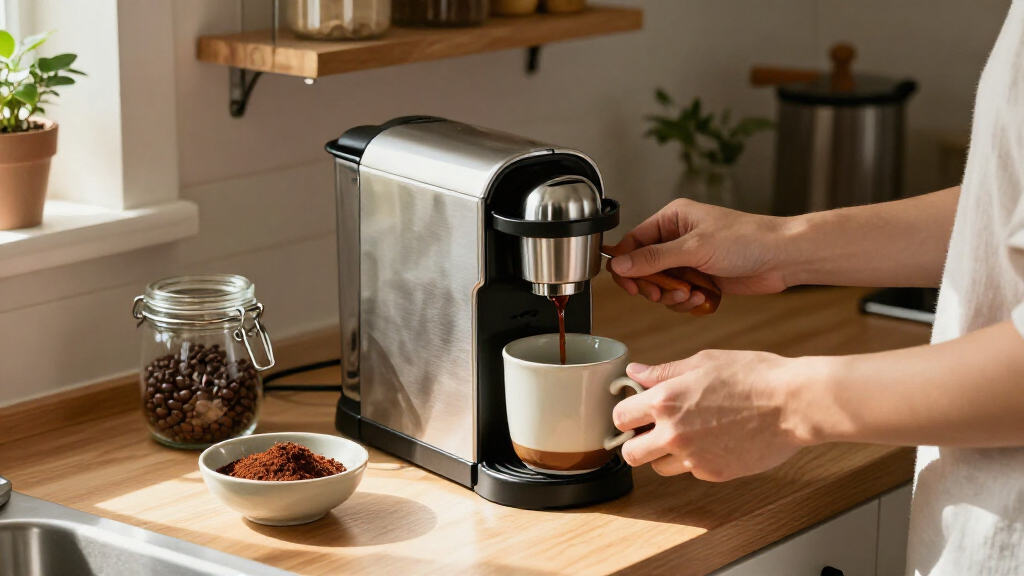
How We Picked
I ranked these brewers by how well their stated features support a lower-waste coffee routine, rather than treating pod compatibility as proof that a machine is zero-waste. I looked at whether each can brew loose grounds with reusable components, whether it supports compostable soft pods, and which materials touch the water or coffee. These details matter because a machine that accepts a disposable pod may still create recurring waste, while a reusable basket can make daily brewing less dependent on single-use portions.
I also compared the practical tradeoffs that can decide whether a lower-waste setup works day to day: water capacity, brew size, cleanup, input flexibility, and filter requirements. Coulée ranks first for its stated plastic-free water path and automated pour-over approach, though its compatible-filter dependency limits flexibility. Briggs follows as the most versatile pod-and-grounds brewer, with a notably larger reservoir and reusable basket, but a plastic body. Willow earns a place for accommodating grounds and using post-consumer recycled plastic, yet its K-Cup path is less aligned with the title’s low-waste promise. I use the supplied product details and make no claim of hands-on testing.
| zero-waste coffee pod machine | Coffee input |
|---|---|
| Coulée Swirl Mini Plastic-Free | Ground coffee |
| Briggs Single-Serve Coffee Bre | — |
| Willow Single-Serve K-Cup Coff | K-Cup pods or ground coffee |
Factors to Consider When Choosing Best Zero-waste Coffee Pod Machines
Before choosing a machine, I would decide which source of waste I am trying to reduce: disposable pods, single-use filters, plastic in the brewing path, or the packaging and grounds left after each cup. These models address different parts of that problem, so the right fit depends on the routine you will actually maintain.
Start with the daily coffee input
If you want to avoid single-use pods, look for a dependable way to brew loose grounds. Briggs names a reusable 30 g basket, while Coulée brews grounds through compatible EcoPour filters. Willow accepts grounds, though its supplied details do not specify a reusable basket. A machine’s pod compatibility is useful for convenience, but it does not make every cup low-waste. I would treat compostable pods as an occasional format choice and check local disposal guidance rather than assume they belong in a home compost bin.
Check filters and pod formats before buying
Compatibility determines which consumables you can realistically use. Coulée requires EcoPour filters, so buyers should understand whether those filters meet their own waste goals and remain easy to source. Briggs accepts compatible 61 mm soft pods but explicitly does not work with Senseo pods. Willow works with K-Cups, though those are still single-use portions. If you already own a particular pod format, confirm its fit; if you are buying for a reusable routine, compare the filter or basket requirements first.
Compare materials by the part they describe
Material claims are not interchangeable. Coulée specifies a plastic-free water path from a glass reservoir through a stainless steel spout. Briggs describes a stainless steel brew head but also a plastic body. Willow uses 99% post-consumer recycled plastic. Recycled content can reduce demand for virgin material, while a plastic-free water path addresses a different concern. I would decide which detail matters to me and avoid reading one material claim as proof that the entire appliance or brewing routine creates no waste.
Match reservoir size to serving habits
Briggs has the clear lead for repeated servings with its 45 fl oz reservoir. Coulée’s 16 fl oz capacity suits a larger single serving but means more frequent refilling in shared use. Willow is oriented around a single 6–12 oz cup. A larger reservoir can reduce interruptions, though it does not reduce pod waste by itself. For a one-person morning routine, a small machine may be enough; for a shared kitchen, a larger tank can make the reusable option easier to stick with.
Think about cleanup and routine friction
A lower-waste system only helps if it fits everyday habits. Coulée’s coffee does not touch the machine, which can reduce residue cleanup, while Briggs has a removable reservoir and reusable grounds basket to rinse. Willow lists dishwasher-safe removable parts. Consider how you prefer to clean grounds and filters, and whether emptying a basket feels manageable before work. Small convenience differences can decide whether you keep using grounds or return to individually packaged pods.
Set a realistic definition of zero-waste
None of these product descriptions establishes a completely waste-free lifecycle. Machines use electricity, coffee comes with its own packaging, and filters or pods may still be involved. I would use “zero-waste” as a buying lens: choose reusable grounds brewing where possible, minimize disposable accessories, and assess the machine’s materials and service life. By that measure, Coulée stands out for its water path, Briggs for its reusable basket, and Willow for offering a route away from K-Cups when you use grounds.
Frequently Asked Questions
Which machine is the best fit for a zero-waste coffee routine?
For a routine centered on loose grounds, Briggs is the clearest fit because it includes a reusable 30 g basket, while Coulée also brews grounds using its compatible EcoPour filters. Coulée is the stronger choice if plastic-free water contact is your main concern. Neither product description establishes that every accessory is reusable or compostable, so I would check the filter or pod details as part of the decision.
Are compostable soft pods the same as reusable coffee filters?
No. A compostable pod is a portioned, single-use product intended for composting under the conditions accepted by its material and local waste service; a reusable basket can be filled with grounds and used again. Briggs supports both compatible 61 mm compostable soft pods and a reusable grounds basket. I would not assume a pod is suitable for home composting without checking its labeling and local rules.
Does Willow’s recycled plastic make K-Cup brewing zero-waste?
No. Willow’s 99% post-consumer recycled plastic describes the material used for the machine, while K-Cups are a separate consumable used for each pod-brewed serving. The machine can also take ground coffee, which gives owners a way to reduce pod use. For this comparison, I count Willow’s recycled material as a positive construction detail, not evidence that disposable-pod brewing creates no waste.
Which brewer is best for making several cups before refilling?
Briggs is the best fit for that habit because its water reservoir holds 45 fl oz, substantially more than Coulée’s 16 fl oz capacity or Willow’s 12 oz capacity. That larger tank can reduce refills across a household or workday. It remains a single-serve brewer, so the larger reservoir supports repeated individual cups rather than a carafe-style batch.
What should I check about compatibility before choosing?
Check the exact pod or filter format and whether it matches the routine you intend to keep. Coulée requires compatible EcoPour filters. Briggs accepts compatible 61 mm soft pods but not Senseo pods, and Willow accepts K-Cups or grounds. If you plan to use grounds most often, confirm that the basket or filter setup is convenient and that you can obtain any required accessories.
Conclusion
For buyers who put plastic-free water contact first, I recommend the Coulée Swirl Mini, with the caveat that its compatible EcoPour filters are part of the ongoing routine. For a household that wants a reusable grounds basket, more reservoir capacity, and an occasional compatible soft pod, Briggs is the most flexible pick. For existing K-Cup users who want a compact machine and intend to shift some servings to grounds, Willow offers that bridge, though it is the least aligned with a strict low-waste goal. My choice would come down to the habit I want to make easiest: reducing plastic in the water path, replacing disposable pods with reusable grounds, or keeping a compact brewer while retaining K-Cup convenience.
Halloween Picks
halloween
As an affiliate, we earn on qualifying purchases.