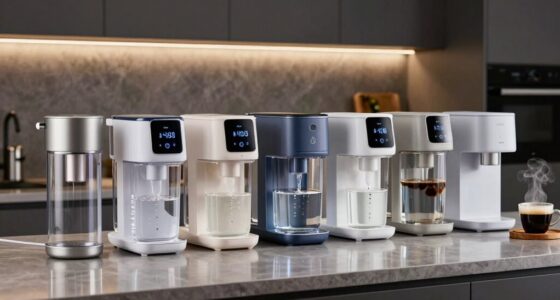
When I compare large capacity electric kettles, I look first at what “large” means for the way you serve. The NutriChef 19L urn is the clear choice for gatherings or a busy shared kitchen, while the NutriChef 5L dispenser offers a more manageable reserve with three ways to dispense water. For smaller households wanting precise temperatures, the Panasonic 3L dispenser trades sheer capacity for preset control and a slow-drip coffee mode.

Get coffee and tea gear delivered free with Prime
- Fast, free delivery on millions of items
- Prime Video, Amazon Music and more included
- Member-only deals all year
The key tradeoff is between storing hot water for repeated pours and boiling water in batches when needed. The two NutriChef units are designed around keeping a reserve ready; the Panasonic adds temperature choices in a smaller vessel. The DEZIN and TopWit are more conventional kettles, with capacities that are generous for a household but far below the urns. I rank these picks by how well their capacity, dispensing style, controls, and footprint serve a distinct buyer.
Complete the kit


Key Takeaways
- For serving a crowd without frequent refills, I’d choose the NutriChef 19L urn; its scale is useful at events but demands substantial counter space and is heavy when full.
- The NutriChef 5L dispenser is the middle ground for shared daily use, with air-pump, electric-pump, and touch-cup dispensing, though its 730-watt element is not the fastest.
- The Panasonic 3L dispenser suits buyers who value four preset temperatures and slow-drip coffee more than maximum capacity; it holds much less than either NutriChef.
- TopWit’s 2.5L capacity and 1200-watt element make it a more useful household batch kettle than DEZIN’s 2L model, while both remain far smaller than hot-water urns.
- A large reservoir is only helpful if its footprint, lifting demands, and serving method fit the space: the 19L NutriChef is for stationary service, while the smaller kettles are easier to handle.
| NutriChef 19L Water Boiler Hot Water Dispenser Urn |  | Best for Large Gatherings | Capacity: 19 liters | Wattage: 1100 watts | Voltage: 120 volts | VIEW LATEST PRICE | See Our Full Breakdown |
| NutriChef 5.2 Qt Electric Water Kettle with 5 Temperature Settings and Safety Lock |  | Best Mid-Size Hot Water Dispenser | Capacity: 5.2 quarts (5 liters) | Wattage: 730 watts | Voltage: 120 volts | VIEW LATEST PRICE | See Our Full Breakdown |
| Panasonic Electric Hot Water Dispenser with 4 Temperature Presets |  | Best for Temperature Choice | Capacity: 3.2 quarts (3 liters) | Temperature presets: 208°F, 190°F, 180°F, and 160°F | Display: LCD screen with water gauge | VIEW LATEST PRICE | See Our Full Breakdown |
| TopWit 2.5L Stainless Steel Electric Kettle |  | Best Household Batch Kettle | Capacity: 2.5 liters | Wattage: 1200 watts | Interior: 304 stainless steel | VIEW LATEST PRICE | See Our Full Breakdown |
| DEZIN 2L Electric Kettle, 1000W Fast Boil Stainless Steel Water Boiler |  | Best Simple Compact Kettle | Capacity: 2 liters | Power: 1000 watts | Voltage: 110 volts | VIEW LATEST PRICE | See Our Full Breakdown |
| large capacity electric kettle | Capacity | Dimensions | Safety | Wattage |
|---|---|---|---|---|
| NutriChef 19L Water Boiler Hot | 19 liters | 11.42 × 11.42 × 23.82 inches | — | 1100 watts |
| NutriChef 5.2 Qt Electric Wate | 5.2 quarts (5 liters) | 8.46 × 11.2 × 16.5 inches | Children’s safety lock and thermal safety cut-off | 730 watts |
| Panasonic Electric Hot Water D | 3.2 quarts (3 liters) | — | Safety lock | — |
| TopWit 2.5L Stainless Steel El | 2.5 liters | 9.06 × 7.28 × 10.04 inches | Automatic shut-off and boil-dry protection | 1200 watts |
| DEZIN 2L Electric Kettle | 2 liters | 9.25 × 7.72 × 7.62 inches | Automatic shut-off and boil-dry protection | — |
More Details on Our Top Picks
NutriChef 19L Water Boiler Hot Water Dispenser Urn
For the largest serving job in this lineup, I’d start with the NutriChef 19L urn. Its capacity is nearly four times the 5L NutriChef dispenser and more than six times the Panasonic’s 3L reservoir, making it the standout when many people need hot water over an extended stretch. The tap-based urn format also suits serving a group better than lifting and pouring a filled household kettle cup by cup.
The tradeoff follows directly from that scale. At 11.42 by 11.42 by 23.82 inches, this is a tall, bulky appliance, and the description warns that it is heavy when full. I’d plan a permanent spot near the serving area rather than treat it as something to move around. Its 1100-watt element is more powerful than the 730-watt one in the 5L NutriChef, but wattage alone does not establish how quickly a full 19L tank heats.
Double-layer insulation and a keep-warm function align with the urn’s purpose: holding water ready for multiple pours. A lock lid and overheat protection add useful safeguards for shared settings. Compared with the Panasonic, it gives up precise temperature presets and a compact footprint. Compared with the smaller NutriChef, it offers far more reserve but loses some flexibility for ordinary household counters.
Pros:- 19L capacity supports extended group service with fewer refills.
- Keep-warm function and double-layer insulation are suited to repeated pours.
- Safety lock lid and overheat protection are listed for shared use.
- 1100-watt heating element is stronger than the 5L NutriChef’s stated 730 watts.
Cons:- Tall, bulky footprint takes a dedicated counter or serving-table space.
- Heavy when filled, so moving it after refilling is impractical.
- No specific temperature presets are listed.
Best for: Hosts, community spaces, and office kitchens that need to serve hot water to many people from a stationary urn.
Not ideal for: Buyers with limited counter space, anyone who needs to carry a filled vessel, or households that only make a few cups at a time.
- Capacity:19 liters
- Wattage:1100 watts
- Voltage:120 volts
- Dimensions:11.42 × 11.42 × 23.82 inches
- Material:Stainless steel
- Special features:Keep-warm function, double-layer insulation, overheat protection, safety lock lid
Our verdict“I’d pick the 19L NutriChef for stationary group service when capacity matters more than compactness or fine temperature selection.”
NutriChef 5.2 Qt Electric Water Kettle with 5 Temperature Settings and Safety Lock
The NutriChef 5L dispenser earns the second spot because it keeps a meaningful reserve without taking on the 19L urn’s scale. For a shared home or a smaller office, 5 liters can cover several rounds of tea, coffee, or instant meals, and the three dispensing methods make access more adaptable than a standard pour kettle. The air pump works without relying on the electric pump, while the electric pump and touch-cup option offer other ways to dispense.
This is a dispenser that holds hot water, not a high-speed kettle for boiling a small amount on demand. Its stated 730-watt power is lower than the 1000 watts in DEZIN and 1200 watts in TopWit, and heating a full reserve may take patience. That lower power also makes it a different proposition from the 19L NutriChef, whose 1100-watt element serves a much larger tank. I would choose by serving pattern, not wattage in isolation.
A 304 stainless steel inner pot, child safety lock, and thermal safety cut-off give this model practical strengths for a household where the dispenser stays within reach. The detachable lid helps with access for cleaning, but the care instructions call for hand washing or wiping. Its plastic exterior also feels less suited to buyers who want an all-metal appearance. I rank it below the urn because it cannot serve as many people, but above the Panasonic for buyers who prioritize volume and dispensing flexibility over temperature precision.
Pros:- 5L capacity provides a larger reserve than the Panasonic 3L dispenser and either conventional kettle.
- Air-pump, electric-pump, and touch-cup options suit different serving situations.
- 304 stainless steel inner pot and thermal cut-off are practical everyday features.
- Child safety lock and detachable lid support safer access and refilling.
Cons:- 730-watt heating element is lower powered than the DEZIN and TopWit kettles.
- Hand washing or wiping requires more care than a dishwasher-safe design.
- Plastic exterior components may not suit buyers seeking an all-metal build.
Best for: Households or small shared kitchens that want several liters held ready and value more than one way to dispense.
Not ideal for: People who want the quickest small-batch boil, dishwasher-friendly cleanup, or the largest possible reserve for events.
- Capacity:5.2 quarts (5 liters)
- Wattage:730 watts
- Voltage:120 volts
- Dimensions:8.46 × 11.2 × 16.5 inches
- Weight:5.29 pounds
- Inner pot:304 stainless steel
- Dispensing:Air pump, electric pump, and touch-cup
- Safety:Children’s safety lock and thermal safety cut-off
Our verdict“I’d choose this NutriChef when a household-sized hot-water reserve and flexible dispensing matter more than fast batch boiling.”
Panasonic Electric Hot Water Dispenser with 4 Temperature Presets
The Panasonic NC-EG3000 is the specialist pick for buyers who want several water temperatures ready, rather than the biggest tank. Its 3L capacity is well below either NutriChef dispenser, but four presets—208°F, 190°F, 180°F, and 160°F—make it easier to match water to different drinks and foods without repeatedly boiling a full kettle. That control gives it a distinct role in this lineup.
The slow-drip coffee mode is another point of difference. It is aimed at drip coffee preparation, while the NutriChef units focus on dispensing stored hot water for general use and the DEZIN and TopWit simply boil water in batches. The LCD screen and water gauge help show the selected temperature and remaining supply. A six-hour energy-saving timer can suit a routine where water is needed at predictable times.
Capacity is the compromise: 3L is adequate for several servings, but the 5L NutriChef offers more of a reserve, and the 19L urn is in another class for group service. The listed footprint is described as large, so I would measure the intended space. The Panasonic’s four presets also stop short of fine-grained adjustment, and there is no built-in filtration system. I rank it third because its controls are compelling, though its volume is modest beside the top two.
Pros:- Four presets cover a range of beverage and food preparation needs.
- Slow-drip coffee mode differentiates it from the general-purpose dispensers.
- LCD screen, water gauge, and 360-degree base aid everyday use.
- Six-hour energy-saving timer supports predictable hot-water routines.
Cons:- 3L capacity is substantially smaller than the NutriChef 5L and 19L models.
- Four fixed presets do not provide fine temperature adjustment.
- No built-in water filtration system is listed, and its footprint may be large for compact counters.
Best for: Tea and coffee drinkers who want preset temperatures, a water gauge, and a slow-drip coffee mode in a 3L dispenser.
Not ideal for: Large events, buyers who want adjustable temperature steps beyond the four presets, or anyone needing integrated filtration.
- Capacity:3.2 quarts (3 liters)
- Temperature presets:208°F, 190°F, 180°F, and 160°F
- Display:LCD screen with water gauge
- Coffee feature:Slow-drip coffee mode
- Energy-saving timer:6 hours
- Base:360-degree rotating base
- Safety:Safety lock
- Interior coating:Bincho-tan charcoal and Diamond fluorine non-stick
Our verdict“I’d select the Panasonic for preset temperature control and coffee features, accepting less capacity than the NutriChef dispensers.”
TopWit 2.5L Stainless Steel Electric Kettle
The TopWit 2.5L kettle is the stronger household choice of the two conventional kettles here. Its capacity is 25% greater than DEZIN’s 2L vessel, which can mean fewer separate batches when serving several people. At 1200 watts, it also has the highest stated wattage among these five options, although I would not translate that figure into a guaranteed boil time without a direct measurement.
This model uses a 304 stainless steel interior and has automatic shut-off and boil-dry protection. Its removable lid and wide opening address a practical downside of enclosed kettles: reaching inside to fill and clean. Compared with the Panasonic, it has less capacity and no temperature presets or hot-water holding features. Compared with the 5L NutriChef, it asks the owner to boil batches instead of keeping a larger volume available.
The TopWit’s 2.5L is generous for a countertop kettle but remains a very different scale from the 5L and 19L dispensers. Its extra volume makes it a sensible choice for a family or small gathering where water is boiled as needed and the kettle will be poured by hand. I would skip it if the goal is uninterrupted service for a crowd. The listed food-grade PP components also mean the construction is not described as all metal, despite the stainless steel interior.
Pros:- 2.5L capacity exceeds the DEZIN kettle’s 2L.
- 1200-watt element is the highest stated wattage in this comparison.
- 304 stainless steel interior with automatic shut-off and boil-dry protection.
- Removable lid and wide opening make filling and interior access easier.
Cons:- Still holds far less water than either NutriChef dispenser.
- No temperature presets or keep-warm function are listed.
- Food-grade PP is included, so it is not specified as an all-metal construction.
Best for: Households that want a larger-than-typical batch kettle with a stainless steel interior and easy lid access.
Not ideal for: Office or event service requiring a continuous hot-water reserve, or buyers who want temperature presets and keep-warm dispensing.
- Capacity:2.5 liters
- Wattage:1200 watts
- Interior:304 stainless steel
- Additional material:Food-grade PP
- Safety:Automatic shut-off and boil-dry protection
- Lid:Removable
- Dimensions:9.06 × 7.28 × 10.04 inches
- BPA-free:Yes
Our verdict“I’d choose TopWit for a household that wants a roomy batch kettle, while a dispenser is a better fit for repeated group pours.”
DEZIN 2L Electric Kettle, 1000W Fast Boil Stainless Steel Water Boiler
The DEZIN 2L kettle is the most compact-capacity pick in this comparison, which is exactly why it has a place. It boils water in a conventional kettle format, so it avoids the height and larger reserve of the NutriChef and Panasonic dispensers. Its stated 2L capacity is still more generous than a small one- or two-cup kettle, but the TopWit holds half a liter more and has a higher stated wattage.
For buyers who want a straightforward appliance, the DEZIN lists automatic shut-off and boil-dry protection alongside a heat-insulated, non-slip handle. Its food-contact interior is described as BPA-free, food-grade stainless steel with no plastic lining. That can appeal to people who prefer a simple interior construction, though the product description does not establish that every exterior component is metal.
The compromise is that 2L is the least capacity in this roundup, so serving a group will require more batches than with TopWit and many more than with a dispenser. Its 1000-watt element is also below TopWit’s 1200 watts, and the stated care instructions require hand washing. I place it fifth because the article is specifically about large capacity: it is useful for a smaller household that wants a manageable kettle, but it is the least suited to sustained high-volume serving.
Pros:- 2L capacity is more generous than a small single-serving kettle.
- Stainless steel interior is described as BPA-free and without plastic lining.
- Automatic shut-off and boil-dry protection are listed.
- Insulated, non-slip handle supports controlled pouring.
Cons:- Lowest capacity in this roundup and smaller than the TopWit 2.5L.
- 1000-watt rating is below TopWit’s stated 1200 watts.
- Hand-wash care is less convenient than a wider-access design.
Best for: A smaller household seeking a simple 2L kettle with a stainless steel interior and basic shut-off protections.
Not ideal for: People who need to serve a crowd, want a large stored reserve, or want more capacity than the TopWit offers.
- Capacity:2 liters
- Power:1000 watts
- Voltage:110 volts
- Material:Stainless steel
- Dimensions:9.25 × 7.72 × 7.62 inches
- Weight:2.1 pounds
- Safety:Automatic shut-off and boil-dry protection
- Care:Hand wash only
Our verdict“I’d choose DEZIN for a compact, straightforward kettle, but its 2L capacity makes it the weakest fit for buyers focused on serving many people.”
How We Picked
I compared the five supplied options by the jobs their capacities support, rather than treating every vessel as an interchangeable kettle. A 19-liter urn can serve a group repeatedly from a tap, while a 2-liter kettle is filled and poured in batches. That distinction changes how useful each product is for gatherings, offices, and everyday household routines.
My ranking also weighs dispensing and temperature control, heating power, safety features, cleaning access, and the likely burden of the footprint. The top position goes to the model with the strongest fit for high-volume serving. The next positions reflect more specialized strengths: a versatile mid-size dispenser, a temperature-focused 3L unit, and two smaller conventional kettles distinguished by capacity and wattage. Each entry has a drawback that can make another pick a better fit.
The descriptions and specifications provided do not establish measured boil times, long-term reliability, or independent safety performance, so I do not make claims on those points. I use stated features such as automatic shut-off, boil-dry protection, insulation, and safety locks as practical comparison points, while keeping the ranking focused on the stated capacity and intended serving style.
| large capacity electric kettle | Safety |
|---|---|
| NutriChef 19L Water Boiler Hot | — |
| NutriChef 5.2 Qt Electric Wate | Children’s safety lock and thermal safety cut-off |
| Panasonic Electric Hot Water D | Safety lock |
| TopWit 2.5L Stainless Steel El | Automatic shut-off and boil-dry protection |
| DEZIN 2L Electric Kettle | Automatic shut-off and boil-dry protection |
Factors to Consider When Choosing Large Capacity Electric Kettles
I’d choose by serving pattern before comparing individual features. The products here split into stored hot-water dispensers and batch-boiling kettles, and their capacities suit very different routines.Decide whether you need an urn or a kettle
A hot-water dispenser keeps a larger supply available for repeated pours. The 19L NutriChef is built for a crowd, while the 5L NutriChef is more at home in a shared household or small office. The Panasonic’s 3L size sits between them, with more emphasis on drink preparation and temperature presets. A conventional kettle like DEZIN or TopWit heats water for a batch that you pour manually. That approach takes less commitment to a large reserve but requires reheating when the batch runs out.
I would not compare capacity alone without considering the serving method. A full 19L urn is awkward to move, but a tap can make repeated serving easier. A smaller kettle is easier to refill and move, but pouring it for a crowd means handling the vessel and boiling more often.
Match capacity to the number of pours
For events, staff areas, or gatherings with continuous demand, the 19L NutriChef offers the clearest capacity advantage. The 5L dispenser gives a household several liters on hand without occupying the same scale as the urn. Panasonic’s 3L reservoir can cover several drinks while leaving room for its temperature controls to be the main draw. TopWit’s 2.5L kettle is the larger of the standard kettles, and DEZIN’s 2L is the smallest option here.
Think about how often you actually refill. If demand comes in bursts, a 2L or 2.5L kettle may be sufficient and less cumbersome. If people will keep returning for hot water over hours, a dispenser’s reserve and keep-warm functions can matter more than a kettle’s batch size.
Consider heat-up power in context
Wattage is one comparison point, not a direct promise of how long a full unit will take to heat. TopWit lists 1200 watts, NutriChef’s 19L urn lists 1100 watts, DEZIN lists 1000 watts, and NutriChef’s 5L dispenser lists 730 watts. The Panasonic description does not provide a wattage figure. These capacities differ sharply, so a higher wattage does not by itself mean a large tank heats faster than a smaller one.
For a conventional kettle, a higher stated wattage can be attractive for repeated batch use, but I would also think about how much water I normally boil at once. For a dispenser, stored hot water and keep-warm operation may be more relevant to the routine than reheating each serving.
Choose temperature control for the drinks you make
The Panasonic’s four presets give it the most explicit temperature choice in this group. That can help when different teas, coffee, cocoa, soup, or baby food call for distinct water temperatures. It also lists a slow-drip coffee mode. The NutriChef 5L mentions five temperature settings in its title, but the supplied specifications do not state the values; its stronger listed distinction is its three dispensing methods. The remaining kettles are presented as basic boiling appliances, with no temperature presets listed.
If you mostly need boiling water, preset control may not justify choosing a smaller reservoir. If water temperature is part of your daily drink routine, the Panasonic is a more specialized option than either standard kettle.
Check the footprint and how you will refill it
Counter space and filled weight are part of capacity. The 19L urn is about two feet tall and explicitly described as heavy when full, so I would reserve a stable, permanent location near a serving area. The 5L NutriChef is shorter but still a substantial countertop appliance. Panasonic is also described as having a large footprint. The conventional kettles are physically smaller and easier to lift, even though their capacities are limited by comparison.
Consider whether the unit can sit near a water source or whether you must carry it to refill. A large capacity saves trips during service but can make moving a filled container harder. A removable lid or wide opening, as listed for TopWit, can make direct filling and interior access simpler.
Weigh safety and cleaning details
For a shared space or a home with children, features such as a safety lock, thermal cut-off, overheat protection, automatic shut-off, and boil-dry protection deserve attention. The listings vary: the NutriChef 5L has a child lock and thermal cut-off, the 19L urn lists a lock lid and overheat protection, Panasonic lists a safety lock, and both smaller kettles list automatic shut-off and boil-dry protection.
Cleaning access differs too. TopWit’s removable lid and wide opening are useful for reaching inside, while the 5L NutriChef has a detachable lid but calls for hand washing or wiping. DEZIN also requires hand washing. The supplied information does not list dishwasher-safe construction for these models, so I would follow each unit’s care instructions rather than assume parts can go in a dishwasher.
Frequently Asked Questions
Which option holds the most water?
The NutriChef 19L urn holds the most by a wide margin. It is designed for group service and repeated pours from a stationary dispenser. The 5L NutriChef is the next largest, while Panasonic holds 3L, TopWit 2.5L, and DEZIN 2L. I would also account for the larger urn’s height and filled weight before choosing it for a home counter.
Is a hot-water dispenser better than a large kettle?
That depends on whether you need a reserve ready for multiple servings. A dispenser such as either NutriChef or the Panasonic can keep water available and provide a serving mechanism, while a standard kettle boils a batch that you pour by hand. For sustained group demand, an urn is usually the more practical format. For smaller batches and easier lifting, TopWit or DEZIN may fit better.
Which model offers the most temperature control?
The Panasonic NC-EG3000 lists four specific temperature presets: 208°F, 190°F, 180°F, and 160°F. Its slow-drip coffee mode adds another preparation option. The NutriChef 5L product title references five temperature settings, but the supplied specifications do not give their temperatures, so I can’t compare their exact range with Panasonic’s stated presets.
Which kettle is easiest to use for a smaller household?
For a smaller household that still wants capacity beyond a small cup kettle, I’d compare the TopWit 2.5L with the DEZIN 2L. TopWit holds an extra half liter and lists a removable lid and wide opening. DEZIN is a simpler, slightly smaller kettle with a stainless steel interior and stated shut-off protections. Either is easier to handle than a full-size urn, though neither offers the stored reserve of the dispenser models.
What should I measure before buying a large capacity electric kettle?
Measure the counter area, the clearance above it, and the route between the sink and the kettle’s intended location. This is particularly useful for the 19L NutriChef, which is nearly 24 inches tall and heavy when full. Also think through how the unit will be refilled and whether you will pour from it or use its dispenser. A capacity that suits your serving demand still needs to fit the space and routine.
Conclusion
For events, office kitchens, and sustained group service, I’d choose the NutriChef 19L urn if there is room for a tall, stationary appliance. For a household or smaller shared kitchen that wants water held ready with flexible dispensing, the NutriChef 5L is the more manageable reserve. Buyers focused on tea temperatures and drip coffee should look to the Panasonic, accepting its smaller 3L capacity.
If I wanted a large batch kettle that is still easy to handle, I’d pick TopWit for its 2.5L capacity, removable lid, and higher stated wattage than DEZIN. DEZIN makes more sense when a simpler 2L kettle is enough. The right choice comes down to how many pours you need, whether water should stay ready between servings, and how much counter space you can give the appliance.