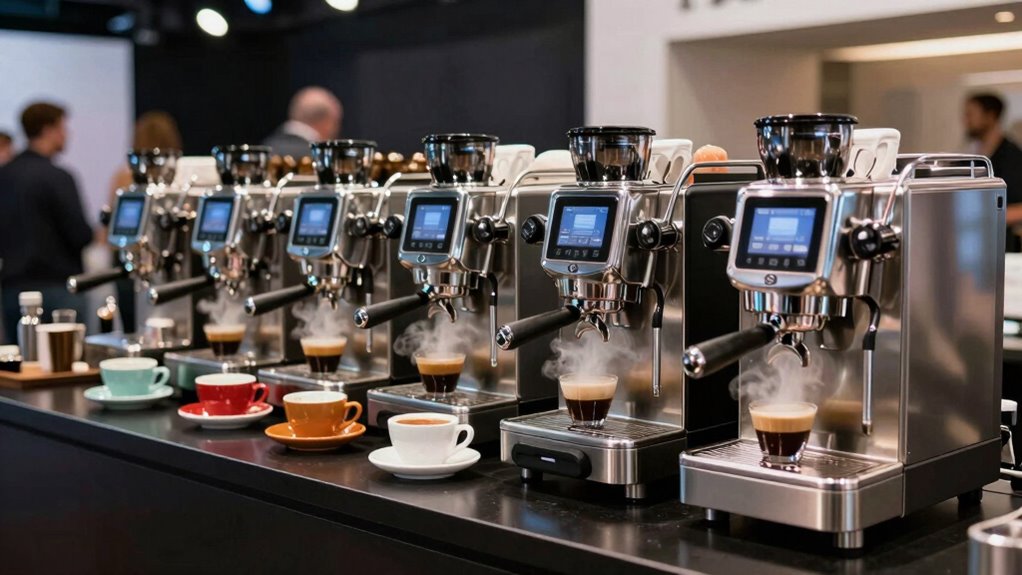
For events with a steady espresso queue, I would start with the Nuova Simonelli Appia Life Automatic Volumetric 2-Group: its two groups and programmed dosing suit repeatable service across multiple baristas. The La Pavoni Bar-Star 2V-R stands out for buyers seeking a substantial 14 L boiler, while the Appia Compact Semi is the space-conscious option in this lineup. The tradeoff is that higher-capacity machines demand more counter space, suitable electrical and water connections, and a workflow that can keep both groups supplied. Boiler size alone does not tell you how quickly a machine will serve a crowd. I compare all seven picks below by event fit, operator demands, installation needs, and the details buyers should verify before choosing.

Get coffee and tea gear delivered free with Prime
- Fast, free delivery on millions of items
- Prime Video, Amazon Music and more included
- Member-only deals all year
Complete the kit


Key Takeaways
- Appia Life Automatic Volumetric is the strongest all-around event pick: its two-group format and automatic dosing support a repeatable pace when several people share service.
- The Bar-Star’s 14 L boiler is its clearest differentiator: it may appeal to buyers prioritizing boiler capacity, but that specification does not replace checking recovery, power requirements, or expected drink volume.
- Two-group machines dominate this roundup: the lineup favors parallel drink preparation, so event buyers should plan for enough trained operators and grinder capacity to use that throughput.
- The Appia Compact Semi trades some automation for a smaller footprint: it suits constrained counters, though a more hands-on workflow may be less convenient during a rush.
- Several models are closely related by intended role: compare the Appia Vol and Appia Life on controls and setup, and compare the La Pavoni options on their stated configuration rather than assuming the shared brand means identical event performance.
| La Pavoni BAR-T 2V-R Commercial Two-Group Volumetric Espresso Machine |  | Best for Busy, Varied Events | Coffee groups: 2 | Boiler capacity: 14 liters | Steam wands: 2 | VIEW ON AMAZON | See Our Full Breakdown |
| Nuova Simonelli Appia Vol 2 Group Espresso Machine |  | Best for Straightforward High-Volume Service | Groups: 2 | Operation mode: Automatic | Dosing type: Volumetric | VIEW ON AMAZON | See Our Full Breakdown |
| Simonelli Appia Life Automatic Volumetric 2-Group Espresso Machine |  | Best for Easier Staff Operation | Groups: 2 | Voltage: 220 V | Construction: Stainless steel body with formed ABS panels on a solid steel frame | VIEW ON AMAZON | See Our Full Breakdown |
| Nuova Simonelli Aurelia II Volumetric 2-Group Espresso Machine |  | Best for Dose and Pre-Infusion Control | Group heads: 2 | Machine type: Commercial grade | Control system: Volumetric with high-resolution screen display | VIEW ON AMAZON | See Our Full Breakdown |
| La Pavoni Bar-Star 2V-R 2-Group Volumetric Commercial Espresso Machine – Red, 14 L Boiler |  | Best for High-Capacity Automated Service | Coffee groups: 2 | Boiler capacity: 14 liters | Steam wands: 2 | VIEW ON AMAZON | See Our Full Breakdown |
| Nuova Simonelli Appia Compact Semi 2-Group Espresso Machine (220 V) |  | Best for Space-Constrained Events | Model: Appia Compact Semi | Group heads: 2 | Voltage: 220 V | VIEW ON AMAZON | See Our Full Breakdown |
| Commercial-Grade Semi-Automatic 2-Group Espresso Machine with 1.6-Gallon Boiler, Rotary Pump, Stainless Steel Finish |  | Best for Back-to-Back Service | Group heads: 2 | Boiler capacity: 1.6 gallons | Pump type: Rotary | VIEW ON AMAZON | See Our Full Breakdown |
| high capacity espresso machine for event | Boiler capacity | Voltage |
|---|---|---|
| La Pavoni BAR-T 2V-R Commercia | 14 liters | 230 V; product information also lists 240 V |
| Nuova Simonelli Appia Vol 2 Gr | 11 liters | — |
| Simonelli Appia Life Automatic | — | 220 V |
| Nuova Simonelli Aurelia II Vol | — | — |
| La Pavoni Bar-Star 2V-R 2-Grou | 14 liters | 230 V |
| Nuova Simonelli Appia Compact | — | 220 V |
| Commercial-Grade Semi-Automati | 1.6 gallons | — |
More Details on Our Top Picks
La Pavoni BAR-T 2V-R Commercial Two-Group Volumetric Espresso Machine
The BAR-T 2V-R suits events where espresso, steamed milk drinks, and hot water need to move at once. Its two groups, two steam wands, and separate hot water tap give staff several ways to work in parallel, while the 14-liter copper boiler supports sustained service. Compared with the Nuova Simonelli Appia Vol 2 Group, this machine offers a larger listed boiler and a second steam wand, useful when a menu spans cappuccinos and tea or Americanos. The tradeoff is a heavy, substantial installation: listed weight reaches 159 lb, and the product information gives conflicting voltage and weight figures. I’d favor it for venues with appropriate power and a fixed counter, where its service capacity matters more than easy relocation.
Pros:- Two groups let staff prepare multiple espresso drinks at once
- Two steam wands support simultaneous milk steaming
- 14-liter copper boiler is suited to sustained service
- Separate hot water tap serves tea and other hot drinks
Cons:- Heavy listed weight makes moving and installation difficult
- Voltage and weight figures conflict within the product information
Best for: Event venues serving espresso, milk drinks, and hot water concurrently from a permanent commercial counter
Not ideal for: Mobile caterers or venues without confirmed 230/240 V service, because the machine is heavy and its listing gives conflicting electrical and weight details
- Coffee groups:2
- Boiler capacity:14 liters
- Steam wands:2
- Hot water tap:1
- Wattage:4370 W
- Voltage:230 V; product information also lists 240 V
- Dimensions:29 × 21 × 21 in (W × D × H)
- Weight:159 lb listed; product information also lists net/gross weights of 125/149 lb
- Operation mode:Semi-automatic
Our verdict“Choose the BAR-T 2V-R for a fixed event station that needs parallel espresso, milk, and hot water service.”
Nuova Simonelli Appia Vol 2 Group Espresso Machine
The Appia Vol 2 Group is a practical fit for staffed events where repeatable shots matter and baristas need a familiar automatic workflow. Volumetric dosing measures each programmed shot, helping a team keep drinks consistent through a rush without relying on every operator to stop extraction by eye. Its automatic boiler fill and 11-liter boiler support service at a steady commercial pace. Compared with the La Pavoni BAR-T 2V-R, it has a smaller listed boiler and the provided details don’t specify two steam wands; the La Pavoni may suit broader simultaneous drink preparation better. The Appia’s appeal is simpler, dose-led operation and a stated lifetime boiler warranty. Its commercial size and weight still call for a dedicated counter and planned installation.
Pros:- Volumetric dosing supports repeatable shot portions
- Automatic boiler fill reduces routine operator tasks
- 11-liter boiler supports extended commercial service
- Lifetime boiler warranty is stated in the product information
Cons:- Large, heavy commercial format is difficult to move
- Provided product details do not specify steam wand count or dimensions
Best for: Caterers and event operators training multiple staff to serve consistent espresso from a fixed station
Not ideal for: Small pop-up crews that need a compact, easily moved machine or multiple dedicated steam stations
- Groups:2
- Operation mode:Automatic
- Dosing type:Volumetric
- Boiler capacity:11 liters
- Boiler fill:Automatic
- Construction:Heavy-duty commercial
- Boiler warranty:Lifetime
Our verdict“Pick the Appia Vol when consistent automatic dosing and a stated lifetime boiler warranty suit a fixed, staffed event setup.”
Simonelli Appia Life Automatic Volumetric 2-Group Espresso Machine
The Appia Life is a strong choice for event teams that need consistent shots and manageable day-to-day upkeep. Programmable volumetric dosing lets staff repeat shot sizes, while automated backflushing reduces the manual steps involved in group-head cleaning. Its push-pull steam control and cool-touch wand also make frequent milk service easier to handle. Compared with the Nuova Simonelli Appia Vol 2 Group, the Life includes more specified operator and cleaning aids, though the Appia Vol lists an 11-liter boiler and lifetime boiler warranty that aren’t stated for this model. The Life’s setup is demanding: it requires a cold water connection, drain, and water softener, and the listing says the softener is needed to maintain warranty coverage. That makes it better for a properly plumbed venue than a temporary station.
Pros:- Programmable volumetric dosing supports consistent shots across staff
- Automated backflushing simplifies routine group-head maintenance
- Push-pull steam system reduces hand effort during steaming
- Cool-touch wand helps reduce accidental contact burns and simplifies cleaning
Cons:- Requires a cold water connection, drain, and water softener
- Large footprint can be difficult to accommodate in temporary event layouts
- 220 V supply limits placement to venues with compatible power
Best for: Event venues with a permanent water hookup that need repeatable shots and streamlined group cleaning
Not ideal for: Mobile caterers and temporary pop-ups without a cold water line, drain, or water softener
- Groups:2
- Voltage:220 V
- Construction:Stainless steel body with formed ABS panels on a solid steel frame
- Steam system:Push-pull
- Steam wand:Cool-touch
- Backflushing:Automated
- Water requirements:Cold water connection, drain, and water softener
- Warranty:2 years
- Made in:Italy
Our verdict“Choose the Appia Life for a plumbed event bar that values easy operation and cleaning over flexible placement.”
Nuova Simonelli Aurelia II Volumetric 2-Group Espresso Machine
The Aurelia II Volumetric fits events where an experienced barista wants more control over extraction while keeping two groups available for a rush. Its high-resolution volumetric controls and programmable pre-infusion let operators tailor how shots are delivered, which can help a skilled team work consistently across different coffees. Compared with the Nuova Simonelli Appia Vol 2 Group, the Aurelia II’s listed advantage is that added control over pre-infusion and energy-saving settings; the Appia Vol’s details make its automatic boiler fill and 11-liter capacity explicit. The Aurelia II listing gives no boiler capacity, so buyers should confirm that detail before planning long, uninterrupted service. Its advanced controls also ask more of new staff, making it a better match for trained operators than a quick pop-up crew.
Pros:- Volumetric control supports repeatable shot dosing
- Programmable pre-infusion gives skilled operators additional extraction control
- Two group heads support parallel drink preparation
- Programmable energy-saving settings offer control over operating modes
Cons:- Advanced controls may take time for new staff to learn
- Product details do not state boiler capacity
Best for: Experienced event baristas who want programmable shot and pre-infusion control on a two-group machine
Not ideal for: New or rotating crews that need a simple workflow, or event planners who require confirmed boiler capacity before selection
- Group heads:2
- Machine type:Commercial grade
- Control system:Volumetric with high-resolution screen display
- Pre-infusion:Programmable
- Energy saving:Programmable energy-efficiency settings
- Intended use:Coffee shops and professional baristas
Our verdict“Select the Aurelia II for a trained team that will use its pre-infusion controls and can confirm boiler capacity for the event load.”
La Pavoni Bar-Star 2V-R 2-Group Volumetric Commercial Espresso Machine – Red, 14 L Boiler
The Bar-Star 2V-R pairs a large boiler with programmed dosing, making it suited to event bars that need both sustained capacity and repeatable operation. Its 14-liter boiler, two groups, and two steam wands support concurrent espresso and milk preparation, while an integrated water softener helps address scale buildup when the machine is connected to a water line. Compared with the La Pavoni BAR-T 2V-R, the Bar-Star is explicitly listed as fully automatic with programmable coffee dosing and includes the softener; the BAR-T description instead identifies semi-automatic operation. Both are heavy, large-format machines with 14-liter boilers, so the Bar-Star’s extra automation does not make it a portable event option. The 31-inch front width and up-to-176-pound gross weight call for advance counter, access, and installation planning.
Pros:- 14-liter boiler supports sustained service
- Two groups and two steam wands allow parallel espresso and milk preparation
- Programmable automatic dosing and hot water delivery standardize routine service
- Integrated water softener helps reduce scale buildup
Cons:- Heavy gross weight and 31-inch width complicate transport and installation
- Complex controls may require staff training
- Direct water line requirement limits use at temporary setups
Best for: Large fixed event bars seeking programmed espresso dosing, dual steaming, and an included water softener
Not ideal for: Mobile caterers or venues with narrow counters, limited access, or no direct water connection
- Coffee groups:2
- Boiler capacity:14 liters
- Steam wands:2
- Hot water spout:1
- Wattage:4370 W
- Voltage:230 V
- Front width:31 in
- Net/gross weight:139/176 lb
- Water connection:Direct water line; integrated water softener included
Our verdict“Choose the Bar-Star for a permanent high-volume event bar that can use its programmed dosing and accommodate its size.”
Nuova Simonelli Appia Compact Semi 2-Group Espresso Machine (220 V)
For event operators who need two drinks moving at once but have limited counter or floor space, the Appia Compact Semi is the most space-conscious fit in this group. Its two group heads support parallel shots, which can keep a small service station moving faster than a single-group setup. Compared with the Commercial-Grade Semi-Automatic 2-Group, it has less disclosed boiler capacity and pump detail, so I would not rank it as confidently for prolonged back-to-back service. The semi-automatic format gives the barista control over extraction timing, while the 220 V requirement can call for suitable wiring or an electrical upgrade. It also lacks advanced temperature controls listed on some higher-end alternatives, making it a better fit for compact setups with trained operators than events demanding the most adjustable workflow.
Pros:- Compact footprint suits crowded service stations
- Two group heads allow parallel drink preparation
- Semi-automatic operation gives the barista control over shot timing
- Nuova Simonelli build reputation may appeal to operators prioritizing established commercial equipment
Cons:- 220 V power may require compatible wiring or an electrical upgrade
- No advanced temperature control features are specified
- Boiler capacity and pump type are not provided, making sustained-service capacity harder to compare
Best for: Small event venues and caterers with limited counter space, access to 220 V power, and a trained barista
Not ideal for: High-volume event teams that need documented large-boiler capacity or advanced temperature controls for sustained service
- Model:Appia Compact Semi
- Group heads:2
- Voltage:220 V
- Machine type:Semi-automatic espresso machine
- Intended setting:Small cafés or high-traffic home setups
- Footprint:Compact; dimensions not specified
Our verdict“Choose the Appia Compact Semi when two-group throughput and a compact footprint matter more than specified large-boiler capacity or advanced temperature adjustment.”
Commercial-Grade Semi-Automatic 2-Group Espresso Machine with 1.6-Gallon Boiler, Rotary Pump, Stainless Steel Finish
The strongest event-service case here is the combination of a 1.6-gallon boiler and a rotary pump: the larger stated boiler is intended to support heat stability through repeated orders, while two groups let staff prepare drinks in parallel. That makes this model a more clearly specified choice for sustained service than the Nuova Simonelli Appia Compact Semi, whose boiler capacity and pump type are not listed. Semi-automatic controls also let an experienced barista set extraction timing, though they require active attention during a rush. The tradeoff is a large footprint, which can be awkward at temporary event bars, and there is no built-in grinder, so the station needs separate grinding equipment. I would favor it for a roomy café or fixed event venue over a mobile setup where every inch and piece of equipment counts.
Pros:- Two groups allow simultaneous brewing
- Stated 1.6-gallon boiler is suited to repeated service
- Rotary pump is specified
- Stainless-steel construction offers a durable, cleanable exterior
Cons:- Large footprint can constrain temporary or crowded event stations
- No built-in grinder, requiring additional equipment and counter space
- Semi-automatic extraction timing demands trained, attentive operators during busy periods
Best for: Cafés, restaurants, and fixed event bars serving repeated orders with room for a large machine and a separate grinder
Not ideal for: Mobile caterers or small pop-up teams with tight counters, limited transport capacity, or no separate grinder
- Group heads:2
- Boiler capacity:1.6 gallons
- Pump type:Rotary
- Construction material:Stainless steel
- Operation mode:Semi-automatic
- Built-in grinder:Not included
- Intended setting:Busy cafés or restaurants
Our verdict“Pick this model for a spacious, fixed service station that needs two-group workflow and a specified large boiler for repeated orders.”

How We Picked
I ranked these machines around the demands of event service: sustained preparation across two groups, consistency when operators rotate, practical workflow, and the installation details that can make a commercial machine usable at a venue. Automatic volumetric dosing earns weight because it can help different baristas repeat shot volumes; a compact footprint matters when counter space is limited. I also considered stated boiler capacity and whether the product information identifies a commercial two-group configuration.
The Appia Life leads because its combination of two groups and automatic dosing makes it a balanced fit for a mixed-skill event team. The Appia Vol and Aurelia II are alternatives for buyers comparing Nuova Simonelli’s two-group commercial offerings, while the Bar-Star earns attention for its stated 14 L boiler. The Appia Compact Semi ranks for space-limited service, and the BAR-T and generic commercial-grade machine require closer specification checks because the available product names alone reveal less about workflow or sustained event output. I would verify voltage, plumbing, dimensions, service access, and manufacturer capacity guidance before treating any model as suitable for a particular crowd.
Factors to Consider When Choosing High Capacity Espresso Machine For Events
Choosing a machine for an event means planning the whole service station, not just the espresso maker. I would estimate the busiest service window, match the equipment to the venue’s utilities, and account for who will operate it. These broader checks can prevent a seemingly capable machine from becoming the bottleneck.
Estimate Peak Demand, Not Attendance
Attendance is a poor stand-in for espresso demand: some guests will choose other drinks, while others may arrive at the same break. Estimate drinks per minute during the busiest window and how long the queue can reasonably wait. Then ask the manufacturer or supplier about expected output under comparable conditions, including recovery between consecutive drinks. A two-group machine allows simultaneous work, but it cannot remove delays caused by grinding, milk steaming, payment, or handoff. A common mistake is buying for the total guest count without mapping when those guests will order. I would plan a service flow and a backup beverage option before paying for more machine capacity.
Match the Machine to the Venue’s Utilities
Commercial espresso machines can require dedicated electrical service, a water connection, drainage, and suitable water treatment. Confirm the exact voltage and electrical load against the venue’s circuits; a product name that lists 220 V should prompt a venue check, not an assumption that a standard outlet will work. Ask whether the installation needs a licensed electrician or plumber, and whether the event site can support permanent connections or requires an approved temporary setup. Water quality also affects taste and maintenance, so find out what filtration the manufacturer specifies. Measure doorways, counter depth, overhead clearance, and the route from delivery point to bar. Skipping these checks can turn a capable machine into equipment that cannot be installed on site.
Plan for Operators and Workflow
Two groups create room for parallel drink preparation only when staffing and station layout support it. Decide who handles grinding and dosing, who steams milk, and who manages orders and handoff; one person may struggle to cover every task during a rush. Automatic volumetric dosing can reduce variation between operators, while semi-automatic controls give the barista more direct control and ask more of their training. Milk drinks add steaming and pitcher-rinsing time that group count does not solve. Practice the menu and station sequence before the event, including decaf or alternate milk if those are offered. If the team changes from event to event, simpler repeatable steps may matter more than extra manual control.
Treat Boiler Capacity as One Part of Throughput
A larger stated boiler can be a useful signal for buyers expecting sustained work, but it does not establish a machine’s complete service capacity. Heating design, recovery, steam use, water supply, and the mix of espresso-only versus milk drinks all affect performance in practice. Ask for the manufacturer’s operating guidance and clarify whether the listed boiler volume describes the full boiler arrangement. Do not compare one machine’s boiler figure with another unless the specifications use the same basis. For an event with many milk drinks, steam performance and the barista’s steaming rhythm deserve as much attention as volume. Capacity claims are most useful when tied to a real menu and a defined peak period.
Budget for Setup, Service, and Transport
The purchase decision should include the support needed to keep a commercial machine ready for an event. Check local technician availability, parts support, routine cleaning requirements, and what maintenance can be done between bookings. If the machine will travel, confirm its weight, handling requirements, and whether the venue setup exposes it to vibration or weather. Portable use may call for a different water and drainage plan than a fixed café installation. Paying more can make sense when stronger service support, suitable controls, or a better fit for repeated high-volume bookings reduces operational friction. I would avoid choosing on a single headline specification before confirming the costs and logistics around it.
Frequently Asked Questions
Is a two-group machine enough for a large event?
It depends on the peak ordering rate, menu, staffing, and how long guests can wait. Two groups let baristas prepare more than one espresso order at once, but milk steaming, grinding, and order handoff may still limit the station. Ask the supplier for realistic output guidance for your drink mix rather than relying on group count alone. For a short rush, consider splitting service across stations or offering batch coffee alongside espresso. A timed rehearsal with the planned team and menu is a practical way to expose bottlenecks.
Should I choose automatic volumetric dosing or semi-automatic controls for event service?
Automatic volumetric dosing can help rotating or less experienced operators produce more consistent shot volumes with fewer manual steps. Semi-automatic machines suit teams that want direct control and have the training to keep shots consistent during busy service. Neither control style guarantees good espresso if the grinder, recipe, and workflow are poorly set up. For events with temporary staff, repeatable controls may reduce coaching time. For a dedicated barista team, manual control may be a worthwhile preference.
Does a larger boiler mean faster service?
Not by itself. Boiler capacity is one factor alongside heating and recovery, steam demand, water supply, and how many milk drinks the team makes. A large boiler may support sustained operation, but the machine still needs a suitable electrical connection and a workflow that keeps orders moving. Compare manufacturer guidance for the actual configuration rather than ranking machines by liters alone. For a mostly espresso menu, grinder and order handling may shape speed more than boiler volume.
What should I verify before bringing a commercial espresso machine to a venue?
Confirm the exact voltage, electrical load, water connection, drainage plan, and any required filtration with both the venue and machine supplier. Measure the counter, access route, and clearances, and check the machine’s dimensions and handling requirements. Ask whether setup requires qualified installation and whether the venue permits the needed connections. Also plan for cleaning, waste-water disposal, and protection during transport. These checks are especially important when the machine’s product listing gives only a short specification summary.
Is a compact machine a sensible choice for events?
It can be a good fit when counter space or access is restricted, provided the machine’s stated configuration matches the event’s workload. Compact size does not remove the need for commercial utilities, enough grinder capacity, or a workable milk station. Compare the available controls and operator workload too: a semi-automatic workflow may demand more training during a rush. If the venue has room and expects sustained high demand, a less compact option may give the team a more suitable setup. Measure the complete station, including grinders and knock boxes, before deciding.
Conclusion
For the broadest mix of event service needs, I would choose the Nuova Simonelli Appia Life Automatic Volumetric 2-Group as the best overall fit, especially when repeatable dosing matters across operators. The Appia Vol is a value-oriented alternative for buyers seeking a two-group Nuova Simonelli configuration, but I would compare the exact controls and installation specifications before choosing between the Appia models. For a premium shortlist, I would look closely at the Aurelia II and confirm its configuration and service support with the supplier. The Appia Compact Semi is the most relevant choice for buyers constrained by space and comfortable with a hands-on workflow. Buyers prioritizing stated boiler volume should investigate the Bar-Star 2V-R; whichever model you select, verify venue utilities, expected peak demand, and local maintenance support before booking it for an event.