A high-end kettle for home brewing should match your batch size and brewing method, not just look capable on a spec sheet. I’d put the Brewer’s Edge Series 2 Mash and Boil first for brewers who want an all-in-one electric setup, while the Northern Brewer MegaPot suits those who prefer a durable stovetop kettle with a valve. For smaller electric batches, the Northern Brewer Gigawort takes up less space and keeps the process contained. The main tradeoffs are capacity versus storage, electric convenience versus system complexity, and built-in filtration versus a simpler kettle you can customize. Read on for how all 11 options compare and which one fits your home brewery.

Get coffee and tea gear delivered free with Prime
- Fast, free delivery on millions of items
- Prime Video, Amazon Music and more included
- Member-only deals all year
Complete the kit



Key Takeaways
- Electric systems lead for convenience: The Brewer’s Edge Series 2 and Mash and Boil combine heating with brewing functions, while standard kettles require a separate heat source.
- Batch size changes the shortlist: The Gigawort is aimed at smaller batches; 10-gallon kettles suit many home setups, while the 16- and 50-gallon options call for more space and a plan for handling larger volumes.
- Filtration is a real point of difference: The Brewsie and VEVOR include filtration features, which may reduce the need for separate equipment but can add parts to clean and manage.
- The three DigiBoil listings are close alternatives: Their stated capacity and electric format overlap, so buyers should verify the exact version, included parts, and electrical requirements before choosing among them.
- A larger kettle is not automatically a better kettle: Oversized capacity can make storage, heating, and safe handling harder when typical brew days use smaller batches.
| Kegco 50-Gallon Stainless Steel Brew Kettle |  | Best for Large Batches | Capacity: 50 gallons | Batch size: Up to 35 gallons | Material: 304-grade stainless steel | VIEW ON AMAZON | See Our Full Breakdown |
| Brewer’s Edge Series 2 Mash and Boil Electric Brewing Kettle with Pump V2 |  | Best for Recirculating Mashes | Voltage: 110V | Model: Series 2 V2 | Integral pump: Yes | VIEW ON AMAZON | See Our Full Breakdown |
| Brewsie Stainless Steel Home Brew Kettle with Dual Filtration, 10 Gallon |  | Best Traditional Kettle Kit | Capacity: 10 gallons (40 quarts) | Material: Stainless steel | Dimensions: 14 inches wide x 16 inches high | VIEW ON AMAZON | See Our Full Breakdown |
| Northern Brewer Gigawort Electric Boil Kettle, 4.4 Gallon |  | Best Compact Electric Kettle | Capacity: 4.4 gallons | Construction: Double-walled 304 stainless steel | Heating element: 1600W | VIEW ON AMAZON | See Our Full Breakdown |
| Brewer’s Edge Mash and Boil All-Grain Brewing System | 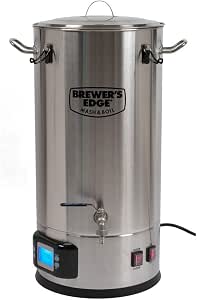 | Best All-in-One Starter System | Capacity: 7.5 gallons | Malt capacity: 16 pounds | Material: Double-wall stainless steel | VIEW ON AMAZON | See Our Full Breakdown |
| VEVOR 16-Gallon Stainless Steel Brewing Kettle with Filter Tray |  | Best for Large Batches | Capacity: 16 gallons | Material: Stainless steel | Material thickness: 0.9 mm | VIEW ON AMAZON | See Our Full Breakdown |
| Concord Stainless Steel Home Brew Kettle, 30 Qt (7.5 Gal) |  | Best for a Straightforward Stovetop Setup | Capacity: 30 quarts (7.5 gallons) | Kettle material: Stainless steel | Accessory material: 304 stainless steel | VIEW ON AMAZON | See Our Full Breakdown |
| Kegland DigiBoil Electric Kettle – 9.25 Gallons (35 Liters), 1500W, Stainless Steel |  | Best for Electric Temperature Control | Capacity: 9.25 gallons (35 liters) | Power: 1500W | Voltage: 110V | VIEW ON AMAZON | See Our Full Breakdown |
| KegLand DigiBoil 9-Gallon Electric Kettle, 110V, 1500W |  | Best for Flexible Heating | Capacity: 9 gallons | Voltage: 110V | Wattage: 1500W total (1000W and 500W elements) | VIEW ON AMAZON | See Our Full Breakdown |
| Kegland DigiBoil 9-Gallon Electric Brewing Kettle |  | Best for Upgrade Flexibility | Capacity: 9 gallons | Voltage: 110V | Current: 15A | VIEW ON AMAZON | See Our Full Breakdown |
| Northern Brewer Stainless Steel MegaPot Brew Kettle with Valve, 10 Gallon |  | Best for Hands-On Batch Brewing | Capacity: 10 gallons (40 quarts / 37.8 liters) | Material: Stainless steel | Bottom: 4 mm tri-clad | VIEW ON AMAZON | See Our Full Breakdown |
| high end kettle for home brewing | Capacity | Material | Weight | Dimensions |
|---|---|---|---|---|
| Kegco 50-Gallon Stainless Stee | 50 gallons | 304-grade stainless steel | 50.3 pounds | — |
| Brewer’s Edge Series 2 Mash an | — | — | — | — |
| Brewsie Stainless Steel Home B | 10 gallons (40 quarts) | Stainless steel | 16 pounds | 14 inches wide x 16 inches high |
| Northern Brewer Gigawort Elect | 4.4 gallons | — | — | — |
| Brewer’s Edge Mash and Boil Al | 7.5 gallons | Double-wall stainless steel | 20.6 pounds | — |
| VEVOR 16-Gallon Stainless Stee | 16 gallons | Stainless steel | 21.4 lb | 15.75 × 15.75 × 18.9 in |
| Concord Stainless Steel Home B | 30 quarts (7.5 gallons) | — | 6.92 kg | 14 × 14 × 13.5 in |
| Kegland DigiBoil Electric Kett | 9.25 gallons (35 liters) | 304 stainless steel | — | 29 in H × 15 in W |
| KegLand DigiBoil 9-Gallon Elec | 9 gallons | 304 stainless steel | — | 29 in H × 15 in W including handles |
| Kegland DigiBoil 9-Gallon Elec | 9 gallons | 304 stainless steel | — | 29 in H × 15 in W including handles |
| Northern Brewer Stainless Stee | 10 gallons (40 quarts / 37.8 liters) | Stainless steel | 23 pounds | — |
More Details on Our Top Picks
Kegco 50-Gallon Stainless Steel Brew Kettle
For brewers working at a scale the other kettles here cannot match, the 50-gallon capacity is the defining advantage. Its tri-clad base spreads heat across the bottom and supports induction, while internal volume markers and the included valve make filling and draining more manageable. Compared with the Brewsie 10-gallon kettle, this Kegco can handle far larger batches, but its 50.3-pound weight and 200-quart volume call for ample space and a suitable heat source. The 22-gauge construction is lighter than a heavy-duty commercial vessel might be, so careful handling matters. I’d choose it for a serious production setup; smaller-batch home brewers will get more practical use from a compact kettle or electric system.
Pros:- 50-gallon capacity accommodates large brewing, mashing, or hot-liquor batches
- Tri-clad bottom supports even heat distribution
- Induction compatibility adds heat-source flexibility
- Includes a lid, volume markers, and two-piece ball valve
Cons:- Its size and weight make it impractical for many home setups
- The 22-gauge body calls for care when handling a large, heavy batch
Best for: Experienced brewers making batches up to 35 gallons who have room for a large kettle and a compatible heat source
Not ideal for: Apartment brewers and small-batch home brewers who lack storage space or have no need for a 50-gallon vessel
- Capacity:50 gallons
- Batch size:Up to 35 gallons
- Material:304-grade stainless steel
- Material gauge:22 gauge
- Bottom:Tri-clad
- Induction compatible:Yes
- Weight:50.3 pounds
- Included accessories:Lid, 1/2-inch MPT hex head plug, and two-piece ball valve
Our verdict“Choose this Kegco for high-volume brewing if you have the space and equipment to put its unusually large capacity to work.”
Brewer’s Edge Series 2 Mash and Boil Electric Brewing Kettle with Pump V2
The Series 2 V2 puts mash recirculation at the center of its design: an integral pump moves wort through the high-flow basket, helping simplify the process and reduce the chance of a stuck sparge. Its low-density heating element is intended to limit scorching, while the digital thermostat gives brewers a direct way to manage temperature. Compared with the Brewer’s Edge Mash and Boil, this model adds a pump and revised basket, making it the more compelling fit for someone who wants recirculation built in. Both rely on a standard 110V outlet, which can limit heating speed, and the provided product data does not specify capacity. That missing figure makes batch planning harder, so I’d confirm the vessel’s volume before choosing it.
Pros:- Integral pump supports mash recirculation
- High-flow basket is designed to reduce stuck sparges
- Low-density element is intended to limit scorching
- Digital thermostat provides programmable temperature control
Cons:- 110V operation may mean slower heating than higher-voltage brewing systems
- Capacity is not stated in the provided product data, complicating batch planning
Best for: All-grain brewers who want an integrated pump for mash recirculation and have a standard 110V outlet available
Not ideal for: Brewers who need a confirmed batch capacity before buying or want faster heating from a higher-voltage system
- Voltage:110V
- Model:Series 2 V2
- Integral pump:Yes
- Programmable:Yes
- Temperature control:Digital thermostat
- Heating element:Low density
- Basket:High flow
Our verdict“Pick the Series 2 V2 if integrated mash recirculation matters more to you than a stated capacity or higher-voltage heating.”
Brewsie Stainless Steel Home Brew Kettle with Dual Filtration, 10 Gallon
The Brewsie suits brewers who want a traditional 10-gallon kettle with much of the basic brew-day hardware bundled in. A false bottom and bazooka screen provide two filtration components, while the thermometer, ball valve, and stamped volume markers support routine brewing tasks without requiring a separate parts hunt. Compared with the Northern Brewer Gigawort, this is a larger passive kettle with filtration hardware, but it does not include electric temperature control or heating elements. That means you’ll need an appropriate external heat source and must manage temperature yourself. Its 16-pound weight and 14-by-16-inch dimensions make it more manageable than the enormous Kegco, though its included screens and fittings add pieces to clean. I’d favor it for hands-on brewers who already have a burner or other heat source.
Pros:- False bottom and bazooka screen provide dual filtration
- Includes a thermometer and ball valve
- Stamped volume markers help measure liquid in the kettle
- 10-gallon capacity is more practical for home batches than the 50-gallon Kegco
Cons:- Requires a separate heat source and hands-on temperature management
- The included filtration components add parts to clean and handle
Best for: Home brewers making mid-sized batches who want a passive kettle with filtration, a thermometer, and a valve included
Not ideal for: Brewers who want an all-in-one electric setup or prefer to avoid managing an external heat source and separate filtration parts
- Capacity:10 gallons (40 quarts)
- Material:Stainless steel
- Dimensions:14 inches wide x 16 inches high
- Weight:16 pounds
- Filtration:False bottom and bazooka screen
- Included components:Kettle, lid, false bottom, bazooka screen, thermometer, ball valve, inner connector, and hardware
- Color:Silver
Our verdict“Choose the Brewsie if you want a well-equipped traditional kettle and already have a suitable way to heat it.”
Northern Brewer Gigawort Electric Boil Kettle, 4.4 Gallon
The Gigawort is the most compact electric option in this group, with a 4.4-gallon capacity suited to smaller batches and limited brewing space. Its two heating elements give it separate jobs: 1600W for reaching a boil and 600W for maintaining one. Double-walled 304 stainless steel helps retain heat, and the digital controller, delayed start, and automatic shutoff add hands-off convenience. Compared with the 7.5-gallon Brewer’s Edge Mash and Boil, the Gigawort takes up a smaller-batch role and offers a delayed start, while giving up capacity and the other model’s internal sparging basket. The 3.5-hour shutoff also sets a firm limit on unattended operation. I’d pick it for compact brew days, not for brewers planning larger all-grain batches.
Pros:- Compact 4.4-gallon capacity suits smaller batches
- Separate elements handle heating and boil maintenance
- Double-walled 304 stainless steel helps retain heat
- Digital control, delayed start, and automatic shutoff add convenience
Cons:- Smaller capacity limits batch size compared with the 7.5-gallon Brewer’s Edge
- Automatic shutoff after 3.5 hours can interrupt longer unattended brew sessions
Best for: Small-batch brewers who want an electric kettle with digital control and have limited space for brewing equipment
Not ideal for: Brewers who regularly make larger batches or need unattended operation beyond the 3.5-hour shutoff window
- Capacity:4.4 gallons
- Construction:Double-walled 304 stainless steel
- Heating element:1600W
- Boil maintenance element:600W
- Temperature control:Digital
- Delayed start:Yes
- Automatic shutoff:3.5 hours
Our verdict“Choose the Gigawort for compact electric brewing and smaller batches; move to a larger system if batch capacity is your priority.”
Brewer’s Edge Mash and Boil All-Grain Brewing System
This Mash and Boil combines mashing and boiling in one vessel, a space-saving approach for brewers beginning all-grain batches without building a separate burner setup. Its 7.5-gallon capacity and internal sparging basket keep the process contained, while the double-wall stainless steel body helps retain heat. A 1600W element runs from a standard 110V outlet, and the adjustable thermostat and delayed-start timer add control without a separate temperature setup. Compared with the pump-equipped Series 2 V2, this model has a stated 16-pound malt capacity and a 24-hour timer, but it lacks the listed integral pump and high-flow basket. Its 110V power can also mean slower heating, and the 20.6-pound weight may make moving it awkward. I’d choose it for a compact all-grain setup with straightforward household power.
Pros:- Combines mashing and boiling in one vessel to save equipment and space
- 7.5-gallon capacity and 16-pound malt capacity support defined batch planning
- Runs on a standard 110V household outlet
- Delayed start can be scheduled up to 24 hours ahead
Cons:- 110V, 1600W heating may produce slower boil times than higher-voltage systems
- At 20.6 pounds, the system may be awkward to move
- Does not list the integral pump included with the Series 2 V2
Best for: New all-grain brewers who want a single-vessel system, a stated malt capacity, and operation from a household outlet
Not ideal for: Brewers seeking faster high-voltage heating, an integrated recirculation pump, or an especially lightweight system
- Capacity:7.5 gallons
- Malt capacity:16 pounds
- Material:Double-wall stainless steel
- Wattage:1600 watts
- Voltage:110 volts
- Weight:20.6 pounds
- Delayed start:Up to 24 hours
- Power cord length:5 feet
Our verdict“Pick this system if you want to start all-grain brewing with one compact vessel and accept the slower heating of household-voltage power.”
VEVOR 16-Gallon Stainless Steel Brewing Kettle with Filter Tray
The 16-gallon capacity gives this VEVOR kettle room for large-volume brewing, while its included filter and filter tray make it more equipped for separating wort than a basic brew pot. The thermometer and ball valve also help with monitoring and draining. Compared with the Kegco 50-Gallon Stainless Steel Brew Kettle, it suits a home setup that needs substantial capacity without moving into commercial-scale volume. Its tri-ply base supports use on compatible induction and gas stovetops, adding flexibility over the electric-only DigiBoil models. The tradeoff is its nearly 19-inch height and 21.4-pound weight: it takes considerable storage space, and its 0.9 mm steel is relatively thin for a kettle this large. Choose it for batch capacity and included filtration; skip it if compact storage or a heavier-gauge pot matters more.
Pros:- 16-gallon capacity accommodates large brewing batches
- Includes a thermometer, ball valve, filter, and filter tray
- Tri-ply base supports compatible induction and gas stovetops
- Stainless steel finish is corrosion-resistant and easy to clean
Cons:- Large dimensions and 21.4-pound weight make storage and handling harder
- 0.9 mm material thickness may feel light for a kettle of this capacity
Best for: Home brewers making large batches who want filtration hardware and a kettle that works on compatible gas or induction stovetops
Not ideal for: Brewers with limited storage or those seeking a compact electric all-in-one system with built-in temperature control
- Capacity:16 gallons
- Material:Stainless steel
- Material thickness:0.9 mm
- Dimensions:15.75 × 15.75 × 18.9 in
- Weight:21.4 lb
- Thermometer range:0–120°C / 0–250°F
- Base:Three-layer base with aluminum layer
- Included components:Filter, filter tray, kettle pot, mini wrench, waterproof tape
Our verdict“Choose the VEVOR if large batches and included filtration matter more than compact storage or electric temperature control.”
Concord Stainless Steel Home Brew Kettle, 30 Qt (7.5 Gal)
The 30-quart Concord is a practical choice for brewers who want a traditional stainless pot with a valve and removable fittings, without the footprint or electrical setup of a DigiBoil. Its weldless accessories can come off for cleaning, and the 304 stainless steel fittings suit repeated brewing and cleanup. Compared with the VEVOR 16-Gallon Kettle, Concord is smaller and easier to fit into a typical home setup, though it gives up the VEVOR’s filter tray and larger batch capacity. The kettle arrives pre-drilled but unassembled, so setup is part of the purchase; a wrench or strong hands are needed. It also lacks the built-in digital temperature control found on Kegland’s electric models. This makes more sense for buyers who already have a compatible heat source and prefer a simpler kettle.
Pros:- Polished stainless steel body with 304 stainless steel accessories
- Removable weldless fittings simplify cleaning and replacement
- 30-quart capacity fits many home brewing batches
- Lid can hang on the kettle’s side
Cons:- Requires assembly before use
- No built-in heating or digital temperature control
Best for: Home brewers with a compatible stovetop or burner who want a mid-size stainless kettle with removable fittings
Not ideal for: Brewers seeking an electric system with digital temperature control or a kettle ready to use without assembly
- Capacity:30 quarts (7.5 gallons)
- Kettle material:Stainless steel
- Accessory material:304 stainless steel
- Finish:Polished
- Dimensions:14 × 14 × 13.5 in
- Weight:6.92 kg
- Assembly:Unassembled; takes less than 10 minutes
- Tool requirement:Wrench or strong hands
Our verdict“Pick the Concord for a mid-size, serviceable stovetop kettle if you are comfortable assembling its fittings.”
Kegland DigiBoil Electric Kettle – 9.25 Gallons (35 Liters), 1500W, Stainless Steel
The DigiBoil’s digital temperature control and two independently operated heating elements give home brewers more control over heating than the stovetop-based Concord or VEVOR kettles. At 9.25 gallons, it has room for typical five-gallon brewing batches, and its concealed elements are easier to clean around than exposed heating hardware. Compared with the closely related KegLand DigiBoil 9-Gallon Electric Kettle, this listing specifies 35 liters of capacity and a 29-inch height; the core 110V, 1500W setup is similar. That makes the choice between them less about a different brewing approach and more about confirming the exact capacity and included setup. The key tradeoff is power: this unit needs a dedicated 15A circuit, and its tall body claims substantial storage space. The main unit is hand-wash only.
Pros:- Digital temperature setting supports controlled water heating
- Two heating elements provide selectable heating power
- 35-liter capacity suits five-gallon-scale brewing
- Concealed elements ease cleaning
Cons:- Requires a dedicated 15A circuit
- Tall form and large capacity require substantial storage space
- Main unit is hand-wash only
Best for: Home brewers who want electric heating with digital temperature control for five-gallon-scale batches
Not ideal for: Brewers without access to a dedicated 15A outlet or enough room to store a tall electric kettle
- Capacity:9.25 gallons (35 liters)
- Power:1500W
- Voltage:110V
- Material:304 stainless steel
- Heating elements:Dual: 1000W and 500W
- Dimensions:29 in H × 15 in W
- Valve:1/2 in ball valve with 13 mm barb
- Temperature units:°F or °C
Our verdict“Choose this DigiBoil for digitally controlled electric brewing if your outlet and storage space can support it.”
KegLand DigiBoil 9-Gallon Electric Kettle, 110V, 1500W
This 9-gallon DigiBoil makes sense for brewers who want to choose between its 1000W and 500W heating elements while monitoring temperature on a digital display. That flexibility can help match heat output to the task, from bringing water up to temperature to maintaining a gentler setting. It is close in design to the Kegland DigiBoil 9.25-Gallon model, but lists a 9-gallon capacity and spells out its five-foot cord and compatibility with DS130 and DS120 reflux or pot still setups. Both take a 110V, 15A connection and use concealed elements, so neither is a compact alternative to a stovetop pot like the Concord 30 Qt. Its electric controls add convenience, but the tall 29-inch body and required 15A outlet limit where it can be placed. Buyers should also confirm that their batch size fits its stated capacity.
Pros:- Independently controlled 1000W and 500W elements allow different heat settings
- Digital display supports Fahrenheit or Celsius temperature control
- Concealed elements and stainless steel construction simplify cleanup
- Includes a ball valve and volume markings
Cons:- Requires a 110V, 15A power connection
- 29-inch height and 9-gallon capacity take up substantial space
Best for: Home brewers who want selectable element power and digital controls, with compatible still setups as an added use
Not ideal for: Small-space brewers or anyone without a 110V, 15A connection
- Capacity:9 gallons
- Voltage:110V
- Wattage:1500W total (1000W and 500W elements)
- Material:304 stainless steel
- Temperature control:Digital; °F or °C
- Power connection:15A plug with 5 ft cord
- Valve:1/2-inch ball valve with 13 mm barb
- Dimensions:29 in H × 15 in W including handles
- Compatibility:Reflux and pot still setups (DS130 and DS120)
Our verdict“Choose this model if selectable heating power and digital control suit your brewing routine and you have the outlet and room for it.”
Kegland DigiBoil 9-Gallon Electric Brewing Kettle
Among these closely related Kegland models, this DigiBoil is the clearest fit for buyers who want volume markings and a glass lid called out alongside digital control and independently operated heating elements. Its 9-gallon stainless body can heat brewing water and can serve as a mash tun with an upgrade kit. Compared with the KegLand DigiBoil 9-Gallon model with still compatibility, this listing specifies an ETL Listed unit, internal dimensions, and a fitting suited to accessory upgrades; distilling requires a compatible still top lid and gasket. The brewing controls and 110V, 15A power needs otherwise make the two versions similar, so these listed details are useful for matching accessories rather than assuming a different core system. It remains tall, hand-wash only, and dependent on the right power supply.
Pros:- Digital controls display temperature in Fahrenheit or Celsius
- Two heating elements can be controlled independently
- Stamped volume markers and a glass lid aid brewing setup
- Can serve as a mash tun with a compatible upgrade kit
Cons:- Requires a 110V, 15A power supply
- Distilling requires a compatible still top lid and gasket
- Hand-wash care and tall dimensions add cleanup and storage demands
Best for: Home brewers who want a digital electric kettle with volume markings and a path to mash-tun upgrades
Not ideal for: Brewers seeking a compact kettle, a plug-in setup for a lower-capacity circuit, or distilling hardware included in the box
- Capacity:9 gallons
- Voltage:110V
- Current:15A
- Wattage:1500W (1000W and 500W elements)
- Material:304 stainless steel
- Dimensions:29 in H × 15 in W including handles
- Power cord:5 ft
- Included fitting:1/2 in stainless steel ball valve with 13 mm barb
- Certification:ETL Listed
Our verdict“Pick this DigiBoil if volume markings and future mash-tun upgrades matter more than compact storage or included distilling parts.”
Northern Brewer Stainless Steel MegaPot Brew Kettle with Valve, 10 Gallon
For home brewers who want a roomy, manually operated kettle, the 10-gallon MegaPot pairs a 4 mm tri-clad bottom with interior volume markings, helping distribute heat evenly and check batch volume without a separate measuring step. Its weld-less ball valve and IsoFlow bulkhead fittings give brewers a direct route for transferring liquid. Compared with the 4.4-gallon Northern Brewer Gigawort, this kettle has room for larger batches but lacks the electric model’s built-in heating convenience. It also asks for more lifting: at 23 pounds before adding liquid, it is a substantial piece of equipment. I’d choose it for a brewing setup with a suitable heat source and space to handle a full kettle; brewers seeking compact, plug-in operation should look at an electric option instead.
Pros:- 10-gallon capacity accommodates larger home-brew batches
- 4 mm tri-clad bottom supports even heat distribution
- Graduated interior markings make volume checks straightforward
- Ball valve and IsoFlow fittings support liquid transfer
Cons:- 23-pound empty weight makes lifting and handling demanding
- Requires a separate compatible heat source
- Large capacity takes substantial storage space
Best for: Home brewers making larger stovetop or burner-heated batches who want measured volume markings and a built-in transfer valve.
Not ideal for: Brewers with limited storage or strength, or anyone seeking a compact electric kettle with integrated heating.
- Capacity:10 gallons (40 quarts / 37.8 liters)
- Material:Stainless steel
- Bottom:4 mm tri-clad
- Valve:Weld-less ball valve with IsoFlow single-piece bulkhead fittings
- Volume markings:Graduated markings inside
- Handles:Silicone-covered
- Weight:23 pounds
- Finish:High gloss
Our verdict“Choose the MegaPot if you brew larger batches over an external heat source and value volume markings and valve-assisted transfer.”

How We Picked
I compared these kettles by how well their stated design fits common home brewing needs: batch capacity, heating method, filtration, handling, and the amount of separate equipment a brewer may need. A kettle that supports a complete electric brew day can be more convenient, while a straightforward stainless model may suit someone who already owns a burner and prefers choosing accessories separately. Capacity matters alongside headroom for a vigorous boil and practical storage, not as a standalone measure of quality.
The ranking favors versatility for typical home batches, then weighs convenience against complexity and specialization. That puts the Brewer’s Edge Series 2 near the top for its electric brewing approach, with the MegaPot and other conventional kettles serving brewers who value a simpler vessel. Smaller electric and filtration-focused choices rank well for their specific use cases. The three DigiBoil entries are grouped as closely related options because their listed specifications overlap; buyers should check each listing’s exact configuration rather than assume the names signal different capabilities.
Factors to Consider When Choosing High End Kettle For Home Brewing
Before choosing a kettle, work backward from your brew day: how much wort you make, where you heat it, and what equipment you already own. These broader checks can prevent paying for capacity or features that do not improve your routine.
Choose capacity from your finished batch
Start with the volume you want in the fermenter, then allow room for boil-off, trub, and a rolling boil. A kettle sized exactly to the final batch volume can leave little headroom and increase the chance of boilovers. Very large vessels also need more storage space and can be awkward to move when filled. If your batch sizes vary, a moderate capacity may be easier to use than buying for an occasional maximum. Think about where the kettle will sit during the boil and how you will drain it before settling on a capacity.
Match the heating method to your space
An electric kettle can simplify brewing when indoor use and a suitable outlet are available, but it ties the setup to electrical requirements and a fixed location. Check the power draw and circuit needs before buying; a high wattage figure alone does not tell you whether your kitchen or brewing area can support it. A conventional kettle offers more freedom to use a burner, though you must supply that heat source separately. Large batches may also challenge a typical household stove. Choose based on the heat source you can use safely and consistently, rather than assuming either format is universally easier.
Decide how much filtration you want built in
Built-in screens or filter trays can help separate grain or hops from liquid, but they do not remove every need for transfer and separation equipment. More parts can mean more cleaning steps and more places for residue to collect. A plain kettle leaves you free to select a filter or hop management method that suits your recipe. Before paying for integrated filtration, consider whether it fits the ingredients and process you actually use. If you change methods often, a simpler kettle with adaptable accessories may offer more flexibility.
Check handling, draining, and cleaning
Filled kettles are heavy, and capacity makes that practical concern more serious than it may look on a product page. Handles, a drain valve, and a stable place to set the vessel affect how easily you can move wort and clean the kettle after brewing. A valve can make draining easier, but it adds a fitting that needs attention during cleaning and storage. Look at how low the outlet sits and whether your tubing or fermenter can fit beneath it. Plan the whole path from kettle to fermenter before choosing a vessel you cannot easily lift.
Pay for features that remove a real bottleneck
Integrated heating, pumps, and filtration can reduce the number of separate purchases and help keep a repeatable process. They also add controls and components that may take more time to learn, maintain, or troubleshoot. If you already own a burner, pump, or mash equipment, some all-in-one features may duplicate what you have. Compare the equipment you would otherwise need with the parts included in the system, and check what is absent from the package. A premium kettle earns its place when its features solve a recurring problem in your brewing routine.
Frequently Asked Questions
Is an electric brewing kettle a good choice for a first all-grain setup?
It can be a good fit if you want heating and brewing functions in one system and have a suitable electrical setup. An all-in-one design may reduce the number of vessels and transfers, but it can also mean learning the system’s controls and cleaning its additional components. Compare that learning curve with a conventional kettle paired with equipment you already understand. Check the power requirements and the full set of included accessories before buying. A first setup works best when its process fits the space and routine you can maintain.
Should I buy a 16- or 50-gallon kettle for ordinary home batches?
Only if your batch volume and brewing space justify it. More headroom can help with larger boils, but a vessel far larger than your usual batch takes up space and can be harder to heat, drain, and clean. Large capacities also make safe lifting and storage more important. Estimate your normal pre-boil volume and the largest batch you realistically expect to make. If those figures are well below the kettle’s capacity, a smaller model may be more practical.
Do I need a kettle with a built-in filter tray?
No; filtration needs depend on your recipe and process. A built-in tray may help with particular grain or hop separation steps, but it adds a component to clean and may not replace every filter or transfer accessory. A plain kettle gives you room to choose equipment as your method develops. Consider whether the tray matches the way you brew most often, rather than treating filtration as an automatic upgrade. Also check whether the listing includes the parts needed to use it.
How should I choose between the similarly named DigiBoil listings?
Start by confirming the precise model and package contents in the current listing. The entries here have overlapping capacity and power descriptions, so their names alone do not establish a meaningful performance difference. Check voltage, wattage, included fittings, controls, and any accessories supplied. Confirm that the electrical requirements match your brewing location. If those details are identical, choose based on the exact configuration and support available to you.
Is a valve worth having on a home brewing kettle?
A valve can make draining into a fermenter or transfer vessel easier, especially when the kettle is too heavy to lift safely. Its usefulness depends on the outlet height, your tubing, and whether your receiving vessel fits below it. Valves also need cleaning around the fitting and may retain a small amount of liquid or sediment. If you prefer lifting and pouring smaller batches, a valve may matter less. Map out your transfer setup before treating the feature as a must-have.
Conclusion
For most brewers who want an electric, flexible setup, I’d choose the Brewer’s Edge Series 2 as the best overall. The Concord 30 Qt kettle is a sensible value pick for smaller batches and a straightforward vessel, while the Northern Brewer MegaPot is my best premium conventional kettle for brewers who want stainless construction and a valve. Beginners who prefer a compact electric approach should look at the Northern Brewer Gigawort; brewers focused on filtration can compare the Brewsie and VEVOR. For larger batches, consider the bigger Kegco or VEVOR capacities only after checking your heat source, storage, and handling plan.