
If you’ve ever chased a better cup of coffee with a new grinder or fresher beans only to be underwhelmed, water chemistry is probably the missing variable. Brewing water makes up roughly 98% of your cup, and the difference between tap water and properly mineralized water is one of the cheapest major upgrades a home barista can make. After comparing the leading options in this category, Third Wave Water Classic Light Roast sticks stand out as the best overall pick for their balance of price, convenience, and flavor impact. For espresso and pour-over obsessives who want Specialty Coffee Association-aligned water, the 125-gallon Mineral Packets offer the lowest cost per gallon in the lineup. And if your ritual leans more bourbon than espresso, Old Limestone Mixing Water brings genuine provenance to the glass. The main tradeoff across all of these is the same: none of them are water itself — you supply RO or distilled water, and they supply the chemistry. How much effort that adds, and how many gallons you get for your money, is what separates these five.

Get coffee and tea gear delivered free with Prime
- Fast, free delivery on millions of items
- Prime Video, Amazon Music and more included
- Member-only deals all year
Complete the kit


Key Takeaways
- Third Wave Water Classic Light Roast is the best overall pick — 12 gallons, broad brewer compatibility, and approachable per-gallon cost for light and medium roasts.
- The 125-gallon Mineral Packets deliver the lowest cost per gallon (roughly a third of Third Wave’s single-gallon sticks) and meet SCA Water for Coffee standards, making them the value and enthusiast choice.
- Third Wave Water’s dark roast lineup splits by batch size: 5-gallon sticks for volume brewers, capsules for small-batch drinkers who also want scale protection.
- Old Limestone Mixing Water is the only finished, ready-to-pour product here — best as a gift or bourbon companion, not an everyday coffee brewing solution.
- Every mineral product except Old Limestone requires you to buy distilled or RO water separately, so factor that cost and an extra prep step into your decision.
| Third Wave Water Classic Light Roast Coffee Water Mineral Profile – 12 Single Gallon Sticks | 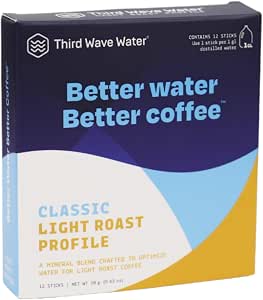 | Best Overall | Quantity: 12 single-gallon sticks | Total Yield: Up to 12 gallons of brewing water | Profile: Classic (Light Roast) | VIEW ON AMAZON | See Our Full Breakdown |
| Mineral Packs for Making Coffee Brewing Water (Makes 125 Gallons) |  | Best Value for Enthusiasts | Total Yield: 125 gallons of brewing water | Usage: Add one of each packet to five gallons of pure water | Includes: 25 packet sets | VIEW ON AMAZON | See Our Full Breakdown |
| Third Wave Water Dark Roast Coffee Water Minerals – 12 Sticks for 5 Gallon Containers |  | Best for Dark Roast Volume Brewers | Quantity: 12 sticks | Treats: 5 gallons per stick (60 gallons total) | Roast Type: Dark Roast | VIEW ON AMAZON | See Our Full Breakdown |
| Third Wave Water Dark Roast Profile Mineral Capsules – 12-Pack (Makes 12 Gallons) |  | Best for Machine Protection | Profile: Dark Roast / Low Acid | Quantity: 12 capsules | Treats: 12 gallons of water | VIEW ON AMAZON | See Our Full Breakdown |
| Old Limestone Mixing Water – 1000ml Bartop Bottle in Decorative Box |  | Best for the Bourbon Bar | Brand: Old Limestone | Volume: 1000ml | Water Type: Limestone-filtered spring water | VIEW ON AMAZON | See Our Full Breakdown |
| premium water solution for home barista | Quantity | Compatibility | Base Water Required |
|---|---|---|---|
| Third Wave Water Classic Light | 12 single-gallon sticks | Keurig, percolator, Moka pot, French press, drip, thermal brewers | — |
| Mineral Packs for Making Coffe | — | Pour-over, drip coffee makers, espresso | Reverse osmosis (RO) or distilled |
| Third Wave Water Dark Roast Co | 12 sticks | All coffee maker types | Distilled water |
| Third Wave Water Dark Roast Pr | 12 capsules | — | Distilled water |
| Old Limestone Mixing Water | — | — | — |
More Details on Our Top Picks
Third Wave Water Classic Light Roast Coffee Water Mineral Profile – 12 Single Gallon Sticks
This is the product I’d point most home baristas toward first, and the reason is simple: it removes nearly every barrier to entry while still delivering a genuinely optimized mineral profile. Each stick treats a single gallon of distilled water, which means you can make exactly as much brewing water as you need for the week without committing to a five-gallon batch. Compared with the 125-gallon Mineral Packets lower in this list, you pay more per gallon, but you gain flexibility — no jugs to store, no measuring, no wondering if a month-old batch has drifted.
The Classic Light Roast formulation leans on magnesium for sweetness and calcium for balanced body, a pairing that flatters the bright, fruity acidity of light roasts where most tap water falls flat. It works in everything from a Keurig to a French press to a Moka pot, so it suits multi-method households. The honest tradeoff: you must buy distilled water separately, and purists doing back-to-back cuppings may eventually outgrow the single profile and want the SCA-precise control the Mineral Packets provide. For everyone else, this is the sweet spot.
Pros:- Single-gallon portions keep every batch fresh and let you dial in small quantities
- Mineral blend tuned for the sweetness and clarity that light roasts depend on
- Compatible with virtually every brewing method, from Keurig to French press
- Straightforward to use — dissolve one stick, no measuring or chemistry knowledge needed
Cons:- Higher cost per gallon than bulk packet options like the 125-gallon Mineral Packets
- Requires purchasing distilled water separately for best results
Best for: Home baristas who want the best flavor-per-effort ratio and brew mostly light or medium roasts across multiple methods
Not ideal for: High-volume brewers who’d burn through sticks quickly, or anyone unwilling to buy distilled water separately
- Quantity:12 single-gallon sticks
- Total Yield:Up to 12 gallons of brewing water
- Profile:Classic (Light Roast)
- Minerals:Magnesium (sweetness), calcium (balanced body)
- Compatibility:Keurig, percolator, Moka pot, French press, drip, thermal brewers
- Preparation:Dissolve one stick per gallon of distilled water
- Notable:As seen on Shark Tank
Our verdict“The most balanced combination of price, convenience, and flavor impact makes this the default recommendation for most home baristas.”
Mineral Packs for Making Coffee Brewing Water (Makes 125 Gallons)
If you’ve committed to water chemistry as a permanent part of your routine, this is where the economics flip in your favor. Treating 125 gallons from 25 packet sets, this product costs a fraction per gallon of the single-gallon Third Wave Water sticks — and unlike those sticks, it’s formulated to meet Specialty Coffee Association Water for Coffee standards, which is the benchmark many café professionals build their recipes around. That precision is why I rank it above the Third Wave products for serious enthusiasts, even though it demands more from you as a user.
The workflow is more involved: each set requires adding one of each packet to five gallons of RO or distilled water, which means a mixing vessel, storage space, and a bit of planning. Where the Third Wave capsules shine for small-batch convenience, this product rewards you for batching. The published ingredient list — magnesium sulfate, calcium citrate, sodium bicarbonate, and sodium chloride — also gives tinkerers a starting point for understanding what each mineral contributes, spanning pour-over, drip, and espresso profiles in one system. The catch is that it’s overkill for someone brewing a few cups a week; the sticks make more sense at that volume.
Pros:- Lowest cost per gallon in this lineup by a wide margin
- Meets Specialty Coffee Association Water for Coffee standards
- One system covers pour-over, drip, and espresso profiles
- Published ingredient list lets you understand and refine your water chemistry
Cons:- Requires mixing five-gallon batches, which adds planning and storage demands
- Still depends on a separate supply of RO or distilled water
Best for: Enthusiasts and daily brewers who want SCA-standard water at the lowest per-gallon cost and don’t mind mixing five-gallon batches
Not ideal for: Casual brewers or anyone without space to store bulk water jugs
- Total Yield:125 gallons of brewing water
- Usage:Add one of each packet to five gallons of pure water
- Includes:25 packet sets
- Ingredients:Magnesium sulfate, calcium citrate, sodium bicarbonate, sodium chloride
- Base Water Required:Reverse osmosis (RO) or distilled
- Compatibility:Pour-over, drip coffee makers, espresso
- Standard:Meets SCA Water for Coffee standards
Our verdict“The enthusiast’s choice — SCA-aligned precision and unbeatable per-gallon economics for those willing to batch their brewing water.”
Third Wave Water Dark Roast Coffee Water Minerals – 12 Sticks for 5 Gallon Containers
This is the dark roast counterpart to the Classic sticks, but the two products are built for different households. Instead of single-gallon portions, each stick here treats five gallons at a time, totaling 60 gallons per box — a per-gallon cost that lands between the single-gallon Classic sticks and the bulk Mineral Packets. That makes this pick better suited to households that brew dark roast coffee daily in a drip machine or large pour-over setup, where a gallon disappears in a couple of days and single-gallon mixing becomes a chore.
The magnesium-and-calcium blend follows the same philosophy as the Classic profile but is tuned to complement the heavier, chocolate-and-caramel character of dark roasts. Compared with the Dark Roast capsules from the same brand, this version skips the capsule format’s scale-protection claims and low-acidity focus in favor of raw volume. One caution that separates it from every other pick here: the product itself notes it isn’t recommended for people hypersensitive to magnesium sulfate, and some users report stomach sensitivity. If you brew dark roasts only occasionally, the capsules are the smarter format; if you go through it by the gallon, this is the one.
Pros:- 60 total gallons per box — five times the yield of single-gallon stick packs
- Mineral profile tuned for the body and sweetness of dark roast coffee
- Works across all standard coffee maker types
- USA-made with a proven formulation
Cons:- Not recommended for users hypersensitive to magnesium sulfate
- Five-gallon batches require a suitable container and storage space
Best for: Dark roast drinkers who brew in volume and want lower per-gallon cost without managing 125-gallon bulk supplies
Not ideal for: Anyone sensitive to magnesium sulfate, or light roast drinkers who should choose the Classic profile instead
- Quantity:12 sticks
- Treats:5 gallons per stick (60 gallons total)
- Roast Type:Dark Roast
- Minerals:Magnesium, calcium
- Origin:Made in USA
- Base Water Required:Distilled water
- Compatibility:All coffee maker types
Our verdict“The volume play for dark roast households — same trusted brand, better economics, as long as your stomach agrees with the minerals.”
Third Wave Water Dark Roast Profile Mineral Capsules – 12-Pack (Makes 12 Gallons)
The capsules occupy a specific niche: dark roast drinkers who brew modest volumes and care about what their water is doing to their equipment. What distinguishes this formulation from its sibling, the 5-gallon dark roast sticks, is the patented blend with no temporary hardness — a design choice aimed at protecting brewing equipment from scale buildup. If you own an espresso machine or a drip brewer you’d rather not descale monthly, that distinction is worth paying a per-gallon premium for. The formulation also explicitly lowers perceived acidity, which flatters dark roasts that can taste harsh or sour with unbalanced water.
At one gallon per capsule, the format matches the Classic sticks for convenience: no batching, no storage jugs, just dissolve and brew. Against the 5-gallon sticks, you trade economy for freshness and equipment care; against the 125-gallon Mineral Packets, you trade precision and cost for simplicity. The drawbacks are real, though — replacement capsules are an ongoing subscription-style expense, and the profile is genuinely optimized only for dark roasts. Run a light roast Ethiopian through this water and you’ll mute exactly the brightness you paid for.
Pros:- Patented blend with no temporary hardness helps prevent scale in brewing equipment
- Lowers acidity for a smoother, rounder dark roast cup
- Single-gallon capsules keep every batch fresh with zero measuring
- Simple fit for espresso machines and small-batch brewing routines
Cons:- Ongoing cost of replacement capsules adds up over time
- Only optimized for dark roast coffee profiles
Best for: Dark roast brewers with espresso machines or expensive brewers who want scale protection and small, fresh batches
Not ideal for: Light and medium roast drinkers, or anyone put off by recurring capsule costs
- Profile:Dark Roast / Low Acid
- Quantity:12 capsules
- Treats:12 gallons of water
- Key Feature:Patented mineral blend, no temporary hardness
- Equipment Benefit:Protects against scale buildup
- Base Water Required:Distilled water
- Notable:As seen on Shark Tank
Our verdict“The pick for equipment-minded dark roast brewers — scale protection and low acidity in a convenient capsule, at a premium per gallon.”
Old Limestone Mixing Water – 1000ml Bartop Bottle in Decorative Box
Old Limestone is the outlier in this lineup, and I mean that in the most literal sense: it’s the only product here that is finished water, ready to pour, rather than a mineral supplement waiting for your distilled water. Tapped from the same limestone aquifer used by Kentucky bourbon makers, it exists to do one job brilliantly — a splash in your bourbon or crystal-clear ice for an old fashioned. For the home barista whose bar cart sits next to the espresso machine, it earns a place as the pour-side companion rather than a brewing ingredient.
As a brewing water for coffee, it doesn’t compete with the Third Wave products or the Mineral Packets — there’s no published mineral targeting for extraction, and the cost per gallon is dramatically higher than any supplement here. That’s not a failure; it’s a different mission. The limestone filtration gives it the calcium content that softens bourbon’s edge and rounds its mouthfeel, which is precisely why Kentucky distillers prize that aquifer. Presented in a bartop bottle with a decorative box, it’s also the only genuinely giftable item in this roundup. The drawbacks are environmental and economic: shipping water cross-country carries a real footprint, and it’s a niche product with no use beyond the whiskey glass.
Pros:- Sourced from the same limestone aquifer used by Kentucky bourbon distillers
- Ready to pour — no mixing, no distilled water required
- Attractive bartop bottle and decorative box make it a strong gift
- Family owned and operated company with genuine Kentucky provenance
Cons:- Niche product aimed at bourbon drinkers, with limited use for coffee brewing
- Shipping bottled water adds notable cost and environmental footprint
Best for: Whiskey lovers and gift-givers who want provenance-matched water for bourbon service and craft ice
Not ideal for: Coffee brewers seeking an extraction-optimized water, or anyone watching per-gallon costs
- Brand:Old Limestone
- Volume:1000ml
- Water Type:Limestone-filtered spring water
- Bottled In:Wilmore, Kentucky, USA
- Primary Use:Bourbon splash and ice cubes
- Packaging:Bartop bottle in decorative box
- Preparation:None — ready to pour
Our verdict“Not a coffee brewing water but a bourbon bar essential — buy it for the whiskey ritual, not the espresso machine.”
How We Picked
I evaluated these five products against the criteria that actually matter to a home barista choosing a premium water solution. Cost per gallon came first, because water is a consumable and the price gap between options ranges from under a dollar per gallon to several dollars. Second, I weighed mineral formulation and credibility — whether a product follows recognized standards like the Specialty Coffee Association’s Water for Coffee guidance, and whether the mineral blend is designed for a specific roast profile or a one-size-fits-all approach. Third, I considered convenience: how many steps stand between you and a jug of brewing water, and whether the product works across espresso machines, drip brewers, pour-over, and pods. Finally, I looked at equipment protection, since scale buildup inside an espresso machine is an expensive problem that some of these products actively address. I deliberately excluded plain bottled spring waters and cheap additive products with no published mineral logic, because a premium water solution should do more than a Brita filter.
| premium water solution for home barista | Compatibility | Base Water Required |
|---|---|---|
| Third Wave Water Classic Light | Keurig, percolator, Moka pot, French press, drip, thermal brewers | — |
| Mineral Packs for Making Coffe | Pour-over, drip coffee makers, espresso | Reverse osmosis (RO) or distilled |
| Third Wave Water Dark Roast Co | All coffee maker types | Distilled water |
| Third Wave Water Dark Roast Pr | — | Distilled water |
| Old Limestone Mixing Water | — | — |
Factors to Consider When Choosing Premium Water Solution For Home Barista
Choosing between these five products comes down to three questions: what you brew, how much of it you brew, and whether you’re willing to mix your own water. Here’s how I’d work through the decision.Roast Profile Matching
The single biggest differentiator among the mineral products here is roast targeting. The Classic Light Roast sticks are formulated to preserve the brightness and fruit that light roasts depend on, while both dark roast products from Third Wave Water are built to smooth acidity and reinforce body. Mismatching matters: a light roast brewed with dark-roast water will taste muted, and a dark roast with light-roast water can taste sharp. If you drink across the roast spectrum, the 125-gallon Mineral Packets are the most flexible since their formulation spans pour-over, drip, and espresso profiles without a roast-specific bias.
Cost Per Gallon and Volume
Do the math on your weekly consumption before choosing a format. If you brew a pot a day, you’ll consume several gallons a week, and the 125-gallon Mineral Packets or the 60-gallon dark roast sticks deliver far better economics than single-gallon formats. If you brew a few cups a week, single-gallon sticks and capsules avoid the stale-batch problem entirely — water sitting in a jug for a month loses the freshness benefit you paid for. And remember that every mineral product requires a separate purchase of distilled or RO water, typically a dollar or two per gallon, which should be part of your budget.
Equipment Protection
If an espresso machine is the centerpiece of your setup, scale is your long-term enemy, and not all of these products address it. The Dark Roast capsules are the only pick in this lineup with an explicit no-temporary-hardness, anti-scale formulation. The SCA-standard Mineral Packets are also machine-safe, but their formula isn’t marketed around descaling intervals the way the capsules are. For French press and pour-over brewers, scale matters far less, and you can prioritize flavor and cost instead.
Brewing Water Versus Serving Water
It’s worth separating two needs that often get lumped together. Brewing water — the 98% of your cup that touches the grounds — is what the four mineral products optimize. Serving water, like the splash that opens up a bourbon or the ice in a craft cocktail, is a different job entirely, and Old Limestone is the only product here designed for it. A well-rounded home bar can legitimately justify both: mineral sticks next to the kettle, a bartop bottle next to the whiskey.
Frequently Asked Questions
Do I really need distilled or RO water, or can I use tap water with these mineral products?
For the four mineral supplement products, distilled or reverse osmosis water is strongly recommended, and the reason is control. Tap water already contains dissolved minerals — sometimes a little, sometimes a lot, depending on your municipality — and adding a formulated supplement on top of an unknown base produces unpredictable results. The mineral blends in Third Wave Water and the SCA-standard packets are calculated assuming a near-zero mineral starting point, so distilled water guarantees the final chemistry matches the label. Using tap water won’t harm you, but it defeats the purpose of buying a precision product, and in hard-water regions it can still contribute to scale buildup in your machine.
Is Third Wave Water actually worth it compared to just filtering my tap water?
A carbon filter like a Brita removes chlorine and some odors, which is a genuine improvement, but it does almost nothing to correct mineral content — and minerals are what drive extraction. Coffee needs a specific balance of magnesium and calcium to pull sweetness and body from the grounds, and hardness that’s too high or too low produces dull or sour cups regardless of your beans. If your tap water happens to be naturally well-balanced, a filter may be all you need. But most municipal water isn’t, and that’s the gap a formulated mineral product fills. Given that a box of sticks costs less than a bag of specialty beans, the price-to-impact ratio is one of the best in coffee.
What’s the difference between the two Third Wave Water dark roast products?
Both carry the dark roast tuning — smoother acidity, reinforced body — but they differ in batch size and formulation focus. The 5-gallon sticks are the volume option: twelve sticks treat 60 gallons total, making them cheaper per gallon and better for households running a drip machine daily. The capsules treat one gallon each, keep every batch fresh, and use a patented no-temporary-hardness blend specifically designed to reduce scale buildup in equipment like espresso machines. If you brew dark roast in large quantities and own a basic coffee maker, choose the sticks. If you brew smaller batches or run expensive gear that you want to protect from scale, the capsules justify their higher per-gallon cost.
Can I use coffee mineral water in my espresso machine safely?
Generally yes, with one important distinction. The SCA-standard Mineral Packets and the Third Wave Water Dark Roast capsules are both formulated to be safe for coffee makers, and the capsules in particular are engineered with no temporary hardness, which is the property most responsible for scale deposits inside espresso boilers. The classic profiles contain calcium, which contributes to hardness, so if you live with very hard tap water normally and fight scale constantly, the low-hardness capsule formulation is the safer long-term choice for a machine with a boiler. For pod machines, drip brewers, and French presses, any of these products are perfectly safe. As a habit, whichever you use, descale on a regular schedule rather than assuming any water product eliminates maintenance entirely.
Why would anyone buy bottled water like Old Limestone instead of using tap water for bourbon?
The argument is about mineral interaction, not purity for its own sake. Bourbon is typically bottled at higher proof and cut by the drinker, and the water you cut it with changes the flavor — Kentucky’s limestone aquifer is famous among distillers precisely because its calcium content rounds the spirit’s edges and enhances mouthfeel while the filtration removes iron and other off-flavors common in well and municipal water. If your local tap water is chlorinated, mineral-imbalanced, or simply tastes off, that character lands directly in your glass. Old Limestone replicates the exact water bourbon makers themselves use, which is a claim no filter can make. Whether that provenance is worth the shipping cost is a personal call, but as a gift for a whiskey enthusiast, it lands remarkably well.
Conclusion
Matching the right product to your routine is easier than it looks. If you’re a light or medium roast brewer wanting the simplest upgrade, go with the Third Wave Water Classic Light Roast sticks — the best overall balance of cost, convenience, and flavor in this lineup. If you brew daily and think in cost-per-gallon terms, the 125-gallon Mineral Packets win on economics and bring SCA-standard precision that enthusiasts will appreciate. If dark roast is your house style, choose the 5-gallon sticks for volume or the capsules if you run an espresso machine and want scale protection. If your goal is gifting or elevating a whiskey ritual, Old Limestone Mixing Water is the only finished, pour-ready option here and the clear pick for the bourbon side of the bar. Whatever you choose, remember that all four mineral products assume you’ll supply distilled or RO water — so the real decision is how much chemistry you want to manage in pursuit of a better cup.
Halloween Picks
halloween
As an affiliate, we earn on qualifying purchases.