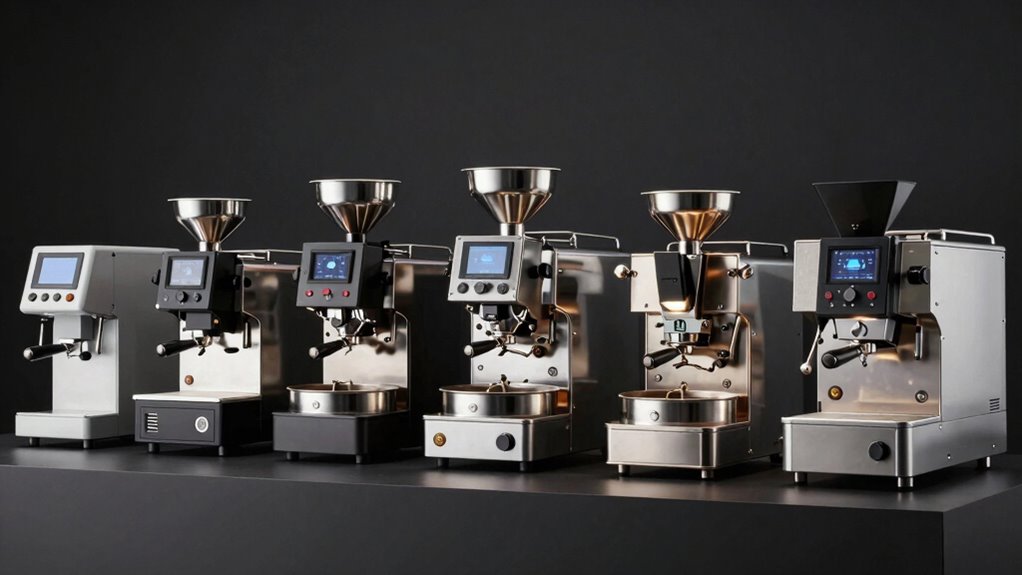

A sample coffee roaster machine is built for one job: roasting small batches consistently so you can judge green coffee accurately, whether you are a home roaster profiling beans or a professional cupping new lots. My top pick overall is the Kaffelogic Nano 7 (Nano110vBoost), because its programmable roast profiles and tight batch control produce results closer to a lab sample roaster than anything else in this lineup at its size. For beginners, the Fresh Roast SR800 bundle stands out for its forgiving fluid-bed design and included accessories, while the 500g Automatic Roaster with smoke filter is the value play if you want drum-style roasting with less smoke in the kitchen. The main tradeoff in this category is precision versus simplicity — fluid-bed roasters are faster and easier but harder to profile, while drum-style machines offer more control at the cost of a steeper learning curve. Read on for the full breakdown of all eight machines.

Get coffee and tea gear delivered free — and shop member deals
- Fast, free delivery on millions of items
- Access to Prime Big Deal Days deals on October 6–7
- Prime Video, Amazon Music and more included
Complete the kit


Key Takeaways
- The two Kaffelogic Nano 7 variants were the only machines in this lineup with true programmable roast profiles, which is what separates a real sample roaster from a hobby home roaster.
- Three of the eight machines (the 500g Automatic, NIASIA, and GIVEROO) are near-identical 500g drum designs, so the differences come down to thermostat consistency, chaff management, and included accessories rather than core capability.
- Smoke filters were inconsistent across the lineup — machines marketed as having them ranged from genuinely effective to largely cosmetic, which matters a lot for indoor roasting.
- The Fresh Roast SR800’s glass extension tube bundle solved the small-batch limitation of stock fluid-bed roasters, making it the strongest option for sub-100g sample roasts.
- The WINB and 1-Pound Automatic roasters trade precision for capacity and price; they can roast samples but lack the repeatability serious cupping demands.
- Batch size expectations should drive the decision: anything over 200g per batch is a home roaster, not a sample roaster, regardless of how it is marketed.


| sample coffee roaster machine | Voltage | Model |
|---|---|---|
| 500g Automatic Coffee Roaster | 110V | — |
| Fresh Roast SR800 Coffee Roast | — | RM (SR800) |
| NIASIA 500 g Automatic Coffee | 110V | PKF-500g |
| 1-Pound Automatic Electric Cof | 110 volts | — |
| Kaffelogic Nano 7 Home Coffee | 110V or 220V | Nano 7 (Nano110vBoost) |
| Kaffelogic Nano 7 Coffee Roast | — | Nano110 |
| GIVEROO 500g Electric Coffee B | 110V | — |
| WINB Home Coffee Bean Roaster | 110V, 60Hz | — |
More Details on Our Top Picks
500g Automatic Coffee Roaster Machine for Home Use with Smoke Filter and Chaff Collector
This drum roaster earns the top spot because it solves the two biggest home-roasting headaches: smoke management and repeatability. The dual exhaust setup — a purifier for light roasts and twin aluminum pipes for darker profiles — gives it an edge over the NIASIA PKF-500g, which shares the same chassis but expects you to vent darker roasts outdoors without question. Nine built-in profiles plus a manual artisan mode mean a novice can press start on day one, then graduate to airflow control (90–100 at first crack) once they understand what they’re tasting. The separate cooling tray with high-speed fan matters more than it sounds — beans that cool in the drum keep cooking and flatten the cup.
The tradeoff is honesty about capacity: you’ll get better results at 350–400g than the advertised 500g, and defective green beans can jam the drum. Compared with the 1-Pound Automatic Roaster, this one handles dark roasts more gracefully, which is why it leads the lineup.
Pros:- Dual smoke exhaust handles light, medium, and dark roasts without guesswork
- Both automatic profiles and manual artisan mode suit growing skills
- Separate cooling tray with high-speed fan stops carryover roasting
- Chaff collector and transparent window make monitoring and cleanup simple
Cons:- Best results require under-loading to 350–400g despite the 500g rating
- Beans with defects or uneven sorting can jam the drum
- Not built for commercial or high-frequency roasting
Best for: Home roasters who want automatic convenience today and manual control later, with real smoke management for all roast levels
Not ideal for: Anyone hoping to run small-batch commercial production — it’s built for domestic duty cycles and will disappoint under daily heavy use
- Capacity:500g per batch (optimal 350–400g)
- Voltage:110V
- Drum Material:Stainless steel
- Roasting Profiles:9 built-in profiles
- Modes:Automatic and manual (artisan)
- Smoke Exhaust:Smoke purifier + 2 aluminum alloy pipes
- Cooling:High-speed fan and separate cooling tray
- Intended Use:Home and small cafes; not commercial
Our verdict“The most balanced home drum roaster here — buy it if you want one machine that grows with your skills and handles every roast level.”
Fresh Roast SR800 Coffee Roaster Bundle with Glass Extension Tube, Digital Scale, Green Coffee Beans, and Chaff Brush
Most roasters in this roundup arrive naked — you still need a scale, beans, and accessories before your first batch. This bundle closes that gap entirely: the SR800 roaster, a digital scale with timer, two pounds of green coffee, sample trays, and a chaff brush land on your counter together, which makes it the least intimidating entry point in the lineup. The glass extension tube is the quiet differentiator — it improves bean circulation and heat distribution in a fluid-bed design, letting you stretch roasts closer to drum-roaster character than the base SR800 alone.
The tradeoff is scale. At 6–8 oz per batch, it roasts roughly a third of what the 500g drum machines handle, so a week’s coffee means multiple sessions. Compared with the Kaffelogic Nano 7, it lacks programmable profiles and PID control — but the Nano 7 assumes you already know what a roast curve is. This kit assumes nothing, and the one-year warranty backs the learning curve.
Pros:- Everything needed to roast on day one, including 2 lbs of green beans
- Glass extension tube improves bean movement and heat distribution
- Digital scale with built-in timer teaches proper batch weighing from the start
- One-year manufacturer warranty covers the learning period
Cons:- Small 6–8 oz batch capacity means frequent roasting sessions
- No programmable profiles or roast-curve software for advancing skills
Best for: Complete beginners who want everything in one box and value fast, visible fluid-bed roasts over batch size
Not ideal for: Households drinking more than a few cups daily — the small batch size turns coffee supply into a roasting chore
- Brand:Fresh Roast
- Model:RM (SR800)
- Roaster Capacity:6–8 oz per batch
- Included Green Coffee:2 lbs
- Components:Roaster, glass extension tube, digital scale, sample trays, chaff brush
- Warranty:1 year
- Power:Electric, whole bean (unroasted)
Our verdict“The fastest path from zero to home-roasted coffee — pick this if you’d rather start roasting tonight than shop for accessories.”
NIASIA 500 g Automatic Coffee Roaster for Home Use
If the top pick’s feature list appeals but the budget doesn’t stretch that far, the NIASIA PKF-500g delivers the same core formula — 500g drum, nine profiles, automatic and manual modes, purifier plus exhaust pipes, separate cooling tray — at a friendlier price. What you give up is polish: unlike the 500g Automatic Coffee Roaster above it, this unit leans on you to vent medium and dark roasts outdoors, so apartment roasters chasing French roast profiles should think twice. For light and medium roasts, though, the smoke purifier handles most of the work indoors.
The practical reality mirrors its pricier sibling: 350–400g batches perform better than a full 500g load, and inconsistent green beans risk jamming the stainless drum, so buy sorted coffee. Compared with the Fresh Roast SR800 bundle, you get triple the batch size but no accessories — bring your own scale and beans. For a value-minded roaster with a window or balcony for the darker profiles, that math works.
Pros:- Same 500g drum capacity and nine profiles as pricier rivals
- Manual and automatic modes cover both skill levels
- Smoke purifier handles light roasts indoors
- Separate cooling tray with high-speed fan protects flavor
Cons:- Medium and dark roasts require venting smoke outside
- Defective or inconsistent beans can jam the drum
- No included accessories — scale, beans, and trays sold separately
Best for: Budget-conscious home roasters with access to outdoor venting who want drum-roaster capacity without the premium price
Not ideal for: Apartment dwellers without a window or venting option — medium and dark roasts will smoke out the kitchen
- Brand:NIASIA
- Model:PKF-500g
- Voltage:110V
- Maximum Batch Capacity:500g (recommended 350–400g)
- Roasting Modes:Manual and automatic
- Roasting Profiles:9
- Drum Material:Stainless steel
- Cooling:High-speed fan and separate cooling tray
- Color:Black
Our verdict“The smart budget play if you can vent darker roasts outdoors and already own a scale — same core capability as the leader for less.”
1-Pound Automatic Electric Coffee Roaster with Smoke Filter
When 500g isn’t enough, this machine’s 16-ounce capacity makes it the volume leader of the roundup — roughly a full pound of green beans per session, cutting your roasting frequency noticeably compared with the NIASIA or the top pick’s 350–400g sweet spot. The three-tier control scheme is the other draw: automatic, assisted, and manual modes on a touchscreen, with the assisted middle ground letting you intervene at key moments without owning the whole roast — a stepping stone the two 500g drum roasters skip entirely.
The compromises are real. Despite its bulk (19 inches deep, it will claim counter space), it leans toward light roasting — the microfilter and vent setup don’t manage dark-roast smoke the way the Best Overall pick’s dual exhaust does. And like every machine here, it’s explicitly not commercial-rated, so the big drum buys household convenience, not café throughput. Buy it for volume and flexibility, not for espresso-blend darkness.
Pros:- Full 1-pound batch capacity, the largest in this lineup
- Assisted mode bridges the gap between automatic presets and full manual control
- Touchscreen interface simplifies profile selection
- Viewing window and sample spoon support mid-roast monitoring
Cons:- Best suited to light roasting; dark roasts overwhelm the filter setup
- Large footprint at 19 inches deep demands serious counter space
- Not rated for commercial use despite the bigger drum
Best for: Multi-coffee households that roast light-to-medium profiles and want fewer, larger batches per month
Not ideal for: Dark-roast enthusiasts — the smoke management and filter design are tuned for lighter profiles
- Capacity:16 ounces (1 pound)
- Operation Modes:Automatic, assisted, and manual
- Voltage:110 volts
- Input Interface:Touchscreen
- Filter Type:Microfilter
- Dimensions:19 × 10.01 × 15 inches (D × W × H)
- Material:Stainless steel
- Included Features:Smoke filter, vent pipe, 2 chimney tubes, chaff collector, observation window, sample spoon
Our verdict“The pick for households that roast in volume and favor lighter profiles — just measure your counter before ordering.”
Kaffelogic Nano 7 Home Coffee Roaster – Professional Sample Roaster (Nano110vBoost), Black
The Nano 7 plays a different sport than everything else here. Where the 500g drum machines target households, this is a genuine professional sample roaster — the tool a roastery or green-bean buyer uses to evaluate coffee consistently. Its PID temperature control with look-ahead and gain scheduling holds roast curves tighter than any thermostat-based rival, and Kaffelogic Studio software lets you save, tweak, and share profiles, which no other pick in this roundup offers. Batch flexibility from 50g to 200g (with the Boost Kit) matches how sample roasting actually works: small, precise, repeatable.
The tradeoffs follow from that focus. Capacity is modest next to the 1-Pound Automatic Roaster, so it won’t feed a household efficiently, and the full 50–200g range requires the optional Boost Kit — the stock configuration centers on 100–120g green loads. But if your goal is understanding coffee rather than producing it in bulk, nothing else here comes close, and the two-year warranty reflects professional-grade confidence.
Pros:- PID temperature control with look-ahead delivers roast-to-roast consistency no rival here matches
- Kaffelogic Studio software saves, edits, and shares roast profiles
- Flexible 50–200g batch range (with Boost Kit) suits true sample roasting
- Two-year warranty — the longest coverage in this lineup
Cons:- Full batch range requires the optional Boost Kit add-on
- Small capacity makes household-scale roasting inefficient
- Premium positioning assumes you care about curves, not just cups
Best for: Aspiring roasters, cuppers, and small roasteries that need repeatable, profile-driven sample roasts for evaluating green coffee
Not ideal for: Anyone roasting for daily household supply — the small batches and precision-first design make bulk production tedious
- Brand:Kaffelogic
- Model:Nano 7 (Nano110vBoost)
- Voltage:110V or 220V
- Recommended Batch Size:80–100g roasted (100–120g green)
- Batch Range with Boost Kit:50–200g green coffee
- Temperature Control:PID with look-ahead and gain scheduling
- Controls:Variable temperature and fan speed, fully programmable
- Software:Kaffelogic Studio (included)
- Warranty:2 years
Our verdict“The choice for precision — buy it if roast profiling and cupping matter more than pounds per hour.”
Kaffelogic Nano 7 Coffee Roaster – Professional Sample Roaster (Nano110), Standard
Among the machines in this lineup, the Kaffelogic Nano 7 is the only one built with genuine lab-grade sample roasting in mind. Its PID temperature control with look-ahead and gain scheduling translates into repeatable roast curves — something the GIVEROO and WINB simply cannot replicate with their basic dial-and-timer designs. For anyone evaluating green coffee lots, that repeatability is the whole point: a sample roast is only useful if you can reproduce it.
The tradeoffs are real, though. The full 50–200g batch range requires an optional Boost Kit, and you must commit to either 110v or 220v at purchase. Compared with the plug-and-play simplicity of the WINB, this is a machine that rewards users willing to program and refine their profiles.
Pros:- PID control with look-ahead and gain scheduling delivers repeatable, profile-based roasts
- Flexible 50–200g batch range suits true sample roasting workflows
- Fully user programmable for custom roast curves
- Compact footprint fits a countertop or lab bench
Cons:- Boost Kit add-on required to unlock the full 50–200g batch range
- Must choose between 110v and 220v models at purchase with no switching later
Best for: Coffee professionals, QC labs, and serious home roasters who need repeatable small-batch profiles for evaluating green coffee
Not ideal for: Casual buyers wanting a cheap, no-learning-curve appliance — the smaller batch sizes and programming workflow demand more engagement than a GIVEROO-style machine
- Model:Nano110
- Wattage:1400 watts
- Power Source:Electric (110v or 220v)
- Batch Size Range:50–200 g (with Boost Kit)
- Recommended Batch Size:80–100 g roasted (100–120 g green)
- Dimensions:4.9″D x 4.9″W x 16.9″H
- Weight:14 pounds
- Control:PID with look-ahead and gain scheduling, fully programmable
Our verdict“If repeatable, professional-grade sample roasts matter more than capacity or simplicity, this is the machine to buy.”
GIVEROO 500g Electric Coffee Bean Roaster Machine with Timer, 110V
Where the Kaffelogic Nano 7 prioritizes precision in tiny 50–200g batches, the GIVEROO goes the opposite direction: capacity. With an optimal load of 400–500g (and a stated maximum of 800g), it roasts roughly four to five times what the Nano 7 handles in one pass — a meaningful difference if you’re supplying a household or small café rather than scoring samples.
The automatic auger system agitates beans continuously, which does most of the evenness work for you, and the transparent glass cover lets you watch color development mid-roast. The catch is that it’s finicky about inputs: small or defective beans can jam the auger, and underloading below 400g produces uneven results. Compared with the WINB, it’s similar in concept but more demanding about batch discipline.
Pros:- Automatic auger system delivers even, hands-off roasting
- Large 800g capacity with a practical 400–500g optimal load
- Transparent glass cover for monitoring roast progression
- Versatile enough for peanuts, chestnuts, barley, and popcorn
Cons:- Small or bad beans can jam the auger if not sifted beforehand
- Loading under 400g produces uneven roasting, ruling out small sample batches
Best for: Home roasters or small café owners who need consistent 400–500g batches without manual stirring
Not ideal for: Sample roasters and small-batch experimenters — loads under 400g roast unevenly, making it poor for testing single lots
- Capacity:800 g (optimal 400–500 g)
- Voltage:110V
- Temperature Range:0–240°C
- Timer:Yes
- Pot Material:Non-stick, non-toxic coating
- Stirring:Automatic auger system
Our verdict“A sensible pick when volume matters more than precision, provided you commit to full-size batches every time.”
WINB Home Coffee Bean Roaster
The WINB occupies the entry-level slot in this lineup. It shares the same basic formula as the GIVEROO — adjustable heat, a timer, a stirring mechanism, and a see-through lid — but with a 100–240°C range and 60-minute timer that give beginners enough control to learn roast development without overwhelming them. Its ability to handle up to 750g looks generous on paper, but the honest sweet spot is 300–500g, which puts its practical capacity in the same league as the GIVEROO despite the bigger headline number.
The real compromise is build: the product information lists plastic as the material, a step down from the GIVEROO’s non-stick pot and nowhere near the Kaffelogic’s powder-coated steel and aluminium chamber. Treat it as a learning tool, not a long-term workhorse.
Pros:- Adjustable temperature (100–240°C) and 60-minute timer offer genuine learning control
- Transparent lid allows visual monitoring of roast color
- Stirring rod keeps beans moving without manual effort
- Handles peanuts, barley, and popcorn beyond coffee
Cons:- Stated 750g maximum exceeds the realistic 300–500g optimal batch size
- Plastic construction raises questions about durability under regular high-heat use
Best for: First-time roasters who want to experiment with 300–500g batches at low cost before committing to a serious machine
Not ideal for: Anyone chasing durability or repeatable results — the plastic construction and vague capacity claims won’t satisfy serious or frequent roasters
- Voltage:110V, 60Hz
- Temperature Range:100–240°C (212–464°F)
- Timer:0–60 minutes
- Maximum Capacity:750 g (1.65 lb)
- Optimal Batch Size:300–500 g
- Roasting Time:About 25 minutes for 750 g
- Material:Plastic
Our verdict“A reasonable first step into home roasting if you accept plastic build and modest real-world capacity as the price of admission.”

How We Picked
I evaluated each machine against the criteria that actually matter for sample roasting: batch size flexibility (a good sample roaster handles 50–150g reliably), repeatability (can you reproduce a roast profile twice in a row?), smoke and chaff management for indoor use, and visibility into the roast through glass or accessible sampling. I also weighed build quality, ease of cleaning between different green lots, and whether the controls allow meaningful adjustment or just a timer dial.
The ranking logic follows a simple hierarchy: machines with programmable profiles and proven repeatability sit at the top, because sample roasting exists to produce comparable results across lots. Accessory-rich bundles that reduce setup friction rank next, followed by value drum roasters that work well for casual sampling. Machines that prioritize capacity over control sit lower, since big batches and imprecise thermostats undermine the whole point of profiling green coffee.
| sample coffee roaster machine | Model |
|---|---|
| 500g Automatic Coffee Roaster | — |
| Fresh Roast SR800 Coffee Roast | RM (SR800) |
| NIASIA 500 g Automatic Coffee | PKF-500g |
| 1-Pound Automatic Electric Cof | — |
| Kaffelogic Nano 7 Home Coffee | Nano 7 (Nano110vBoost) |
| Kaffelogic Nano 7 Coffee Roast | Nano110 |
| GIVEROO 500g Electric Coffee B | — |
| WINB Home Coffee Bean Roaster | — |
Factors to Consider When Choosing Sample Coffee Roaster Machine
Before choosing a sample roaster, it helps to understand what separates genuine sample-roasting capability from general home roasting, and where most buyers overspend or buy the wrong tool entirely.Repeatability Beats Features
The single biggest mistake buyers make is prioritizing capacity or accessories over roast-to-roast consistency. A sample roaster exists so you can compare two green lots side by side, and that comparison is meaningless if one roast ran hot and the other didn’t. Machines with programmable profiles or at minimum a reliable thermostat and adjustable fan will always outperform timer-only roasters for this purpose. If a machine only lets you set a countdown timer, you are controlling duration but not energy — two roasts of the same length can land at wildly different temperatures. Ask yourself whether you will actually compare lots, or just roast for yourself; the answer determines how much repeatability is worth paying for.
Batch Size and How Small You Actually Go
Sample roasting typically means 50g to 150g batches, and many machines marketed as sample roasters actually struggle below 200g. Fluid-bed roasters naturally handle small loads better because airflow, not drum contact, does the work. Drum machines with a large 500g chamber often roast tiny batches unevenly, with beans sitting against a hot wall rather than tumbling freely. Check the manufacturer’s stated minimum batch, not just the maximum — the minimum is the number that matters for cupping. Buyers who plan to roast full 500g batches for drinking should skip the sample-roaster framing entirely and buy a home roaster.
Smoke Management for Indoor Use
Roasting produces smoke, especially past second crack, and a “smoke filter” means very different things on different machines. Some units include a activated carbon filter that genuinely reduces kitchen smoke; others have a thin screen that catches chaff but lets smoke straight through. If you roast indoors without strong ventilation, this is the factor most likely to make or break your experience. Fluid-bed roasters generally produce less smoke at sample sizes simply because the batch is small. Plan for roasting near a window or under a range hood regardless — no filter in this price range fully eliminates smoke at darker roast levels.
Drum vs. Fluid-Bed: The Core Design Tradeoff
Fluid-bed (hot air) roasters are fast, clean, and easy to learn, with excellent bean visibility through glass — but they develop flavor quickly and can taste “one-dimensional” compared to slower roasts. Drum roasters take longer and cost more to do well, but they allow longer development times that many roasters prefer for judging potential in a green lot. Professional sample roasters are almost always drum-based for this reason. For casual cupping, a fluid-bed machine is usually enough; for buying decisions on expensive lots, drum roasting gives a more honest preview of how the coffee will perform commercially.
Total Cost of Ownership
The sticker price is rarely the full cost. Budget for green coffee (you will burn through beans while learning), replacement parts like heating elements and filters, and possibly a venting setup. Bundles that include scales, beans, and accessories can offset real costs for beginners, though the accessories are usually entry-grade and get replaced later. Also factor in longevity: machines with sealed electronics and no replaceable parts effectively have a shelf life, while modular designs can be repaired. A cheaper roaster that dies after a year of daily sampling costs more than a durable one bought once.
Chaff Collection and Cleaning Between Lots
This is the most overlooked factor in sample roasting. When you roast multiple lots back to back for a cupping table, cross-contamination of chaff and residue between batches can muddy your comparisons. Look for machines with removable, washable chaff collectors and accessible roasting chambers. Glass components help here — you can see residue building up and clean it immediately. Drum machines with enclosed chambers require more deliberate cleaning routines, which adds time to every cupping session. If you roast a new lot only occasionally, this matters far less than if you profile several coffees in one afternoon.
Frequently Asked Questions
Can I use a regular home coffee roaster for sample roasting?
You can, but with limits. The defining requirements of sample roasting are small minimum batches and repeatable results, and many home roasters are designed around larger loads where they perform best. A 500g drum roaster roasting a 100g sample often produces uneven results because the beans tumble poorly in a mostly empty drum. Fluid-bed home roasters generally handle small batches better since airflow drives the roast. If you already own a home roaster, try a small batch first and check for even color development before assuming it will work for cupping — uneven samples will mislead your evaluation of the green coffee itself.
What batch size should I roast for a proper cupping sample?
The standard approach is enough coffee for a cupping bowl set — typically 100g to 150g of green coffee, which yields roughly 85g to 130g roasted, enough for three to five bowls plus retastes. Roasting much smaller batches makes it hard to evaluate the coffee fairly because slight temperature variations affect a tiny mass of beans disproportionately. Roasting much larger batches wastes green coffee you may be evaluating for purchase. Consistency matters more than the exact number: always roast the same batch size across lots you are comparing, because batch size changes roast dynamics and will skew your comparison.
Is the more expensive Kaffelogic Nano 7 Boost version worth it over the standard model?
The Boost variant exists to deliver more heat and airflow, which matters most if you roast at larger sample sizes or want faster roast development without the machine struggling. For strictly minimal 50g to 100g batches, the standard model performs well and the extra power goes underused. Where the Boost earns its premium is repeatability at the top of the roast range — hitting dark roast levels or maintaining profile accuracy in a cold room. If your sample roasting stays light-to-medium and your batches stay small, the standard version is the smarter spend. Buyers planning to roast for others or evaluate many lots weekly will get more from the Boost.
Do I really need a smoke filter if I roast small batches?
Small batches produce less smoke than full home-roasting loads, but the smoke is still real, especially if you develop roasts past first crack for evaluation purposes. A carbon filter meaningfully reduces odors in an apartment or closed kitchen, which affects how often you will actually roast — nobody continues a hobby that sets off the smoke alarm. That said, no filter in this category replaces ventilation, and roasting under a range hood or near an open window outperforms any built-in filter. If you roast outdoors or in a garage, you can deprioritize the filter and save money. Indoor-only roasters should treat smoke management as a first-tier requirement, not an afterthought.
Why are so many 500g roasters on the market nearly identical?
Many 500g home drum roasters sold under different brand names come from the same few OEM factories, sharing the same chassis, heating element, and drum design with minor cosmetic differences. This is why specs look interchangeable across listings and why real differences show up in quality control, thermostat calibration, and support rather than features. When comparing these machines, look at the seller’s responsiveness, warranty terms, and parts availability rather than the spec sheet, since the hardware is often the same. Accessories in the box vary meaningfully between sellers even when the machine does not. This also means a lower-priced version of a familiar design is often the same machine — but verify return policies before betting on it.
Conclusion
The right pick depends entirely on how seriously you sample roast. For best overall, the Kaffelogic Nano 7 Boost is the clear leader — its programmable profiles and repeatable small-batch performance make it the only machine here that behaves like a true professional sample roaster. For best value, the 500g Automatic Coffee Roaster with smoke filter and chaff collector delivers drum roasting and reasonable consistency at a price that leaves room in the budget for green coffee. For beginners, the Fresh Roast SR800 bundle is the smartest entry point: forgiving, fast, and complete with everything needed to roast a first batch the day it arrives. For premium buyers who want sample-grade precision without the Boost model’s extra power, the standard Kaffelogic Nano 7 covers small-batch profiling at a slightly lower cost. And for casual roasters who mostly drink their roasts and only occasionally sample, the GIVEROO 500g or WINB machines trade precision for capacity and simplicity — a fair trade if cupping accuracy is not your priority. Match the machine to your batch sizes and repeatability needs, not the marketing, and you will land on the right one.
Fall Picks
fall essentials
As an affiliate, we earn on qualifying purchases.