Coffee storage canisters exist to solve one problem: whole beans start losing aroma within days of exposure to oxygen, light, and moisture, and a bad container makes that decline faster. The AirScape by Planetary Design 2.2 lbs takes the top spot here because its piston lid actively pushes air out rather than just sealing it in — a design advantage no clamp lid or screw top in this lineup can match. For budget-conscious buyers, the Veken 22 oz canister with window delivers a genuinely airtight seal, a scoop, and a date wheel for a fraction of the price, while the glass sets with bamboo lids suit buyers who prioritize counter aesthetics over long-term freshness. The main tradeoffs you will face are steel versus glass (light protection versus visibility), single-purpose versus multi-canister sets, and passive airtight seals versus active air evacuation. Read on for the full breakdown of all twelve.
Complete the kit


Key Takeaways
- Only one product in this roundup — the AirScape 2.2 lbs — actively removes air from the container; every other canister relies on a passive airtight seal, which preserves freshness well but cannot match piston-style air displacement.
- The Veken lineup (16 oz, 22 oz, 39 oz) appears four times because it hits the best price-to-seal-quality ratio in the category, but the sizes are not interchangeable: the 16 oz forces frequent refills for anyone buying 12 oz bags, while the 39 oz swallows two full bags.
- Every glass option in this comparison — including the ANSQU jar and both glass sets — lets you see your beans, which is convenient but means exposing coffee to light; glass picks trade freshness longevity for visibility and styling.
- The 2×63 oz stainless steel set and the Oggi 62 oz clamp-lid canister target bulk buyers, and their larger openings make scooping easier, but both have bulkier footprints that overwhelm small countertops.
- Date trackers separate serious coffee storage from repurposed kitchen jars: the Veken models include date wheels, while the Oggi, AirScape, and glass options offer no way to track roast dates without adding your own label.




| coffee storage canister | Material | Capacity | Seal |
|---|---|---|---|
| Veken Coffee Canister with Win | 304 stainless steel | 22 oz | Airtight silicone seal |
| Veken 39OZ Coffee Canister | 304 stainless steel | 39 oz (2.2 lbs) | Airtight silicone seal |
| ANSQU Glass Jar with Spoon | Borosilicate glass, bamboo, silicone | 20.3 oz | Airtight silicone-sealed wooden lid |
| 2×63 oz Stainless Steel Coffee | Stainless steel | 2 x 63 oz (126 oz total) | Airtight silicone gasket lids |
| 17 oz Coffee Canister with Sco | Borosilicate glass | 500 ml (17 oz) per jar | — |
| Veken Coffee Canister with Win | 304 stainless steel | 16 oz | Silicone seal |
| Set of 5 Glass Kitchen Caniste | Borosilicate glass with stainless steel lids | — | Silicone ring |
| Veken Coffee Canister with Win | 304 stainless steel | 22 oz | Silicone seal |
| Oggi Stainless Steel Coffee Ca | Stainless steel | 62 fl oz | Silicone gasket |
| Veken Coffee Canister with Win | 304 stainless steel | 22 oz | Silicone rubber seal |
| AirScape by Planetary Design 2 | Stainless steel | 2.2 lbs of coffee | — |
| Coffee Container | Borosilicate glass | 10 oz per canister | Leak-proof with unidirectional exhaust system |
More Details on Our Top Picks
Veken Coffee Canister with Window, Airtight Stainless Steel Container, 22 OZ
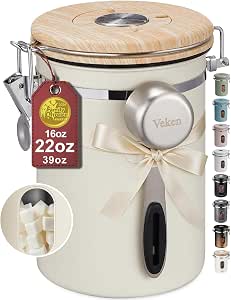
This Veken 22 oz canister earns my top spot because it balances the features that actually matter for coffee freshness without padding the price. The one-way CO2 valve is the standout — freshly roasted beans release gas, and unlike the ANSQU Glass Jar, which relies on a simple silicone seal, this model lets that gas escape without letting oxygen in. I also appreciate the viewing window, something the larger Veken 39 oz gives up entirely; I can check bean levels without breaking the seal. The date tracker on the lid solves the single most common coffee storage mistake: forgetting when beans were opened. Compared with the 2×63 oz set, it’s far more compact, though 22 oz means frequent refills if I buy beans in bulk.
Pros:- One-way CO2 valve manages off-gassing from fresh roasts
- Viewing window lets you check contents without breaking the seal
- Date tracker tracks bean freshness
- Durable 304 stainless steel blocks light completely
Cons:- 22 oz capacity is tight for one-pound bags
- Hand-washing is recommended, adding cleanup effort
Best for: Daily coffee drinkers who buy 12 oz bags of whole beans and want maximum freshness per cup
Not ideal for: Bulk buyers or households with multiple coffee drinkers — 22 oz forces constant refills
- Capacity:22 oz
- Material:304 stainless steel
- Seal:Airtight silicone seal
- Valve:One-way CO2 valve
- Extras:Date tracker, viewing window, stainless steel scoop
- Best for:Whole bean coffee, standard 12 oz bags
Our verdict“If you buy standard 12 oz bags and care most about freshness, this is the canister to beat.”
Veken 39OZ Coffee Canister, Airtight Stainless Steel Container for Coffee Storage
When one pound of beans at a time is the norm, the Veken 39 oz canister is the right tool. It holds a full 2.2 lbs of beans — nearly double the 22 oz Veken with window — so I can decant an entire bulk bag at once instead of storing the rest in a half-closed bag. It keeps the same CO2 valve and date tracker as its smaller sibling, so freshness protection doesn’t slip as capacity grows. The tradeoff is honest: with no viewing window, I’m opening the lid to check levels, and the taller footprint crowds a small counter. Compared with the 2×63 oz set, it’s a single-canister solution — less organizational hardware, but also less total storage and no shelf display.
Pros:- Holds a full pound-plus of beans in one fill
- CO2 valve handles fresh-roast off-gassing
- Blocks all light to protect oils and flavor
- Doubles as storage for tea, sugar, and dry goods
Cons:- No window means opening the lid to check levels
- Footprint is bulky for compact counters
Best for: Bulk shoppers and subscribers who receive one-pound or larger bags of whole beans
Not ideal for: Small kitchens or anyone who likes to visually confirm contents — it’s tall, opaque, and bulky
- Capacity:39 oz (2.2 lbs)
- Material:304 stainless steel
- Seal:Airtight silicone seal
- Valve:One-way CO2 valve
- Extras:Date tracker, stainless steel scoop
- Window:No
- Use:Coffee beans, grounds, tea, sugar, dry goods
Our verdict“The clear choice if you buy coffee by the pound and want it all in one airtight container.”
ANSQU Glass Jar with Spoon, 20.3oz Airtight Coffee Bean Container
The ANSQU glass jar is the one I’d put on display. Its borosilicate glass body and bamboo lid give a modern farmhouse look that stainless options like the Veken 39 oz can’t match, and the built-in spoon slot in the lid is genuinely clever — no more digging for a scoop. Full transparency means I always know exactly what’s inside, beating both Veken models on visibility. The compromises are real, though: glass lets light in, and light degrades coffee oils, so this works better for beans I’ll finish within a couple of weeks. The bamboo lid needs hand washing, unlike the fully dishwasher-safe 2×63 oz stainless set. At 20.3 oz, capacity sits at the small end, similar to the Veken 22 oz but with less freshness hardware.
Pros:- Attractive borosilicate glass and bamboo design worth displaying
- Integrated bamboo spoon always within reach
- Full visibility of contents and levels
- Glass body is dishwasher safe
Cons:- Clear glass offers no light protection for coffee oils
- Bamboo lid requires hand washing and drying
Best for: Design-minded coffee drinkers who finish beans quickly and want a counter-worthy jar
Not ideal for: Long-term bean storage — clear glass exposes coffee to light, which accelerates staling
- Capacity:20.3 oz
- Dimensions:3.54″ W x 4.72″ H
- Material:Borosilicate glass, bamboo, silicone
- Seal:Airtight silicone-sealed wooden lid
- Included:Built-in bamboo spoon
- Dishwasher safe:Yes (glass); hand wash wooden parts
- Use:Coffee beans, grounds, tea, sugar, nuts, spices
Our verdict“A stylish short-term storage jar for fast-moving beans — skip it if freshness over weeks is the priority.”
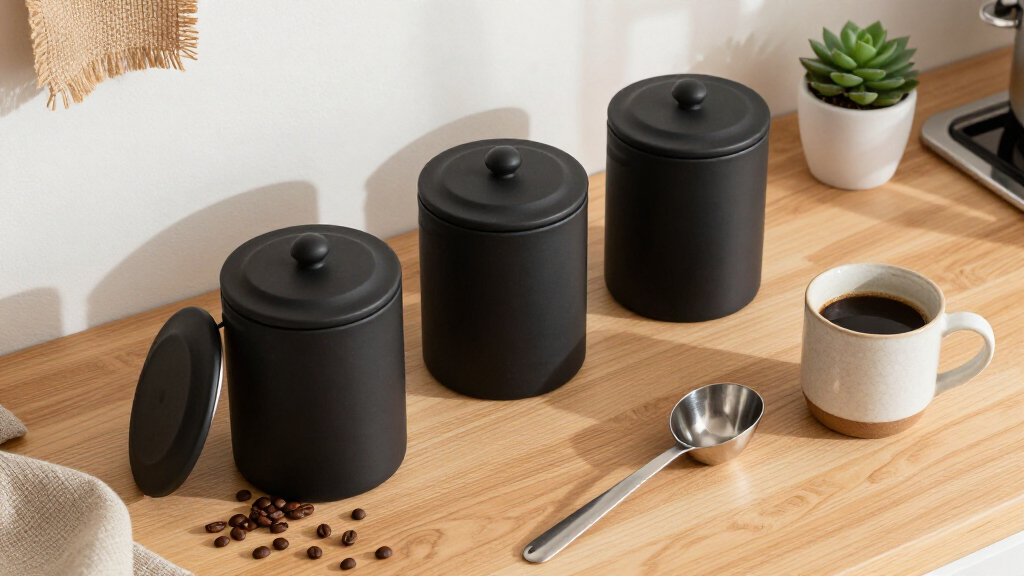
2×63 oz Stainless Steel Coffee Canister with Shelf and Scoop
This is the storage-and-display system of the group. Two 63 oz canisters plus a wooden shelf create an organized coffee station in one purchase — something no single-jar option, including the Veken 39 oz, attempts. With 126 oz of total capacity, I could keep decaf and regular, or beans and grounds, side by side. The black stainless finish looks sharp on the shelf, though it shows fingerprints and demands wiping. The seal is a silicone gasket rather than the CO2-valve system Veken uses, so very fresh roasts may build slight pressure — a fair trade for dishwasher-safe convenience. It’s the priciest footprint here, so it makes sense only if a full station is the goal rather than one canister that disappears into a cabinet.
Pros:- 126 oz total capacity across two canisters
- Wooden shelf creates an organized coffee station
- Dishwasher-safe stainless bodies
- Airtight silicone gaskets block moisture
Cons:- No CO2 valve for freshly roasted beans
- Black finish shows fingerprints and needs frequent wiping
- Largest counter footprint in this lineup
Best for: Households setting up a dedicated coffee station with multiple beans, blends, or drink types
Not ideal for: Minimalists and small kitchens — two large canisters plus a shelf consume serious counter space
- Capacity:2 x 63 oz (126 oz total)
- Material:Stainless steel
- Seal:Airtight silicone gasket lids
- Includes:Wooden shelf, silver coffee scoop
- Dishwasher safe:Yes
- Color:Black
Our verdict“Buy this if you’re building a coffee station, not just storing a bag of beans.”
17 oz Coffee Canister with Scoop and Wooden Lids, Airtight Glass Storage Containers (Set of 2)
Two airtight jars, two scoops, one price — this 17 oz glass set wins on cost per container. It suits the buyer who wants to separate beans from grounds or coffee from tea without buying two separate canisters like the Veken 22 oz. The wooden lids with silicone seals echo the ANSQU jar’s aesthetic at a lower per-jar cost, though without that model’s integrated spoon slot — here the scoops live loose inside or beside the jars. Capacity is the smallest in this batch at 17 oz each, which is fine for grounds and smaller bags but cramped for a full pound of beans. The wooden lids need gentle handling to keep the seal tight over time, so this is a set for careful daily use rather than set-and-forget storage.
Pros:- Two jars and two scoops at a strong price per container
- Borosilicate glass is sturdy and contents fully visible
- Attractive vintage-style wooden lids
- Works for home or commercial countertops
Cons:- Smallest capacity in the roundup at 17 oz per jar
- Wooden lids need careful handling to maintain the seal
- Not microwave safe
Best for: Budget-conscious buyers who want matching jars to separate coffee types or dry goods
Not ideal for: Whole-bean bulk buyers — 17 oz per jar won’t hold a standard one-pound bag
- Capacity:500 ml (17 oz) per jar
- Quantity:Set of 2
- Material:Borosilicate glass
- Lid:Wooden with silicone seal
- Included:2 scoops
- Use:Coffee grounds, beans, dry goods; home or commercial
Our verdict“The smart pick when you need two modest canisters for less than one premium single jar.”
Veken Coffee Canister with Window, Airtight Stainless Steel Container, 16 oz
Not everyone stores coffee by the pound. This 16 oz canister is sized for people who buy small bags of single-origin beans and finish them within a couple of weeks — and for that use, it’s arguably the most sensible pick here. The one-way CO2 valve is the feature that separates it from simpler jars like the Set of 5 Glass Kitchen Canisters: freshly roasted beans release carbon dioxide, and without a valve, that gas builds up and degrades flavor. The date tracker on the lid solves the ‘when did I open this?’ problem, while the viewing window lets you check bean levels without breaking the seal. Compared with the 22 oz Veken, it takes up noticeably less counter space, which matters in small kitchens.
Pros:- One-way CO2 valve actively manages off-gassing from fresh roasts
- Date tracker and viewing window make freshness monitoring effortless
- Compact footprint suits small counters and cabinets
- Includes a stainless steel scoop
Cons:- 16 oz capacity is too small for bulk buyers or multi-coffee households
- Viewing window adds a seam that needs careful cleaning
Best for: Coffee drinkers who buy 12 oz bags of specialty beans and want freshness tracking without bulky countertop gear
Not ideal for: Households that buy coffee in bulk or grind a week’s worth at once — 16 oz fills up fast
- Capacity:16 oz
- Material:304 stainless steel
- Valve:One-way CO2 valve
- Seal:Silicone seal
- Extras:Date tracker, viewing window, stainless steel scoop
Our verdict“Buy this if you drink small-batch coffee and want degassing handled properly; skip it if you store more than a standard 12 oz bag at a time.”
Set of 5 Glass Kitchen Canisters with Airtight Stainless-Steel Lids
This five-piece set isn’t really a coffee canister — it’s a whole-pantry storage system that happens to hold coffee well. If your goal is decanting flour, sugar, beans, and coffee into matching containers, this beats buying a single-purpose unit like the Oggi 62 fl oz canister on pure versatility. The borosilicate glass handles temperature swings without cracking, and the graduated sizes (4″ to 11.8″) let you match container to quantity. But coffee purists should note what’s missing: no CO2 valve, which means super-fresh roasts will slowly staledom under a passive silicone seal. It’s a tradeoff — you gain dishwasher-safe convenience and visible contents, but lose the degassing advantage that the Veken canisters provide.
Pros:- Five graduated sizes cover everything from spices to bulk flour
- Stackable design saves significant pantry shelf space
- Dishwasher safe, unlike most stainless valve canisters
- Borosilicate glass resists thermal shock
Cons:- Stainless lids can dent if dropped or handled roughly
- Largest sizes overwhelm tight cabinets or small apartments
- No CO2 valve or date tracker for coffee-specific storage
Best for: Home organizers who want one cohesive canister set for coffee plus flour, sugar, and other dry goods
Not ideal for: Serious coffee enthusiasts storing freshly roasted beans — the absence of a CO2 valve costs you freshness over time
- Material:Borosilicate glass with stainless steel lids
- Number of Canisters:5
- Sizes:11.8″, 8″, 6.6″, 5″, 4″
- Diameter:3.7 inches
- Seal:Silicone ring
- Dishwasher Safe:Yes
Our verdict“Choose this set if a unified, see-through pantry matters more than maximum coffee freshness; serious bean storage calls for a valved canister instead.”
Veken Coffee Canister with Window, Airtight Stainless Steel Container, 22 OZ
Sometimes the deciding factor isn’t specs — it’s presentation. This 22 oz Veken canister earns a spot as the best gift option because it bundles everything a coffee lover needs in one polished package: the CO2 valve, a date tracker, a viewing window, and a matching scoop, all in an elegant stainless body that looks intentional on a counter. Functionally it mirrors the 16 oz Veken, so the real question is sizing — 22 oz comfortably holds a full standard 1 lb bag of beans with headroom, which the smaller model can’t. Against the Oggi 62 fl oz, it trades raw capacity for the freshness-tracking features the Oggi lacks. The main gap is capacity: bulk buyers will still outgrow it.
Pros:- 22 oz capacity fits a full standard bag of beans
- Complete feature set: CO2 valve, date tracker, window, and scoop
- Attractive finish makes it genuinely gift-worthy
- Airtight silicone seal preserves flavor effectively
Cons:- Capacity still falls short for serious bulk storage
- Cleaning guidance is unclear — hand washing appears necessary around the valve
Best for: Gift-givers shopping for a coffee-obsessed friend, or singles/couples who buy one bag at a time
Not ideal for: Bulk coffee buyers and large households — 22 oz won’t hold a month’s supply
- Capacity:22 oz
- Material:304 stainless steel
- Valve:One-way CO2 valve
- Seal:Silicone seal
- Extras:Date tracker, viewing window, stainless steel scoop
Our verdict“This is the pick when the canister is a present as much as a tool — full features, good looks, and enough room for a standard bag.”
Oggi Stainless Steel Coffee Canister 62 fl oz – Airtight Clamp Lid, Clear See-Thru Top
When your coffee comes from warehouse clubs or you grind in batches, most canisters in this roundup simply run out of room. The Oggi’s 62 fl oz capacity — nearly three times the 22 oz Veken — makes it the bulk buyer’s answer. The clamp lid with silicone gasket creates a genuinely tight seal, and the clear see-thru top is a clever touch: check your bean level without opening anything, which is arguably more useful than Veken’s side window since you see it from above on a shelf. The tradeoff is simplicity — no CO2 valve, no date tracker. What you get instead is straightforward, mechanical reliability and a design that suits both modern and traditional kitchens.
Pros:- 62 fl oz capacity dwarfs typical 16-22 oz canisters
- Clear top lets you check bean level without breaking the seal
- Clamp lid with silicone gasket forms a reliably airtight closure
- Durable food-grade stainless body holds up to daily use
Cons:- No CO2 valve or freshness date tracker
- Clamp lid can be difficult to open for some users
- Stainless exterior shows fingerprints and needs regular wiping
Best for: Bulk buyers and large households who store a pound or more of coffee at once
Not ideal for: Those with weak grip strength or arthritis — the clamp mechanism can be stiff to open
- Capacity:62 fl oz
- Material:Stainless steel
- Lid Type:Airtight clamp lid with clear see-thru top
- Seal:Silicone gasket
- Dimensions:5″ x 7.5″
Our verdict“If you buy coffee in bulk and prioritize capacity over degassing features, this is the workhorse to get.”
Veken Coffee Canister with Window, Airtight Stainless Steel Container, 22 OZ
What separates this 22 oz Veken from its near-identical sibling (the B0CWH7JL3Y) is the measuring scale printed on the body — a small detail that changes daily behavior if you brew by ratios. Pour-over and espresso drinkers who weigh or measure doses can skip the separate scale step for approximations, making morning routines faster. Like the other Veken models, it pairs the CO2 valve with a date tracker, so freshness management is built in rather than remembered. Compared with the Oggi 62 fl oz, it’s the smarter choice for methodical brewers who value precision over volume. It does cost more than basic plastic containers, and the stainless body wants regular wipe-downs to stay presentable — but for dial-in obsessives, the measuring scale justifies the premium.
Pros:- Built-in measuring scale simplifies dose-checking during brewing
- CO2 valve plus date tracker covers full freshness management
- 22 oz size suits a standard bag of beans
- Includes scoop, silicone seal, and viewing window
Cons:- Pricier than simple plastic alternatives
- Requires regular cleaning to keep stainless looking sharp
- Not sized for bulk purchases
Best for: Pour-over and espresso brewers who measure doses and want markings built into the canister
Not ideal for: Budget-focused buyers who just need an airtight container — a basic plastic or glass jar does the job for less
- Capacity:22 oz
- Material:304 stainless steel
- Valve:One-way CO2 valve
- Seal:Silicone rubber seal
- Measuring Scale:Yes
- Extras:Date tracker, viewing window, coffee scoop
Our verdict“The right choice for brewers who treat coffee like a craft — the measuring scale turns a storage container into part of the brewing workflow.”
AirScape by Planetary Design 2.2 lbs Coffee Storage Matte Black
The AirScape takes a different approach to freshness than every other canister in this lineup. Instead of just sealing coffee in, its patented plunger lid with a two-way valve actively pushes oxygen and humidity out as you press it down — a genuine advantage over passive airtight options like the Oggi 62 oz Clamp Lid Canister, which traps whatever air remains inside. The stainless steel body also blocks UV light completely, something glass options like the 17 oz Glass Canister Set can’t do. The tradeoff is price and practicality: it costs noticeably more than the Veken canisters, and the plunger mechanism means hand-washing only. If you buy premium whole beans and want them to taste the same on day fourteen as day one, this is the canister that justifies its cost. Casual drinkers won’t notice the difference.
Pros:- Active oxygen and humidity removal keeps coffee fresher longer than passive seals
- Stainless steel construction blocks UV rays that degrade coffee oils
- Holds up to 2.2 lbs of beans, one of the largest capacities in this lineup
- Versatile enough for tea, flour, and other perishable dry goods
Cons:- Not dishwasher safe — the plunger valve requires careful hand-washing
- Priced well above basic stainless steel canisters like the Veken models
- No clear size dimensions published, making countertop planning difficult
Best for: Serious coffee enthusiasts who buy premium whole beans in bulk and want maximum freshness retention
Not ideal for: Budget shoppers or anyone who wants dishwasher-safe convenience — the valve mechanism requires hand-washing and the price is steep
- Capacity:2.2 lbs of coffee
- Color:Matte Black
- Material:Stainless steel
- Lid Design:Patented plunger lid with two-way valve
- Freshness Method:Active oxygen and humidity expulsion
- UV Protection:Yes — opaque steel body
- Dishwasher Safe:No
- Use Cases:Coffee, tea, flour, dry goods
Our verdict“Worth the premium only if you’re storing expensive beans long-term and want active, not passive, freshness protection.”
Coffee Container, 10 oz Airtight Glass Storage Canister, 2 Pack
Where most canisters here chase capacity, this two-pack of 10 oz borosilicate glass jars goes the opposite direction — and that’s its whole appeal. The one-handed pop-up lid with a unidirectional exhaust valve makes quick morning scoops easier than the clamp-style lid on the Oggi 62 oz, and unlike every stainless steel option in this roundup, these are microwave and dishwasher safe with a -4°F to 302°F range. Compared with the 17 oz Wooden Lid Glass Canisters, you get a stronger seal but half the capacity per jar. The real limitation is fragility: glass breaks, and 10 oz empties fast if you drink more than a cup or two a day. That makes these better suited as single-origin display jars or a divided set for beans and grounds than as your main storage.
Pros:- Two jars let you separate beans from grounds or rotate two roasts
- One-handed pop-up lid is the easiest access in this roundup
- Borosilicate glass handles -4°F to 302°F — freezer, microwave, and dishwasher safe
- Leak-proof seal with exhaust valve keeps small batches genuinely fresh
Cons:- 10 oz capacity is the smallest in this lineup and requires frequent refills
- Glass is breakable compared with stainless steel alternatives like the Veken canisters
Best for: Light coffee drinkers, single-origin enthusiasts who rotate small batches, or anyone wanting separate jars for beans and grounds
Not ideal for: Heavy coffee drinkers or households storing bulk beans — 10 oz per jar runs out quickly and glass won’t survive a busy kitchen
- Capacity:10 oz per canister
- Number of Pieces:2 canisters
- Material:Borosilicate glass
- Lid Type:Airtight one-handed pop-up lid
- Seal:Leak-proof with unidirectional exhaust system
- Temperature Range:-4°F to 302°F
- Microwave Safe:Yes
- Dishwasher Safe:Yes
- Use Cases:Coffee, sugar, tea, dry goods
Our verdict“A smart pick for small-batch drinkers who value convenience and glass cleanliness over bulk capacity and durability.”
How We Picked
I evaluated each canister against the four factors that actually determine whether beans stay fresh: seal integrity (does the lid mechanism create a real barrier against oxygen and humidity), material and light protection (stainless steel blocks UV, glass does not), capacity honesty (whether the stated volume holds a standard 12 oz or 1 lb coffee bag with room for scooping), and day-to-day usability (one-handed opening, scoop storage, date tracking, and cleaning difficulty). Price-per-ounce of storage was the tiebreaker between models with similar performance.
The ranking logic follows freshness performance first, then value. Active air-removal designs outrank passive seals, steel outranks glass for long-term storage, and models with date wheels and included scoopes outrank bare canisters at the same price. Sets and glass options rank lower on freshness but earn their positions by serving buyers whose priorities differ — aesthetics, multi-item pantry storage, or gifting — because a roundup that only measured oxygen exclusion would ignore how most people actually shop for canisters.
Factors to Consider When Choosing Coffee Storage Canisters
Before picking a specific canister, it helps to understand what actually degrades coffee and where buyers most often go wrong. These are the factors I weighed during the comparison, explained with the tradeoffs the product blurbs cannot cover.
Seal Type Matters More Than Material
The single biggest mistake buyers make is assuming any container with a rubber gasket is airtight. Clamp lids, screw-on steel lids, and bamboo wood lids create very different seals, and a loose-fitting wooden lid can be worse than a well-sealed mason jar. Piston-style lids that push air out are the only design that reduces the oxygen already inside the canister, which is why they command premium prices. If you buy a passive-seal canister, the practical workaround is filling it as full as possible — less headroom means less oxygen contacting your beans. Buyers who refill small amounts weekly can get away with any decent seal; those who store beans for three or more weeks should pay up for active air removal or buy smaller bags instead.
Size Your Canister to Your Buying Habits
Canister capacity is where the most money gets wasted. A 16 oz canister cannot hold a full 12 oz bag plus headroom, so you end up storing the overflow in the original bag — defeating the purpose. A 39 oz canister makes sense only if you buy one-pound bags or roast your own; otherwise, a half-empty large canister traps more air around a smaller quantity of beans. My general guidance: match canister volume to roughly 1.5 times your typical coffee purchase. Also weigh whether you drink one coffee at a time or keep a decaf and a regular going — in that case, two smaller canisters beat one large one every time, which is why the two-canister glass sets earn a spot despite their freshness limitations.
Glass Versus Stainless Steel: The Freshness Tradeoff
Light is one of coffee’s enemies, and glass offers zero protection against it. This does not make glass canisters a bad purchase — it makes them a different purchase. Glass suits buyers who store coffee in a cabinet, go through beans within ten days, or want a container attractive enough to leave on the counter. Steel suits buyers buying in bulk, storing near a window, or living in humid climates where condensation inside glass becomes a real problem. One overlooked point: glass shows you exactly how much coffee remains, which prevents the mid-brew discovery that you are out of beans. Steel models with viewing windows, like several in this lineup, split the difference but add a second seam where seals can fail.
Date Tracking and Scoop Storage Are Underrated
Coffee does not expire on a fixed clock — whole beans peak roughly one to two weeks after roasting and decline steadily afterward. A canister with a built-in date wheel turns that timeline into something you can actually manage; a plain canister leaves you guessing whether those beans are two weeks or two months old. This sounds minor until you have three half-full canisters, which is common in multi-coffee households. Built-in scoop storage is similar: a scoop that lives inside the lid or clips to the canister gets used, while a loose scoop ends up in a drawer and you start using tablespoons that transfer hand oils and moisture to the beans. These convenience features cost manufacturers almost nothing, so their absence at premium prices is a legitimate reason to look elsewhere.
When Sets Beat Single Canisters (and When They Do Not)
Multi-canister sets look like better value on paper, but the math only works if you will actually use every piece. A five-canister set is a pantry organization purchase, not a coffee freshness purchase — its value comes from matching containers for flour, sugar, and tea alongside your coffee. If you only need one coffee canister, a set means paying for storage you will never use while getting a smaller, less specialized coffee container than the same money would buy individually. Sets do make sense for households with multiple coffee drinkers, for people who buy both whole bean and ground, or as a way to get a consistent countertop look. Be honest about which buyer you are before the set’s per-canister price lures you in.
Cleaning and Long-Term Maintenance
Coffee oils coat container walls and go rancid, transferring stale flavors to fresh beans — a problem almost never mentioned in product listings. Narrow-mouthed steel canisters with deep lids are genuinely difficult to clean and dry, and trapped moisture in a lid gasket can introduce mold. Glass is the easiest material to clean and inspect, which partially offsets its light problem. Wide-mouthed designs let you reach in with a sponge, and lids that fully disassemble for washing prevent oil buildup in the seal. If you switch between dark and light roasts, cleaning matters even more, because residual dark roast oils will muddy a light roast’s delicate flavors regardless of how airtight the canister is.
Frequently Asked Questions
Are airtight coffee canisters actually necessary, or is the original bag enough?
Valve-sealed coffee bags do a respectable job while unopened, but once you cut into them, the one-way valve cannot compensate for the air you let in with every opening. Rolling the bag and clipping it slows oxidation but never restores a seal, and most bags are not opaque enough for long-term counter storage. A canister with a true gasket seal reduces oxygen exchange dramatically, and one with active air removal reduces it further. The difference is most noticeable with light roasts and single-origin beans, where delicate aromatics fade fastest. If you finish every bag within a week, a good clip is adequate; beyond that, a canister pays for itself in beans you no longer throw away half-stale.
What size canister do I need for a standard bag of coffee?
A standard 12 oz bag needs at least a 16 oz canister, and even then you will scoop from a mostly full container — which is actually ideal, because less headroom means less trapped air. A one-pound bag requires roughly 24 to 32 oz of usable volume, since beans are irregularly shaped and do not settle like flour. The common regret in this category is buying too small: a 10 oz canister means storing leftover beans in the bag and defeating the purpose. Buying slightly large is the safer mistake, but only slightly — a half-empty 63 oz canister holds more air around your beans than a snugly filled 22 oz one. Match the canister to the bag size you actually buy, not the one you aspire to.
Is it worth paying more for the AirScape’s piston lid instead of a standard airtight canister?
It depends on how long beans sit in the container. The piston lid presses down onto the beans and pushes the air above it out through a valve, so the oxygen level inside stays low even as you use up the coffee. A passive airtight canister keeps new air out but cannot remove the air already sealed in, and that headspace grows as the coffee depletes. If you empty a canister in ten days, the difference is marginal and a $20–$30 Veken-style canister serves you fine. If you buy in bulk, roast your own, or keep a backup canister open for a month, the AirScape’s advantage becomes genuinely measurable in the cup. One caveat: the piston adds a mechanism that needs occasional cleaning, so it is not the zero-maintenance option.
Can I store ground coffee in these canisters, or are they only for whole beans?
Every canister in this roundup works for ground coffee, but the freshness math changes completely. Ground coffee has vastly more surface area exposed to oxygen and stales in days rather than weeks, so even the best canister only slows the decline. If you buy pre-ground, a large canister is arguably the wrong purchase — two smaller canisters that you open in rotation will preserve more flavor than one big one opened daily. Grinding just before brewing remains the single biggest freshness upgrade available, and no container substitutes for it. If pre-ground is non-negotiable, choose the most airtight option you can afford and buy smaller quantities more often.
Where should I place my coffee canister — counter or cabinet?
Location changes which material makes sense. A countertop near a window exposes the canister to light and heat, both of which accelerate staling, so steel is the safer counter material — glass canisters belong in a cabinet or a shaded corner. Kitchens near dishwashers or stoves also create heat and humidity cycles that stress gasket seals over time. Refrigeration is a common mistake: the temperature swings and moisture from condensation harm beans more than room-temperature storage does, and coffee absorbs fridge odors readily. Freezing works only for whole beans in truly airtight, fully filled containers that you thaw once, not repeatedly. The best spot is cool, dark, dry, and convenient enough that you actually use the canister daily.
Conclusion
Matching these twelve coffee storage canisters to buyer types makes the decision straightforward. Best overall goes to the AirScape by Planetary Design 2.2 lbs — its piston lid is the only active air-removal design in the lineup, and it holds a full pound-plus of beans, which makes it the right call for serious coffee drinkers and bulk buyers. Best value is the Veken 22 oz canister with window, which delivers a real gasket seal, date wheel, and scoop at a price that leaves no excuse for storing beans in the bag. Best premium also belongs to the AirScape if you want the ceiling of the category, while the Oggi 62 oz clamp-lid is the premium pick for buyers who prefer a classic bistro look with a large capacity. Best for beginners is the Veken 16 oz — it is inexpensive enough to try, and the date wheel teaches new coffee drinkers to think in roast-date terms. For specific needs: the Veken 39 oz for one-pound bag buyers, the 2×63 oz stainless set with shelf and scoop for bulk households, the 17 oz glass and bamboo set or the ANSQU glass jar for style-focused buyers who store coffee in cabinets, the five-canister glass set for whole-pantry organization, and the 10 oz glass two-pack for small kitchens or single-bag households. Whatever you choose, the jump from an open bag to any properly sealed canister here is bigger than the gap between any two canisters on this list — pick the one that matches your bag size and counter, and stop letting good beans go stale on the shelf.