
Automatic espresso machines promise café-quality coffee at the push of a button, but the gap between the best and the rest is wider than most buyers expect. The De’Longhi Rivelia earns my top spot for its adaptive brewing intelligence and consistent milk drinks, while the De’Longhi PrimaDonna Aromatic stands out as the premium choice for serious espresso drinkers and the Philips 5500 Series with LatteGo offers the best balance of one-touch milk drinks and easy cleaning. The main tradeoff in this category is between convenience and control: fully automatic machines handle everything but limit your ability to tweak shots, while semi-automatic models like the Breville Barista Express demand skill but reward it. Price, milk system design, and grinder quality also separate the field dramatically. Read on for the full breakdown of all 14 machines and which one fits your kitchen.

Get coffee and tea gear delivered free with Prime
- Fast, free delivery on millions of items
- Prime Video, Amazon Music and more included
- Member-only deals all year
Complete the kit


Key Takeaways
- De’Longhi dominates the top of this roundup with five entries, but its machines vary widely — the Rivelia and PrimaDonna Aromatic outclass the budget Magnifica Start by a clear margin in grinder quality and milk consistency.
- Philips‘ LatteGo milk system (5500 and 2300 Series) proved the easiest to clean of any milk setup here, making Philips the stronger pick for latte drinkers who hate daily rinsing routines.
- Two products in this lineup — the AMZCHEF and the generic ‘Fully Automatic Espresso Machine’ — blur the line between automatic and semi-automatic, and lack the one-touch drink programming that defines true fully automatic machines.
- The Philips 2200 Series and De’Longhi Magnifica Start deliver genuine entry-level value under $600, but both cut corners on drink variety and grind adjustment compared with mid-tier models.
- The Breville Barista Express is the odd one out: it’s a semi-automatic machine included because buyers compare it directly, but it belongs on your shortlist only if you want to learn barista skills rather than skip them.




More Details on Our Top Picks
De’Longhi Rivelia Automatic Espresso Machine, Milk Frother, White
Best Overall goes to the Rivelia because it balances automation, customization, and counter footprint better than anything else in this lineup. The standout feature is its two interchangeable 8.8 oz bean hoppers, which let a household split between, say, light-roast espresso beans and decaf without dumping and refilling a single hopper — something the De’Longhi Magnifica Duo simply can’t do. Four user profiles mean each person’s drink pulls up instantly on the 3.5-inch touch display, and the LatteCrema Hot system handles milk texturing with no skill required.
The tradeoff is complexity. Compared with the Philips 4400 Series, the Rivelia asks more of you during setup, and its learning curve is real for anyone who just wants a button and a cup. The white finish also shows staining more readily than silver or black models.
Pros:- Interchangeable dual bean hoppers let you switch between beans instantly
- Four user profiles save individual drink preferences
- One-touch operation with automatic milk frothing
- Compact footprint relative to its feature set
Cons:- Initial learning curve for profiles and customization menus
- White finish is more prone to coffee staining and visible wear
- Only 13 grinder settings, fewer than some competitors offer
Best for: Multi-person households where different drinkers want different beans and saved drink profiles without babysitting the machine
Not ideal for: Set-and-forget minimalists who want zero menus to learn — the profiles and hopper system add complexity they’ll never use
- Bean Hoppers:Two 8.8 oz interchangeable
- Grinder Settings:13
- Milk Frothing System:LatteCrema Hot System
- Display:3.5-inch color touch
- User Profiles:4
- Color:White
Our verdict“If your household argues over beans and drinks, the Rivelia’s dual hoppers and profiles solve that problem more elegantly than any other machine here.”
De’Longhi PrimaDonna Aromatic Fully Automatic Espresso Machine
This is the most ambitious machine in the roundup, and its price reflects that. What separates the PrimaDonna Aromatic from the Rivelia is intelligence: Bean Adapt technology actually recognizes the beans you load and adjusts grind and temperature automatically, rather than making you dial in settings yourself. With 38 recipes spanning espresso, drip coffee, and cold brew, plus milk texturing that works both hot and cool, it covers more ground than the Magnifica Duo’s 20 presets — nearly double the menu.
The 5-inch touch display makes that range navigable, but the machine itself demands real counter space and a real budget. Buyers stepping up from a Philips 4400 Series are paying primarily for bean recognition and the expanded recipe list, not dramatically better espresso in the cup.
Pros:- Bean recognition automatically tunes grind and temperature to the beans loaded
- 38 hot and iced recipes, the widest menu in this batch
- LatteCrema Hot and Cool covers both steamed and iced-drink milk textures
- Large 5-inch touch display keeps the huge menu navigable
Cons:- Highest price point among these five machines
- Bulkier footprint requires generous counter space
- Setup complexity means slower path from box to first cup
Best for: Enthusiasts who rotate through different bean origins and want the machine to adapt itself rather than manually re-dialing the grinder
Not ideal for: Budget-conscious buyers or anyone with limited counter space — the same core espresso quality is available from cheaper models in this lineup
- Bean Recognition Technology:Yes
- Number of Recipes:38
- Milk Texture Options:Adjustable, Hot and Cool
- Display:5-inch touch screen
- Integrated Grinder:Yes
- Country of Design:Italy
Our verdict“Worth the premium only if bean variety and recipe breadth genuinely excite you; everyone else gets 90% of the experience for far less.”
De’Longhi Magnifica Duo Automatic Espresso Machine with Milk Frother, Silver
The Magnifica Duo lands in the sweet spot between the cheaper Philips 2200 Series-style machines and the expensive PrimaDonna Aromatic. You get 20 preset recipes — including drip coffee and a cold brew in under three minutes — plus a built-in conical burr grinder, at a price well below De’Longhi’s flagship. The milk system handles both hot and cool foam, so iced lattte season is covered without a separate frother.
Where it gives ground: there’s no bean recognition like the PrimaDonna, no user profiles like the Rivelia, and the dishwasher-safe removable parts are a genuine plus, but the full cleaning routine across so many subsystems takes longer than the Philips LatteGo cleanup. It’s a machine for people who want range without the flagship tax.
Pros:- 20 preset hot and iced recipes cover nearly every café order
- Cold brew ready in under three minutes
- Built-in conical burr grinder for fresh grounds every cup
- Dishwasher-safe removable parts simplify cleanup
Cons:- More subsystems mean longer and more fiddly cleaning than LatteGo-style machines
- No user profiles or bean-recognition features found on pricier De’Longhi models
- Priced above what light-use drinkers realistically need
Best for: Buyers who want a broad hot-and-iced drink menu and fresh-ground beans without paying flagship pricing
Not ideal for: Casual one-drink-a-day users — the recipe variety and cleaning routine are overkill compared with a simpler Philips 2200-class machine
- Number of Recipes:20 preset hot and iced
- Brewing Technologies:3
- Milk Frothing:Hot and Cool
- Removable Parts:Dishwasher-safe
- Cold Brew Speed:Under 3 minutes
- Color:Silver
Our verdict“The sensible middle of this lineup: flagship-adjacent versatility at a mid-range price, if you’ll actually use the full menu.”
Bosch 300 Series Fully Auto Espresso Machine with Grinder and Steam Wand
The Bosch 300 Series takes a different philosophy from everything else here: instead of a fully automated milk carafe, it pairs one-touch bean-to-cup brewing with a traditional steam wand. Compared with the De’Longhi Rivelia’s automatic LatteCrema system, that means more work per cappuccino, but far more control over milk texture — and microfoam quality a carafe can’t match. Its ceramic grinder won’t heat the beans or wear the way steel burrs can over years of use.
This model makes the most sense for buyers who want automatic brewing but refuse to give up manual milk craft. The downside is real, though: there’s no recipe menu, no iced drinks, and no profiles. Next to the Magnifica Duo’s 20 presets, the Bosch feels almost spartan, and beginners may find steam-wand technique frustrating at first.
Pros:- Traditional steam wand produces café-quality microfoam a carafe can’t match
- Durable ceramic grinder resists heat and long-term wear
- Removable brew unit and Calc’n Clean simplify maintenance
- One-touch bean-to-cup brewing keeps espresso side simple
Cons:- No preset drink menu, iced options, or user profiles
- Steam wand demands practice that pure automatic buyers won’t want
- Feature set lags similarly priced De’Longhi alternatives
Best for: Semi-manual coffee drinkers who want push-button espresso but still want to texture their own milk like a barista
Not ideal for: Fully hands-off buyers who want one-touch lattes — the steam wand requires technique and adds time to every milk drink
- Grinder:Ceramic
- Brewing Method:Bean to cup, one-touch
- Milk Frother:Adjustable steam wand
- Cleaning Features:Removable brew unit, Calc’n Clean
Our verdict“Choose this only if manual milk texturing is the point; if you want total automation, the De’Longhi options serve you better.”
Philips 4400 Series Fully Automatic Espresso Machine Black Chrome Bundle
Where the Bosch 300 Series asks for technique and the PrimaDonna Aromatic asks for counter space and cash, the Philips 4400 asks for almost nothing. Its LatteGo milk system rinses clean in under 10 seconds — no tubes, no carafe valves — which is the most meaningful convenience difference in daily use across this whole batch. Pair that with the AquaClean filter rated for up to 5,000 cups before descaling and SilentBrew operation that Philips claims is 40% quieter than earlier models, and this is the machine for people who drink coffee rather than fuss over it.
The tradeoffs: 12 recipes is half the Magnifica Duo’s menu, some automatic cleaning functions require extra purchases, and the sheer number of customizable settings plus HomeID app pairing can overwhelm a first-time owner.
Pros:- LatteGo milk system cleans in under 10 seconds with no tubes to scrub
- AquaClean filter enables up to 5,000 cups without descaling
- SilentBrew technology runs about 40% quieter than earlier Philips models
- 12 hot and iced drinks with 12 adjustable ceramic grinder settings
Cons:- Some automatic cleaning functions require additional purchases
- Recipe menu is smaller than comparably priced De’Longhi rivals
- Deep settings menus and app pairing can overwhelm first-time automatic machine owners
Best for: Busy daily drinkers who prioritize fast cleanup, quiet mornings, and minimal descaling over maximum recipe variety
Not ideal for: Tinkerers who want the deepest recipe menu and bean-adaptation features — the Philips 4400 trades breadth for simplicity
- Coffee Recipes:12 hot & iced drinks
- Milk System:LatteGo
- Noise Level:40% quieter than earlier models
- Descaling Interval:Up to 5,000 cups with AquaClean filter
- Grinder:Ceramic, 12 adjustable settings
- Temperature Range:195°F to 210°F
- App Compatibility:HomeID app
- Color:Black Chrome
Our verdict“The lowest-friction ownership experience in this lineup — pick it if cleanup time matters more to you than drink count.”
Philips 2200 Series Fully Automatic Espresso Machine
For shoppers who want the core one-touch bean-to-cup experience without paying for drink-count inflation, this model is the sensible entry point. Compared with the Philips 5500 Series, it trades 20 presets for just two coffee varieties, but that simpler menu is exactly what many households actually use day to day — espresso and black coffee. The 100% ceramic grinder is a genuine advantage at this price, since ceramic runs cooler and won’t impart metallic flavors the way cheaper steel burrs sometimes can. The classic panarello-style frother works, but it demands more hands-on effort than the LatteGo system on the Philips 2300 Series. The tradeoff is straightforward: less automation and fewer drinks in exchange for a meaningfully lower price and the same low-hassle AquaClean maintenance.
Pros:- Ceramic grinder preserves bean flavor and resists overheating
- AquaClean filter dramatically cuts descaling frequency
- Simple touch interface with almost no learning curve
- Lower price than higher-series Philips machines with the same grinding hardware
Cons:- Only two coffee varieties limits drink menu
- Classic milk frother requires manual technique and more cleaning than LatteGo
Best for: Budget-conscious coffee drinkers who mainly brew espresso and black coffee and want push-button convenience
Not ideal for: Milk-drink lovers who want automated lattes — the manual frother and two-drink menu will feel limiting
- Presets:3
- Coffee Varieties:2
- Grinder:100% ceramic
- Frother:Classic milk system
- Filter:AquaClean
- Display:Touch
- Color:Black
Our verdict“The right pick if you want reliable one-touch espresso and coffee at the lowest fully-automatic price point, and you don’t need a dozen preset drinks.”
AMZCHEF Espresso Machine With Grinder, Temp Control, 44 Grind Settings
Where every Philips machine in this lineup hides the variables behind presets, the AMZCHEF puts them front and center: 44 grind settings and a 190–201°F temperature range you control directly. That granularity is what separates this machine from one-touch models like the De’Longhi Magnifica Evo — it rewards users who want to dial in a specific bean rather than accept a fixed house profile. The 60oz water tank also outpaces typical fully-automatic machines in this batch, which matters for multi-cup mornings. The catch is the learning curve; unlike the Philips 2200, this isn’t a press-and-walk-away appliance, and it runs louder during grinding and brewing. Buyers choosing between the two are really choosing between convenience and control.
Pros:- Fine-grained grind and temperature control for dialing in specific beans
- Versatile brewing modes including cold brew and pour-over
- Large 60oz tank supports back-to-back servings
- Stainless steel steam wand produces microfoam suitable for latte art
Cons:- Steeper learning curve than preset-driven machines
- Louder operation than quieter models like the Philips 5500
Best for: Hands-on enthusiasts who want to experiment with grind and temperature across espresso, pour-over, and cold brew
Not ideal for: Anyone who wants zero-fuss morning coffee — the deep settings add steps before your first cup
- Temperature Range:190℉–201℉
- Grind Settings:44
- Water Tank Capacity:60oz
- Power:1350W
- Steam Wand:Stainless steel, 8mm
- Display:HD touch screen
Our verdict“Buy this if tweaking variables is part of the fun; skip it if you just want a button that produces a consistent latte.”
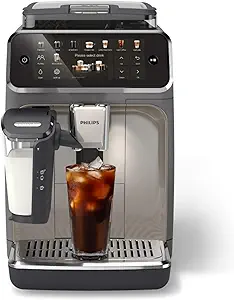
Philips 5500 Series Fully Automatic Espresso Machine with LatteGo Milk System
This is the machine I’d point most households toward, because it solves the two problems that ruin automatic machines: milk cleanup and noise. The LatteGo system has no tubes or hidden channels — it’s two parts that rinse in seconds, a real advantage over the classic frother on the Philips 2200 Series. Twenty presets covering hot and iced drinks put it far ahead of the Philips 2300 Series‘ four beverages, making it the better fit for mixed households where one person drinks espresso and another wants an iced latte. The 3-second heat-up and 40% quieter operation are outcomes you notice every morning, not spec-sheet padding. The tradeoffs are real, though: it’s the most expensive route to Philips coffee, and that large preset menu takes a weekend to learn. It also leans on regular descaling more than filter-equipped siblings.
Pros:- 20 one-touch presets covering hot and iced drinks
- LatteGo milk system rinses clean with no tubes to scrub
- 3-second heat-up and 40% quieter brewing than earlier models
- Intuitive display makes multi-user customization simple
Cons:- High upfront cost compared with entry-level fully-automatics
- Interface takes time to learn initially
- Requires regular descaling and maintenance to stay in top form
Best for: Busy households with varied drink preferences who want café-quality milk drinks with minimal cleanup
Not ideal for: Espresso purists on a budget — the preset depth is overkill if you only drink straight shots, and the 2200 costs far less
- Presets:20
- Milk System:LatteGo
- Brewing Time:3 seconds to ready
- Noise Level:40% quieter than earlier models
- Drink Types:Hot and iced, including espresso, latte, cappuccino
Our verdict“The best all-around choice for households that drink a variety of milk-based coffee and want the least friction between craving and cup.”
De’Longhi Magnifica Evo Automatic Espresso Machine with Milk Frother
De’Longhi takes a different philosophy than Philips here: fewer presets (7 versus the Philips 5500‘s 20), but each one is built around the LatteCrema System, which produces denser, more textured foam than the tube-free LatteGo — a real difference if you take milk texture seriously. The built-in conical burr grinder with 13 settings gives more grind adjustability than Philips’ fixed ceramic setup, letting you tune extraction to your beans. What earns this model its spot, though, is the dedicated iced coffee function paired with genuinely dishwasher-safe, removable parts — cleanup is less of a chore than on the AMZCHEF’s fixed components. The downside: the LatteCrema carafe adds assembly steps Philips owners never deal with, and the price sits above casual users’ comfort zone.
Pros:- LatteCrema System produces rich, café-style milk texture
- 13-setting conical burr grinder for tuning extraction
- Dishwasher-safe removable parts simplify cleaning
- Includes one-touch iced coffee recipes
Cons:- LatteCrema carafe has more pieces to handle than Philips’ LatteGo
- Menu depth can overwhelm first-time espresso machine owners
- Premium price for a 7-recipe machine
Best for: Iced coffee and cappuccino fans who value dense milk foam and dishwasher-safe cleanup
Not ideal for: Casual once-a-day drinkers — the price and 7-recipe system are more machine than a single-shot habit needs
- Beverage Options:7 one-touch recipes
- Grind Settings:13
- Milk Frothing System:LatteCrema System
- Cleaning:Auto-clean, dishwasher-safe parts
- Grinder:Built-in conical burr
- Color:Silver
Our verdict“The pick for milk-texture purists and iced coffee regulars who want one-touch drinks and easy cleanup — as long as the price fits.”
Philips 2300 Series Fully Automatic Espresso Machine with LatteGo Milk System
This machine occupies the smart middle ground in Philips’ lineup: it adds the LatteGo milk system that the Philips 2200 Series lacks, without jumping to the 5500 Series‘ price or overwhelming preset count. Four beverages — espresso, coffee, latte, and hot water — cover what most people actually drink, and the machine handles grinding, tamping, and brewing automatically, so the only manual step is placing your cup. The removable brew group is the standout maintenance feature; it lifts out and goes in the dishwasher, something no De’Longhi in this roundup can claim. SilentBrew Technology also keeps it quieter than the AMZCHEF. The tradeoffs: customization is shallower than enthusiast machines offer, and app connectivity through HomeID is convenient but not essential.
Pros:- LatteGo froths milk automatically and rinses clean in seconds
- Removable, dishwasher-safe brew group makes deep cleaning easy
- AquaClean filter supports up to 5,000 cups without descaling
- SilentBrew Technology keeps morning noise down
Cons:- Limited customization compared with enthusiast-grade machines
- Higher cost than manual espresso setups
- Only four beverage presets
Best for: Latte and cappuccino drinkers upgrading from a basic machine who want automated milk drinks under a mid-range budget
Not ideal for: Tinkerers who want granular control — the fixed profiles will frustrate anyone used to adjustable temperature or 40+ grind settings
- Presets:4
- Beverage Options:Espresso, coffee, latte, hot water
- Milk System:LatteGo
- Pressure:15 Bar
- Filter:AquaClean (up to 5,000 cups)
- Cleaning:Removable brew group, dishwasher-safe parts
- Connectivity:HomeID app
- Technology:SilentBrew Technology
Our verdict“The sweet spot if you want automated milk drinks and tool-free cleaning without paying the 5500’s premium for 20 presets you may never touch.”
Aromaster 1400W Espresso Machine with Milk Frother, Stainless Steel
At just 7 inches wide, this is the slimmest footprint in the entire lineup, and that alone gives it a role that machines like the Breville Barista Express can’t claim — Breville’s grinder-equipped body demands nearly double the counter space. The Aromaster pairs its compact frame with genuinely useful tech: PID temperature control and pre-infusion, features usually reserved for pricier machines, which translate to more consistent shots than you’d expect at this size.
The tradeoff is that this is semi-automatic, not fully automatic. There’s no built-in grinder and no one-touch drinks, so compared with the De’Longhi Magnifica Start, you’re trading convenience for control and a smaller price and footprint. The 37 oz tank also empties quickly in multi-drink households.
Pros:- Exceptionally narrow 7-inch footprint fits cramped counters
- PID temperature control and pre-infusion for shot consistency
- Fast heat-up suits quick single-drink routines
- Removable tank and descaling function keep maintenance simple
Cons:- No built-in grinder means an extra purchase and step in the workflow
- 37 oz water tank limits back-to-back drink-making
- Semi-automatic operation requires some brewing skill
Best for: Apartment dwellers or office nooks where counter space is the deciding factor and the buyer enjoys hands-on brewing with pre-ground coffee or a separate grinder
Not ideal for: Anyone wanting true push-button convenience — no grinder and semi-automatic operation mean this demands more involvement than a Philips 2200 Series or Magnifica Start
- Power:1400W
- Water Tank Capacity:37 oz
- Pressure Pump:20 Bar
- Dimensions:13″D x 7″W x 14″H
- Operation Mode:Semi-Automatic
- Key Features:Pre-Infusion, PID Temperature Control, Cup Warmer, Auto Shut-Off
Our verdict“This pick makes the most sense for space-constrained buyers who want temperature-controlled espresso at a low price and don’t mind grinding separately.”
Breville BES870XL Barista Express Espresso Machine, Brushed Stainless Steel
The Barista Express occupies a distinct middle ground: it’s not fully automatic like the Philips 4400 Series, and that’s the point. Compared with one-touch machines, its built-in conical burr grinder with adjustable grind size and a manual steam wand put you in charge of every variable, which is exactly what someone learning espresso craft wants. The PID temperature control keeps extraction stable while you experiment with dose and grind.
The tradeoffs are real. It costs more than the Aromaster while offering less automation, it’s bulky for small kitchens, and the manual microfoam wand takes weeks to master. But unlike the fully automatic De’Longhi Magnifica Start, which caps you at three pre-set recipes, this machine grows with your skills indefinitely.
Pros:- Built-in conical burr grinder with adjustable grind size for fresh, tuned shots
- PID digital temperature control for repeatable extraction
- Manual steam wand capable of true microfoam for latte art
- Includes accessories so you can brew from day one
Cons:- Premium price for a machine that still requires skill and practice
- Large footprint demands serious counter space
- Manual milk texturing has a steep learning curve
Best for: Hobbyists who want to learn dialing in grind, dose, and milk texturing, and who see espresso-making as a craft rather than a chore
Not ideal for: Buyers who just want to press a button and drink — a Philips 2300 Series with LatteGo delivers milk drinks with far less effort and learning
- Power:1600 Watts
- Bean Hopper Capacity:1/2 lb
- Water Tank Capacity:67 oz
- Grinder:Built-in Conical Burr, Adjustable Grind Size
- Temperature Control:PID Digital
- Steam Wand:Manual Microfoam
- Warranty:1 Year Limited
Our verdict“This model is better suited to buyers who want to develop barista skills than anyone prioritizing morning-speed convenience.”
Fully Automatic Espresso Machine with Milk Frother & Grinder
This machine competes directly with the Philips 4400 Series on automation, and its distinguishing card is the combination of a touchscreen interface, automatic milk frother, and a self-cleaning system in one package. Where the Breville Barista Express asks you to grind, tamp, and steam manually, this one moves beans to finished latte with a single touch — a meaningful difference for busy mornings.
The 15 grind settings give it more adjustability than the De’Longhi Magnifica Start’s simpler grinder setup. But the tradeoffs mirror its rivals: it’s deep at 17.5 inches, so it may not fit under standard cabinets, and at nearly 24 pounds it’s not a machine you’ll shuffle around. The 200g bean hopper is also modest compared with the Breville’s half-pound capacity.
Pros:- Genuine one-touch brewing from bean to finished milk drink
- 15 grind settings offer real adjustability for taste tuning
- Automatic milk frother requires no steaming skill
- Self-cleaning system reduces daily upkeep
Cons:- Very deep footprint may not clear upper cabinets
- 200g bean hopper needs frequent refilling
- Touchscreen menu system can overwhelm first-time owners
Best for: Busy households that want cafe-style milk drinks with zero technique and are willing to give up serious counter depth for it
Not ideal for: Small kitchens — its 17.5-inch depth is the largest in this batch, and tinkerers will find one-touch workflows limiting
- Operation Mode:Fully Automatic
- Wattage:1300 Watts
- Pressure:20 Bar
- Water Tank Capacity:1.5 Liters
- Bean Hopper Capacity:200g
- Grind Settings:15
- Dimensions:17.5″D x 7.36″W x 13.23″H
Our verdict“This option stands out for buyers who value push-button milk drinks and self-cleaning more than compactness or hands-on control.”
De’Longhi Magnifica Start Automatic Espresso Machine, Milk Frother, Black
The Magnifica Start is the most approachable entry into bean-to-cup brewing in this lineup. Compared with the touchscreen-driven Fully Automatic Espresso Machine above, its three pre-set recipes and straightforward controls strip away intimidation — there’s simply less to get wrong. The built-in conical burr grinder and PID temperature control mean you still get fresh, stable extraction without learning to dial anything in.
Its compromises are about ceiling, not floor. Those same three recipes feel limiting next to the Philips 4400 Series’ wider drink menu, and the manual milk frother requires a small learning curve — less convenient than a LatteGo system, though it does teach useful texturing skills. There’s also little programmability for users who later want scheduled brews or custom drink memory.
Pros:- Three one-touch recipes make first-week success easy
- Built-in conical burr grinder delivers fresh grounds automatically
- Removable, dishwasher-safe parts simplify cleaning
- PID temperature control supports consistent extraction
Cons:- Only three pre-set recipes with little room to customize
- Manual milk frother takes practice to master
- Minimal programmable features for advanced users
Best for: First-time espresso machine owners upgrading from pod coffee who want fresh-ground shots without a steep learning curve
Not ideal for: Experienced users or large households wanting many programmable drink options — the Philips 5500 Series covers far more ground
- Bar Pressure:15 Bar
- Grinder Type:Built-in Conical Burr
- Temperature Control:PID
- Brew Strength:Adjustable
- Pre-Set Recipes:3
- Milk Frother:Manual
- Auto Shut-Off:Yes
Our verdict“This pick makes the most sense for beginners who want simple, fresh-ground espresso now and can upgrade later if their ambitions grow.”

How We Picked
I evaluated these 14 machines against the criteria that actually determine satisfaction with an automatic espresso machine: espresso quality straight from the machine, milk system performance and cleanup, grinder consistency, ease of daily use, and long-term maintenance burden. Because these machines range from roughly $500 to over $2,000, I also weighed value at each price point — a machine can be mediocre in absolute terms and still be a smart buy if it punches above its price. Machines with adaptive settings, ceramic grinders, and well-designed milk carafes ranked higher because those features translate directly into better coffee with less fuss.
The ranking also reflects category fit. This is a roundup of automatic espresso machines, so semi-automatic models that require manual grinding, tamping, and milk steaming were judged more critically on whether they belong on the list at all. That’s why the Breville Barista Express and AMZCHEF sit lower despite being competent machines in their own right — they serve a different buyer. Finally, I factored in brand support, parts availability, and how easily each machine can be descaled and cleaned, since a machine that’s hard to maintain gets abandoned within a year regardless of how good its coffee is.
Factors to Consider When Choosing Automatic Espresso Machines
Before picking a specific model, it helps to understand what actually separates a satisfying automatic espresso machine from an expensive countertop ornament. These are the factors that shaped my rankings and the ones most buyers get wrong.True Automatic vs. Semi-Automatic: Know What You’re Buying
The single most common mistake in this category is buying a machine that doesn’t match the level of automation you expect. A fully automatic machine grinds, doses, brews, and (often) froths milk at the press of one button — the Philips 5500 and De’Longhi Rivelia are textbook examples. A semi-automatic machine like the Breville Barista Express automates grinding but leaves tamping, extraction timing, and milk texturing to you. Some listings use ‘automatic’ loosely to describe machines that are really manual with a grinder attached, which is why the AMZCHEF and the generic no-name model rank low here. If your goal is pressing a button before work, verify the machine has programmable one-touch drinks — not just a grinder and a brew switch. Semi-automatics reward practice with better espresso over time, but they punish anyone who wants zero effort. Be honest about which buyer you are before spending anything.
Milk System Design Matters More Than You Think
The milk system is where cheap and expensive automatic machines diverge the most, and it’s the part you interact with every single day. There are three main types: a steam wand (as on the Bosch 300 Series) that gives full control but requires skill and manual cleaning, a frothing carafe (De’Longhi’s Magnifica line, Rivelia) that stores in the fridge and auto-froths, and two-piece systems like Philips’ LatteGo that have no tubes and rinse in seconds. If you drink milk-based drinks daily, cleaning difficulty will determine whether you still love the machine in six months. Steam wands produce the best microfoam for flat whites and cappuccinos but demand technique. Carafes are the middle ground — convenient, but another thing to wash and refrigerate. LatteGo-style systems win on hygiene and speed, though some espresso purists find the foam slightly less silky than wand-steamed milk.
Grinder Quality and Adjustment Range
The grinder does more for flavor than any other component, and it’s the spec most buyers overlook because it hides inside the machine. Look for a burr grinder (ceramic burrs, as Philips uses, run cooler and last longer than steel) and a wide grind adjustment range — ideally 10+ settings so you can actually tune extraction when beans change. Machines with only a few grind steps, common at the entry level, force you to compensate with dose or coffee strength settings instead of fixing the root cause. Fresh beans go stale and oily at different rates, so a machine that can’t adjust finely will produce sour or bitter shots you can’t correct. If you switch between light and dark roasts regularly, prioritize grind range over drink count. A machine with 12 drink options but 5 grind settings is less useful than the reverse.
Maintenance, Descaling, and Longevity
Every automatic espresso machine needs regular descaling, brew group cleaning, and grinder maintenance — the difference is how painful each brand makes it. Removable, rinseable brew groups (standard on De’Longhi and Philips) are far easier to live with than fixed internal groups that require service calls. Philips’ AquaClean filter reduces descaling frequency dramatically, which is a genuine quality-of-life feature rather than a gimmick. Before buying, check the price and availability of replacement parts: filters, brew group seals, and carafe lids. Machines from major brands like De’Longhi, Philips, and Bosch have wide parts availability; no-name imports often don’t, which effectively caps their lifespan. Budget for ongoing costs of roughly $50–100 per year in filters and cleaning supplies regardless of which machine you buy.
Price Tiers and When to Pay More
This lineup spans roughly $500 to $2,000, and the value curve is not linear. The jump from entry-level (Philips 2200, De’Longhi Magnifica Start) to mid-tier (Philips 4400/5500, Magnifica Evo/Duo) buys you meaningfully better grinders, more programmability, and superior milk systems — that’s where most buyers should land. The jump from mid-tier to premium (PrimaDonna Aromatic) buys refinement: better temperature stability, drink customization depth, and build quality, but the coffee improvement is incremental rather than transformative. Pay for premium only if you drink multiple espresso-based drinks daily and plan to keep the machine for many years — daily use amortizes the cost quickly. A common mistake is overbuying for a once-a-day habit: a $600 machine makes a genuinely excellent straight espresso if the grinder is good. Under-buying is just as costly, since replacing a disappointing budget machine after a year costs more than buying right the first time.
Frequently Asked Questions
Is a fully automatic espresso machine worth it over a semi-automatic like the Breville Barista Express?
It depends entirely on whether you view coffee-making as a chore or a hobby. Fully automatic machines like the De’Longhi Rivelia or Philips 5500 deliver a consistent shot with zero skill and about 60 seconds of involvement, which matters if you make coffee before work or for multiple people. Semi-automatics like the Barista Express can produce a better shot once you’ve learned dose, grind, and milk technique — but the learning curve takes weeks, and every drink takes five minutes of active work. A useful test: if you currently pay for coffee because making it feels like effort, buy fully automatic. If you’ve owned a French press and enjoy the ritual, semi-automatic will satisfy you more. Also note the resale angle: fully automatic machines hold value reasonably well because demand is broad, while semi-automatics appeal to a narrower buyer pool.
Which milk system is best if I drink lattes every day?
For daily latte drinkers, cleaning burden beats foam quality as the deciding factor, and that points strongly to Philips’ LatteGo system on the 5500 and 2300 Series. It has no tubes or hidden passages — the two plastic pieces rinse under the tap in about fifteen seconds, which is why it survives the daily-use test better than most. De’Longhi’s carafe systems (Rivelia, Magnifica Duo) are nearly as convenient and keep the milk chilled in your fridge between drinks, but they’re one more thing to wash and store. Steam wands, like the one on the Bosch 300 Series, make the best microfoam but require you to steam manually and purge and wipe the wand after every single drink — that adds up fast at two lattes a day. If your household drinks different milk types (dairy, oat, almond), a system with easy rinsing between drinks matters even more, since milk residue affects flavor.
Are Philips or De’Longhi automatic machines more reliable long-term?
Both brands have strong track records, but they fail differently, and that shapes the ownership experience. De’Longhi machines tend to have more robust brew groups and extensive parts availability, so when something wears out after years of use, replacement parts are cheap and repair guides are everywhere. Philips machines lean on ceramic grinders that rarely dull and the AquaClean filter system that cuts descaling dramatically — less maintenance overall, but their sealed designs can make certain repairs a job for a service center. For hard-water households, Philips’ filter ecosystem is a real advantage because scale is the number-one killer of these machines. For heavy daily use across many years, De’Longhi’s serviceability gives it a slight durability edge. Whichever you choose, using filtered water and descaling on schedule matters more to longevity than the brand badge on the front.
Can an entry-level machine like the Philips 2200 or Magnifica Start make genuinely good espresso?
Yes, with caveats that explain why they don’t rank at the top of this comparison. Both machines have competent grinders and produce a genuinely enjoyable straight espresso — the Philips’ ceramic grinder in particular punches above its price. The compromises show up in adjustability and milk workflow: fewer grind settings mean less ability to fix a sour or bitter shot when you change beans, and their basic frothers make milk drinks that are good but not café-silky. If you mostly drink black coffee with the occasional cappuccino, these entry models are honest value and I’d recommend them without hesitation. Where they fall short is for milk-heavy drinkers and tinkerers — those buyers will feel the limitations within months. The smart move at this price is prioritizing grinder quality over drink-menu length, since a long drink list with a mediocre grinder still makes mediocre drinks.
How much should I budget for a good automatic espresso machine in 2026?
The sweet spot for most buyers sits between $700 and $1,200, which is where the Philips 4400 and 5500 and the De’Longhi Magnifica Evo and Duo live — you get a quality grinder, a proper milk system, and enough programmability without paying for luxury refinements. Below $600, you’re making real compromises in grind adjustment and milk handling, though the Philips 2200 shows the floor is higher than it used to be. Above $1,500, machines like the PrimaDonna Aromatic buy temperature stability, drink customization, and build quality that justify themselves only for daily multi-drink households. Budget an additional $50–100 per year for filters, descaler, and cleaning tablets, plus good fresh beans — a $1,500 machine fed stale supermarket beans will lose to a $600 machine fed fresh roasts every time. Also watch for sales: this category discounts 15–25% several times a year, and last year’s model number often carries the same internals for noticeably less.
Conclusion
After comparing all 14 machines, the right choice comes down to what kind of coffee drinker you are. For the best overall, the De’Longhi Rivelia delivers the most consistent balance of espresso quality, milk drinks, and usability in this lineup. The best premium pick is the De’Longhi PrimaDonna Aromatic, which justifies its price for daily drinkers who want refinement. For best value, the Philips 4400 Series (or the LatteGo-equipped 5500 if milk drinks dominate your routine) delivers mid-tier performance at a friendlier price. Beginners should start with the Philips 2200 or 2300 Series or the De’Longhi Magnifica Start — simple, reliable, and cheap to learn on. Households making drinks for two people should look at the De’Longhi Magnifica Duo, while anyone who actually wants to learn barista skills should skip the automatics entirely and pick the Breville Barista Express. Whatever you choose, buy for the drinks you actually make every day, not the drink menu you’ll never scroll through.
Fall Picks
fall essentials
As an affiliate, we earn on qualifying purchases.